
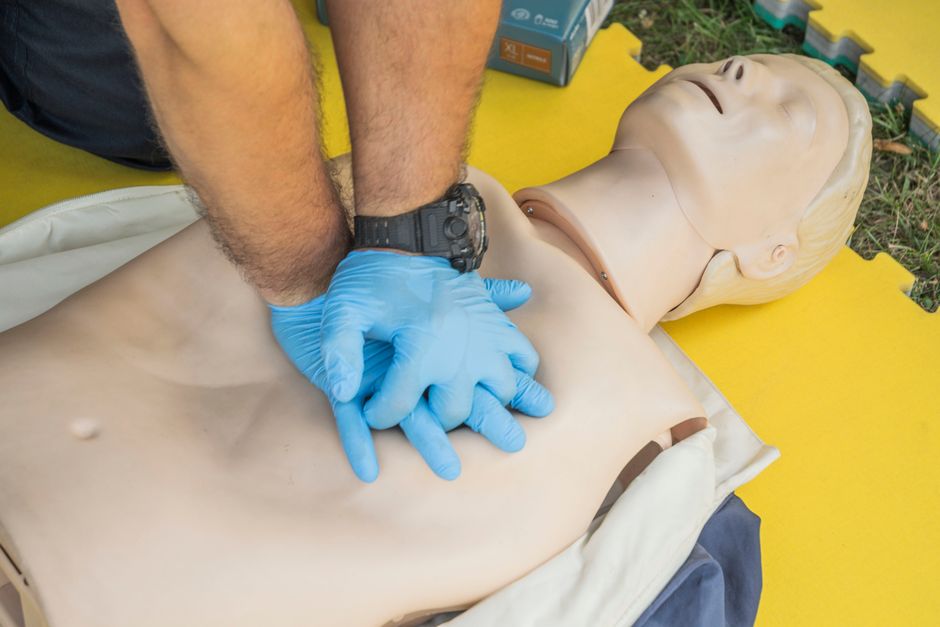
You can practice most of CPR at home without a manikin by rehearsing the sequence of steps on a firm surface or a firm mattress, using a pillow or folded towel to stand in for a chest. What a manikin adds is feedback on depth and recoil, and that part cannot be fully replicated at home. The skills you can build without one — recognizing cardiac arrest, calling 911, hard and fast compressions, and using an AED — are the skills that matter most in a real emergency.
What Can You Actually Practice Without a Manikin?
You can practice the entire sequence of bystander CPR except accurate depth measurement. That covers more than most people realize.
The chain of survival starts with recognition. A person who is unresponsive, not breathing normally, and not responding to a tap on the shoulder needs CPR. Agonal breathing — gasping, snoring-like sounds, or occasional slow breaths — is not normal breathing and is common in the first minutes of cardiac arrest. Practicing how to tell the difference between agonal breathing and real breathing is something you can do at home with no equipment at all.
From there, you can rehearse:
- Checking responsiveness and calling 911 or directing someone else to call
- Positioning your hands on the center of the chest, on the lower half of the breastbone
- Keeping your arms straight and your shoulders directly over your hands
- Using your body weight rather than your arm muscles to push
- Sending someone to find an AED while you begin compressions
The physical compression motion itself can be practiced on a firm mattress, a couch cushion on the floor, or a folded blanket. These surfaces do not push back the way a human chest does, so they build the movement pattern but not the force calibration.
How To Practice CPR At Home Without A Manikin: Step-By-Step
Work through the sequence in order, out loud, the same way you would in a real emergency. Saying the steps aloud builds the habit of acting rather than freezing.
Step 1: Check for response. Tap the person’s shoulders firmly and shout. If there is no response, move to the next step immediately.
Step 2: Check breathing. Look at the chest for no more than 10 seconds. If the person is not breathing normally, treat it as cardiac arrest.
Step 3: Call 911. Put the phone on speaker and set it beside you. The dispatcher can talk you through compressions while you work. Do not stop compressions to make the call if someone else is present to call.
Step 4: Position your hands. Place the heel of one hand on the center of the chest, on the lower half of the breastbone. Place your other hand on top and interlace your fingers. Keep your fingers off the ribs.
Step 5: Compress. Push hard and fast. For adults, the target is at least 2 inches deep at a rate of 100 to 120 compressions per minute. Let the chest come all the way back up between compressions without lifting your hands off the chest.
Step 6: Keep going. Do not stop until an AED arrives, EMS takes over, or the person starts breathing normally. If you are trained and willing, give rescue breaths at a ratio of 30 compressions to 2 breaths. If you are not, hands-only CPR is what the American Heart Association recommends for untrained bystanders.
Practicing this sequence on a cushion lets you rehearse the order and the hand placement. What it cannot teach you is whether you are pressing hard enough. That feedback only comes from a manikin with a depth indicator or from an instructor.
How Hard and How Fast Should Compressions Be?
For an adult, the target is a depth of at least 2 inches and a rate of 100 to 120 compressions per minute. These figures come from the American Heart Association and are the same ones used in CPR certification courses.
The rate is easier to judge than the depth. The beat of the song “Stayin’ Alive” runs at roughly 100 beats per minute, which is why it is used as a teaching tool. Any song in that range works.
Depth is where home practice falls short. A pillow compresses too easily. A firm mattress gives some resistance but nowhere near what a human chest provides. Pressing on a mattress will not tell you whether you are reaching 2 inches.
One detail that gets overlooked: full recoil matters as much as depth. Between compressions, the chest needs to expand back to its natural position so the heart can refill with blood. Leaning on the chest between compressions reduces how much blood moves. You can practice the recoil habit by fully releasing pressure on the cushion between each push.




Can You Learn CPR From a Video or App?
Video and app-based instruction can teach the sequence and the reasoning behind each step. They cannot correct your hand position or tell you whether your compressions are deep enough.
Research on CPR self-instruction has generally found that people who learn from video or kit-based programs perform better than people who have no training at all, but the evidence on whether they perform as well as people trained in instructor-led courses is mixed. Hands-only CPR instruction delivered by video has been studied fairly widely, and the general finding is that it improves willingness to act and basic technique.
The practical takeaway is that a video is a reasonable starting point. It is not a substitute for a hands-on course if you want verified technique.
What a Manikin Teaches That Home Practice Cannot
A manikin provides feedback that no household object can replicate. The two things it measures are depth and recoil.
Most training manikins click or light up when you reach the correct compression depth. That click teaches your body what 2 inches of resistance feels like. Without it, people tend to compress too shallowly — a well-documented problem even among people who have been trained. A manikin also has a rigid chest that springs back, so you learn to feel and allow full recoil.
What a manikin does not teach is judgment. Recognizing agonal breathing, deciding to act, and managing a real emergency are skills that come from rehearsal and from knowing the steps cold. Those you can build at home.
Where To Find Hands-On CPR Training
Instructor-led CPR courses are widely available through the American Red Cross, the American Heart Association, hospitals, community centers, fire departments, and many employers. Courses typically run a few hours and include a manikin component.
If you want to practice at home between courses, some CPR training kits include an inflatable manikin with a depth feedback mechanism. These are sold for home use and are a reasonable middle ground between a video and a full course.
One point worth being clear about: CPR certification is not required to perform CPR. Good Samaritan laws in all 50 states provide some legal protection for bystanders who act in good faith during an emergency. The specific protections vary by state, so if that matters to you, check your state’s law. But the decision to act should never hinge on whether you hold a card.
What To Do If You Are Unsure
If you are not sure whether someone needs CPR, start compressions. The risk of doing nothing is far greater than the risk of doing compressions on someone who did not need them.
Hands-only CPR — compressions without rescue breaths — is what the American Heart Association recommends for untrained bystanders and for anyone who is unwilling or unable to give breaths. It is also recommended for dispatcher-assisted CPR. You do not need to be certified, and you do not need a manikin to do it.
The single most important thing you can practice at home is the decision to act. Rehearse the recognition step. Rehearse calling 911 on speaker. Rehearse putting your hands on the center of the chest and pushing hard and fast. Those habits are what carry you through the first critical minutes before help arrives.
Frequently Asked Questions
Can you practice CPR on a pillow?
Yes, a pillow or firm cushion can be used to rehearse hand placement and the compression motion. It cannot teach you correct depth because it compresses far too easily.
How deep should chest compressions be for an adult?
At least 2 inches, at a rate of 100 to 120 compressions per minute. These targets come from the American Heart Association and are the same ones used in certification courses.
Do you need a manikin to learn CPR?
No. You can learn the sequence, hand placement, and rate without one. A manikin is the only way to get feedback on compression depth and full chest recoil.
Is hands-only CPR as good as CPR with breaths?
For untrained bystanders, the American Heart Association recommends hands-only CPR. For adults with cardiac arrest, hands-only CPR performed well is considered effective in the first few minutes.
