
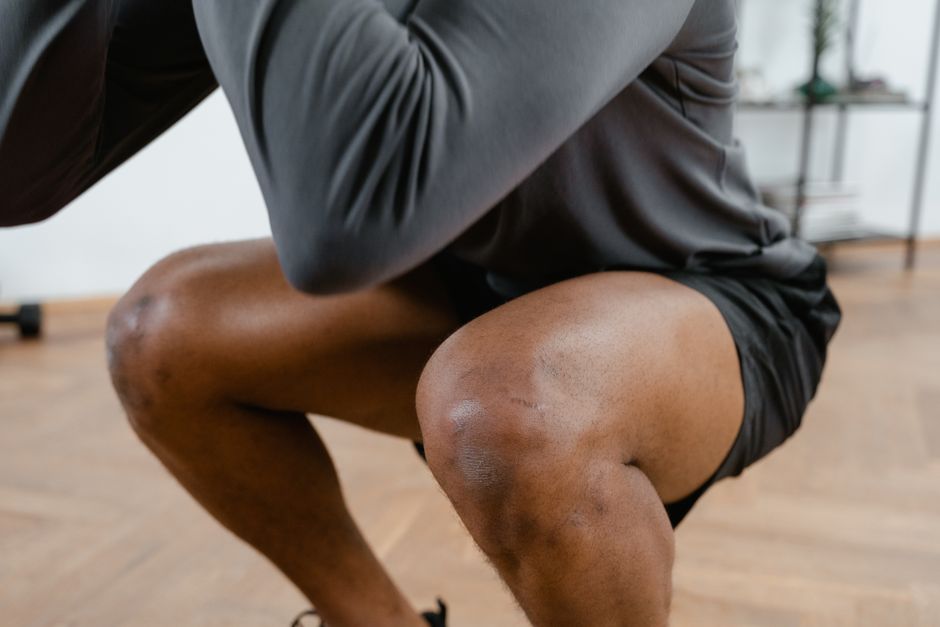
You cannot safely “pop” your own knee on purpose. The cracking sound most people are chasing comes from gas bubbles in the joint fluid or from tendons and ligaments moving over bone — and forcing it can damage cartilage, ligaments, or the joint itself. If your knee feels stiff or “locked,” the right move is to find out why, not to crank on it until it pops.
That said, many knees crack on their own during normal movement, and that is usually harmless. This guide explains what the sound actually is, when it means something, and what safe options exist for a knee that feels stuck or tight.
What Actually Makes a Knee Pop?
Most knee popping is either gas or soft tissue, not bone grinding on bone. Knowing which one you are hearing tells you a lot about whether to worry.
The classic “crack” comes from cavitation. Your knee joint is a sealed capsule filled with synovial fluid. That fluid holds dissolved gases, mostly carbon dioxide. When the joint surfaces separate quickly — like when you squat or straighten your leg fast — pressure inside the capsule drops and those gases form a bubble, which collapses with a pop. It takes time for the gas to redissolve, which is why you usually cannot crack the same joint twice in a row.
The second common source is a tendon or ligament snapping over a bony bump. The iliotibial band sliding across the outside of the knee, or the patellar tendon moving over the shin bone, can produce a distinct click with movement. This is a mechanical sound, not a gas bubble.
A third source — and the one that deserves attention — is cartilage or a loose fragment inside the joint. This tends to sound different: a grinding, crunching quality called crepitus.
Is Cracking Your Knee Bad For You?
For a normal, pain-free knee, occasional cracking does not appear to cause harm. That is the honest position based on what is known about joint mechanics.
The concern is not the sound itself. It is what forced popping does to structures that were not designed for that load. When you grab your knee and twist or push it past its natural range to get a pop, you are applying force to ligaments, the meniscus, and cartilage. Those tissues have limits.
There is a common belief that cracking a joint “releases” something or “realigns” it. No evidence supports this. The pop does not reposition bones or fix a misalignment. What people often feel afterward is temporary relief from pressure — the same sensation as cracking a knuckle — not a structural correction.
One clarification worth knowing: habitual knuckle cracking has been studied and has not been shown to cause arthritis. That research is about fingers, not knees, and it does not mean forcing a knee to pop is safe. The knee is a weight-bearing joint carrying your body weight, and the forces involved are different.
Why Does My Knee Feel Like It Needs To Pop?
A knee that feels “stuck” or “full” usually has a reason, and it is rarely solved by popping it. That sensation is a signal.
Common causes include:
- Joint effusion — extra fluid in the joint from irritation or injury makes the capsule feel tight and full.
- Muscle tightness — a tight quadriceps or hamstring can pull on the kneecap and create a sense of pressure.
- Patellofemoral tracking problems — the kneecap gliding slightly off its usual path can cause clicking and a stuck feeling.
- Meniscal tears — a torn piece of meniscus can catch in the joint and create a locking or catching sensation.
- Loose bodies — small fragments of cartilage or bone floating in the joint can cause intermittent catching.
The distinction matters. Tight muscles often respond to stretching and strengthening. A meniscal tear or loose body does not, and forcing the joint to pop can make it worse.





How To Pop Your Knee Safely: What You Can Actually Do
You cannot reliably make a knee pop on command, but you can address the stiffness and pressure that make you want to. These approaches work with the joint rather than forcing it.
Move through your full range of motion
Slow, controlled leg extensions and gentle knee bends often produce a natural pop as the joint moves through its range. The key word is slow. Sit in a chair and straighten your leg fully, then bend it back down. Repeat several times. If a pop happens, it happens on its own.
Release the muscles around the knee
Much of the “need to pop” feeling comes from tight tissue above and below the joint. Gentle stretching of the quadriceps, hamstrings, and calves can reduce that pressure. A foam roller on the thigh and calf — not directly on the kneecap — is a reasonable option for many people.
Strengthen what supports the kneecap
Weak quadriceps and hip muscles let the kneecap track poorly, which contributes to clicking and catching. Straight-leg raises, wall sits, and glute bridges are low-impact options. This is a longer game than a single pop, but it addresses the cause rather than the sensation.
Use heat before movement
A warm shower or heating pad for a few minutes before you move can relax surrounding muscles and make gentle motion more comfortable. This is a comfort measure, not a treatment for any underlying problem.
When Should You Not Try To Pop Your Knee?
Some knee symptoms mean stop and get evaluated. Forcing a pop in these situations risks making an injury worse.
Seek medical assessment if you have:
- Sudden swelling after an injury
- Pain that stops you from bearing weight
- A knee that locks in a bent position and will not straighten
- Popping accompanied by immediate pain at the time of injury
- Redness, warmth, or fever around the joint
- Instability — the knee feels like it will give way
A pop you hear at the moment of an injury is different from a pop you produce on purpose. That sound often signals a ligament tear or meniscal injury, and the joint needs proper assessment, not more movement. Swelling, locking, and inability to bear weight are the signals that matter most.
Does Popping a Knee Ever Help?
There is no evidence that deliberately popping a knee provides a therapeutic benefit. The relief people report is real but temporary and is best explained by the release of joint pressure, not by any correction of the joint.
What does help a stiff or clicking knee is addressing the underlying mechanical issue — muscle imbalance, tightness, or an injury — through movement, strengthening, and where needed, professional evaluation. That is a less satisfying answer than “just pop it,” but it is the accurate one.
If your knee cracks without pain or swelling, it is generally not something to fix. If it cracks with pain, catching, or locking, the sound is a symptom worth investigating rather than a problem to solve by force.
Frequently Asked Questions
Can you pop your knee on purpose?
You can sometimes produce a pop by moving the joint through its full range, but you cannot reliably force one, and forcing it is not safe. Deliberately twisting or pushing the knee past its natural range can damage cartilage and ligaments.
Why does my knee pop every time I squat?
Popping during squats usually comes from gas bubbles in the joint fluid or from tendons and ligaments sliding over bone. If it is painless, it is generally not a concern.
Is it bad if my knee cracks but doesn’t hurt?
Painless cracking on its own is not a sign of damage and does not need treatment. Cracking that comes with pain, swelling, or locking should be checked by a clinician.
What does it mean if my knee pops and then hurts?
A pop at the moment of injury followed by pain can indicate a ligament or meniscal injury. Get the knee evaluated rather than trying to pop it again.
