
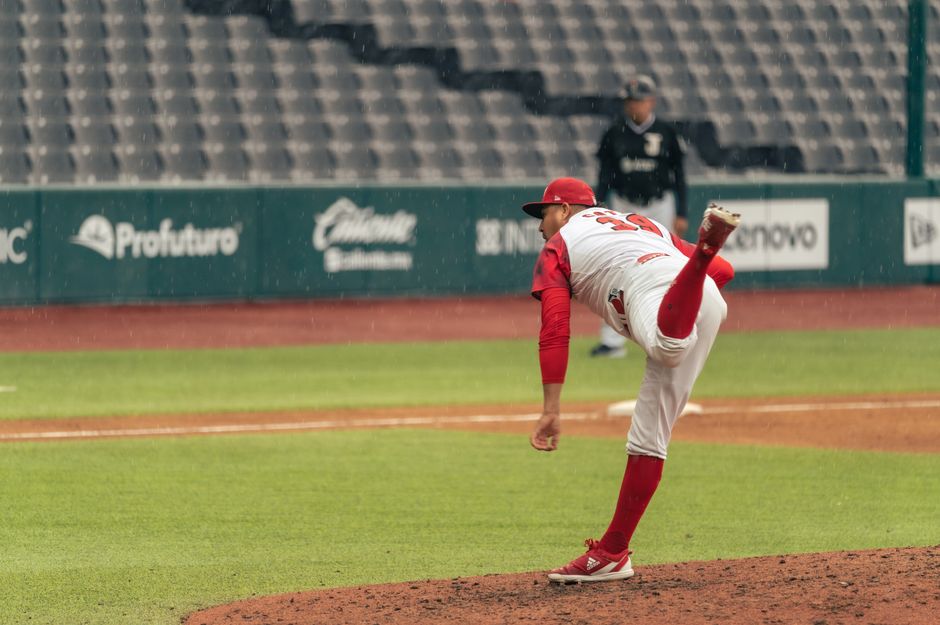
Throwing a baseball harder is not about arm strength alone. The power that creates high velocity starts in your legs and travels up through your hips, torso, and finally to the ball. If you want to pitch harder, you need to build velocity from the ground up by training your lower body to generate force and learning to transfer that force efficiently through your entire body.
Why Lower Body Strength Matters for Pitching Velocity
Pitching is a full-body movement that begins the moment your front foot leaves the rubber. The legs drive toward home plate, and that forward momentum creates the energy that eventually reaches the baseball. Research consistently shows that lower body strength and power correlate with increased pitch velocity.
The arm acts like a whip at the end of a chain. A whip only cracks as hard as the energy sent through it. If your legs and core produce little force, your arm has little to work with. Elite pitchers generate massive ground reaction forces — the push against the mound — that transfer energy upward through the kinetic chain.
When pitchers focus only on arm exercises, they often hit a velocity ceiling. The arm can only move so fast on its own. Building a stronger foundation in the legs and hips allows you to push harder into the ground, creating more energy to transfer into the throw.
How Force Transfers From the Ground to the Ball
The kinetic chain in pitching follows a specific sequence. It starts with the back leg driving off the rubber. That push creates force against the ground, and the ground pushes back. This force travels up the back leg, through the hips, into the trunk, across the shoulders, and down the arm to the fingertips.
Timing matters as much as strength. If the hips rotate before the front foot lands, energy leaks out of the system. If the upper body fires before the lower body finishes its job, the arm takes on extra stress and velocity drops. The most efficient throwers sequence their movements so that energy builds smoothly rather than in disconnected bursts.
The front leg plays a critical braking role. When the front foot plants, it stops the forward momentum of the body. That sudden stop transfers energy upward, like a car crashing into a wall — the energy has to go somewhere. In pitching, it goes into trunk rotation and arm acceleration. A weak front leg cannot brace properly, and energy gets lost.
Best Lower Body Exercises for Velocity Gains
Compound movements that train the muscles used in the drive phase produce the most transferable results. Squats, deadlifts, and hip thrusts build the glutes and hamstrings — the primary power muscles in pitching. These exercises should be performed with proper form and progressive overload over time.
Single-leg work deserves special attention. Pitching is a single-leg sport. You push off with one leg, land on the other, and brace with that landing leg. Split squats, Bulgarian split squats, and single-leg Romanian deadlifts train each leg independently, correcting imbalances that can limit velocity and increase injury risk.
Olympic lift variations and their derivatives — such as cleans, snatches, and jump squats — train explosive power. These movements teach the body to produce force quickly, which matters more than raw strength alone. A pitcher who can squat 400 pounds but moves slowly will not throw as hard as a pitcher who can squat 300 pounds explosively.
Plyometric exercises bridge the gap between strength and speed. Box jumps, broad jumps, and lateral bounds train the stretch-shortening cycle. This is the muscle’s ability to store elastic energy during a quick stretch and release it during the subsequent contraction. Pitching involves this cycle constantly, especially during the leg drive and front leg brace.





Core Training That Supports Velocity
The core transfers force from the lower body to the upper body. Without a strong midsection, power generated in the legs dissipates before it reaches the arm. Core training for pitchers should focus on anti-rotation and anti-extension exercises rather than just crunches and sit-ups.
Pallof presses train the core to resist rotation. This matters because pitching requires the trunk to rotate with control, not collapse under rotational forces. Dead bugs and bird dogs train anti-extension, teaching the spine to stay stable while the limbs move.
Medicine ball throws are among the most sport-specific core exercises available. Rotational throws, overhead slams, and chest passes train the core to produce and transfer force at speed. These exercises mimic the timing and coordination of the pitching motion more closely than any machine-based core workout.
Core work should not replace lower body training. It complements it. The core is the bridge in the kinetic chain — it cannot generate the same magnitude of force as the legs, but it must be strong enough to transmit that force without energy loss.
Improving Mechanics to Maximize Ground Force Use
Strength without proper mechanics wastes potential. A pitcher with elite lower body strength but poor sequencing will throw slower than a weaker pitcher with efficient mechanics. The goal is to convert strength into ball speed through movement quality.
The drive phase should be aggressive but controlled. Pitchers who explode toward home plate with their back leg create more forward momentum. However, rushing this phase can cause the front foot to land too early or too late, disrupting the entire sequence. The front foot should land slightly closed and firmly braced, allowing the hips to rotate through.
Hip separation is a key mechanical concept. This refers to the upper body staying back while the hips rotate forward. Elite pitchers create significant separation between hip rotation and shoulder rotation. This stretch stores elastic energy in the trunk and shoulder, adding velocity without additional muscular effort.
Video analysis helps identify mechanical flaws. Working with a qualified pitching coach who understands biomechanics can reveal inefficiencies that are impossible to feel from the mound. Many pitchers believe they are using their legs effectively when video shows otherwise.
How To Pitch Harder Build Velocity From the Ground Up — Training Program Principles
An effective velocity program follows progressive overload. This means gradually increasing the weight, volume, or intensity of training over time. Doing the same exercises with the same weights will produce the same results — plateauing is guaranteed without progression.
Training should be periodized. Off-season programs focus on building strength and power. In-season programs shift toward maintenance, prioritizing recovery and freshness for game days. Attempting to gain significant strength during a competitive season often backfires, leaving pitchers fatigued and at higher injury risk.
Recovery is a training component, not an afterthought. Muscles grow and adapt during rest, not during workouts. Pitchers need adequate sleep, nutrition, and rest days to allow their bodies to respond to training. Overtraining leads to decreased performance and increased injury risk.
Long-toss throwing programs can complement lower body training. Throwing at extended distances stresses the arm in ways that build arm strength, but it does not replace lower body work. The two approaches serve different purposes — long toss builds arm resilience while lower body training builds the engine that powers the throw.
Common Mistakes That Limit Velocity Gains
Neglecting the front leg is one of the most common errors. Many pitchers train their drive leg heavily but ignore the landing leg. The front leg’s braking action is essential for energy transfer. Weak front legs force the body to absorb energy through the arm, reducing velocity and increasing injury risk.
Overtraining the arm while undertraining the body is another frequent mistake. Young pitchers especially spend hours on arm exercises and throwing programs while skipping lower body work. This approach produces arms that cannot handle the forces generated by a properly trained lower body.
Using poor lifting form creates injury risk without velocity benefit. Squatting with a rounded back, deadlifting with poor hip hinge mechanics, or landing plyometric jumps with valgus knees (knees collapsing inward) can cause injuries that sideline pitchers for months. Proper form always precedes heavy weight.
Ignoring mobility restricts movement patterns. Tight hips limit the ability to achieve proper hip separation. Limited ankle mobility affects the drive phase. Restricted thoracic spine mobility reduces arm slot efficiency. A comprehensive program includes mobility work alongside strength training.
Realistic Expectations for Velocity Improvement
Velocity gains take time. Some pitchers see improvement within weeks of starting a structured program, particularly if they were previously doing no lower body training. Others need months or years of consistent work to see meaningful change. Genetics, age, and training history all influence how quickly someone gains velocity.
Research on training programs shows that most pitchers gain somewhere between 1 and 5 miles per hour over a dedicated off-season program. Claims of gaining 10 miles per hour in a month are marketing, not science. Sustainable gains come from consistent training over multiple seasons.
Age matters. Younger pitchers with developing bodies often gain velocity more quickly as they mature physically. Older pitchers may need to work harder to maintain velocity and focus on efficiency improvements rather than raw strength gains.
The most important factor is consistency. A well-designed program followed for 12 weeks produces better results than a perfect program followed for 2 weeks. Velocity building is a long-term investment in your body’s ability to produce and transfer force.
Frequently Asked Questions
How long does it take to increase pitching velocity?
Most pitchers see measurable gains within 8 to 12 weeks of consistent lower body and mechanics training. Gains of 1 to 5 miles per hour over a full off-season are realistic for most athletes.
Can you increase pitching velocity without lifting weights?
Yes, but weight training is the most efficient method for building the lower body strength needed for velocity. Bodyweight exercises and resistance bands can help, but they have limits for progressive overload.
Does long toss increase pitching velocity?
Long toss can contribute to arm strength and velocity, but it does not replace lower body training. The legs generate the majority of pitching power, and long toss alone will not maximize your velocity potential.
Is it safe for young pitchers to lift weights?
Yes, when supervised and age-appropriate. Bodyweight exercises and light resistance training with proper form are safe for adolescents. Heavy maximal lifting should wait until skeletal maturity, typically around age 16 to 18.
