
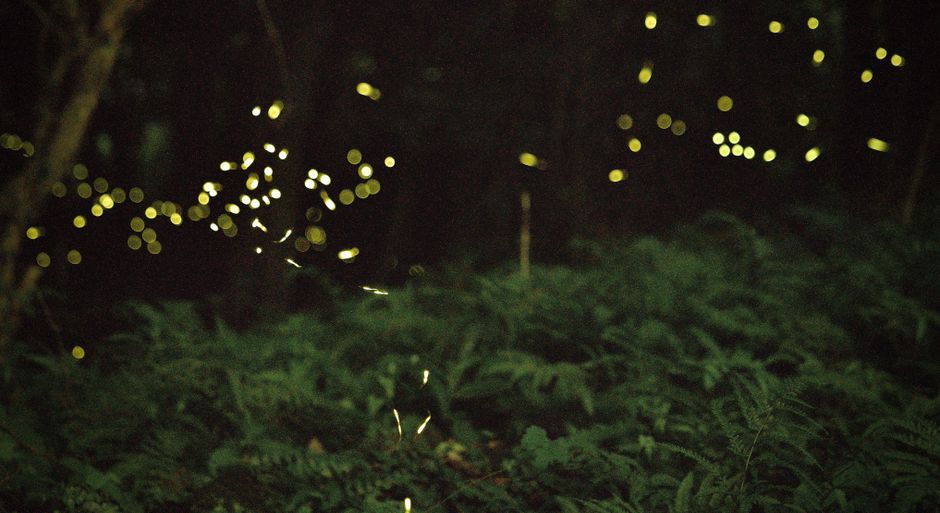
Photographing fireflies is one of the most rewarding night photography challenges you can take on. To get a sharp, bright image of a firefly’s glow, you need a tripod, a wide aperture, a high ISO, and a long shutter speed. Because fireflies blink on and off, you will rarely capture multiple glowing insects in a single frame, so the best method is to shoot many frames and stack them later in editing software.
What Camera Settings Work Best for Fireflies?
Start with manual mode. You control everything, and the camera’s auto settings will fail in near-total darkness.
Set your aperture to its widest setting, typically f/1.8, f/2.0, or f/2.8. This lets in the most light and helps the glowing insects stand out against the dark background. If your lens does not open that wide, f/4 can still work, but you will need a higher ISO.
Your ISO should be high. Start at ISO 1600 or 3200. Modern cameras handle these values well. If your images look too dark, raise the ISO to 6400. If they look grainy and noisy, lower it slightly. There is no single correct ISO because every camera sensor behaves differently in low light.
Shutter speed is the variable you will adjust most. Firefly flashes last only a fraction of a second. A shutter speed of 10 to 30 seconds will capture the glowing trails as the insects move, but individual blinks will appear as short streaks. If you want a single sharp dot of light, you need a shutter speed around 1 to 4 seconds. Longer exposures risk blurring the firefly movement, but they also capture more ambient light in the scene.
How Do You Focus in the Dark?
Autofocus will not work in near-total darkness. You must focus manually.
Before the fireflies come out, while there is still some daylight, set your focus to the distance where you expect the insects to be. This is often 10 to 30 feet away. Use your camera’s live view mode and zoom in on a distant object, like a tree trunk or a fence post. Rotate the focus ring until that object looks sharp. Then switch the lens to manual focus and do not touch the ring again.
If you change your position or your subject distance, you must refocus. A flashlight with a red light mode helps you see the focus ring without ruining your night vision. Some photographers tape the focus ring in place once it is set, so it cannot shift accidentally.
What Is Focus Stacking and Why Do You Need It?
Focus stacking is the process of combining multiple images taken at different focus distances into one final photo where everything is sharp. In firefly photography, you usually do not need focus stacking for the insects themselves. Fireflies are small points of light, and they do not require the same sharpness as a flower or a portrait subject.
You do need a different kind of stacking: time stacking. This means layering multiple exposures taken over several minutes so that every firefly blink appears in a single final image. A single 20-second exposure might catch two or three blinks. Twenty stacked exposures might catch thirty or forty. The result looks like a dense, magical field of glowing insects, even if the actual firefly activity was sparse.




How Do You Stack Firefly Images?
The most common method is to shoot a series of identical exposures and merge them in editing software using a “lighten” blend mode.
Take 20 to 50 consecutive photos with the same settings and the camera locked on a tripod. Do not change anything between frames. Import the images into software like Adobe Photoshop or Affinity Photo. Load all the images as layers in one document. Select all layers, then set the blend mode to “Lighten.” This keeps the brightest pixels from each layer, which means every firefly glow appears in the final image while the dark background stays clean.
If you have a modern camera with an intervalometer function, you can automate the shooting. Set it to take one photo every 2 to 5 seconds for 10 to 15 minutes. A remote shutter release or an app on your phone can also trigger the camera without touching it, which prevents vibration and blur.
What Equipment Do You Actually Need?
You do not need expensive gear, but you need the right basics.
- A tripod is non-negotiable. Handheld shots at long exposures will always be blurry.
- A camera with manual controls. A DSLR, mirrorless camera, or even a high-end smartphone with a pro mode can work.
- A wide-aperture lens. Prime lenses like a 35mm f/1.8 or 50mm f/1.8 are excellent choices.
- A remote shutter release or a 2-second self-timer to avoid camera shake when pressing the button.
- A red flashlight to see your camera settings without ruining your night vision.
Do not bring a bright white flashlight or headlamp. It will ruin your eyes’ dark adaptation and scare away nearby fireflies. If you must use one, keep it pointed at the ground and turn it off between adjustments.
How Do You Find the Best Location and Time?
Fireflies are most active in warm, humid evenings from late spring through midsummer. They typically emerge about 30 minutes after sunset and remain active for one to two hours. The exact timing depends on your region and the species.
Look for fields, forest edges, or meadows near standing water. Fireflies prefer areas with tall grass and damp soil. Avoid locations with bright streetlights or house lights, which wash out the faint glow and reduce the number of visible insects.
Check the weather forecast. Fireflies are less active on cool nights, windy nights, or nights with heavy rain. A calm, warm, slightly humid evening is ideal. The moon phase also matters. A new moon or a crescent moon leaves the sky darker, which makes the firefly glows appear brighter in your photos.
What Are Common Mistakes to Avoid?
The most common mistake is using too low an ISO. Many photographers try ISO 400 or 800 to keep noise low, and their images come out nearly black. It is better to have a slightly noisy image with visible fireflies than a clean image with nothing in it.
Another mistake is moving the camera between shots. If you bump the tripod or change the framing mid-sequence, the stacking process will not work. The background will look misaligned, and the fireflies will appear in the wrong positions.
Do not overexpose the ambient light. If you are shooting in a field with a distant town glow, a 30-second exposure can turn the sky orange. Shorten the shutter speed to 10 or 15 seconds, or move to a darker location. The fireflies will still appear, but the background will stay natural.
Finally, do not expect every firefly to be perfectly sharp. Some will be out of focus because they are closer or farther than your focus point. This is normal and often looks natural, since the eye sees the same effect in real life.
How Do You Edit Firefly Photos After Stacking?
After you merge the layers, the image will still look flat and dark. Basic edits make a big difference.
Raise the exposure slightly. Increase contrast so the dark background separates from the glowing points. Use the vibrance or saturation slider to enhance the yellow-green color of the firefly light. Be careful not to oversaturate, or the image will look artificial.
If there are unwanted bright spots, like a distant porch light or a car headlight, use a spot healing brush or a clone stamp to remove them. This is easier than trying to avoid every light source in the field.
If you shot with a high ISO, apply noise reduction to the background. Modern editing software does this well, but apply it selectively. Heavy noise reduction can blur the tiny firefly points, making them look soft and less defined.
Frequently Asked Questions
What is the best shutter speed for firefly photography?
A shutter speed of 10 to 30 seconds captures glowing trails and ambient light, while 1 to 4 seconds freezes individual blinks as sharp points.
Do I need a special lens for fireflies?
No, any lens with a wide aperture like f/1.8 or f/2.8 works well because it lets in more light.
How many photos do I need to stack for fireflies?
Most photographers take 20 to 50 exposures over 10 to 15 minutes, then merge them using a lighten blend mode.
Can I photograph fireflies with a smartphone?
Some high-end smartphones with manual mode and a tripod can capture fireflies, but image quality and stacking options are limited compared to a dedicated camera.
