
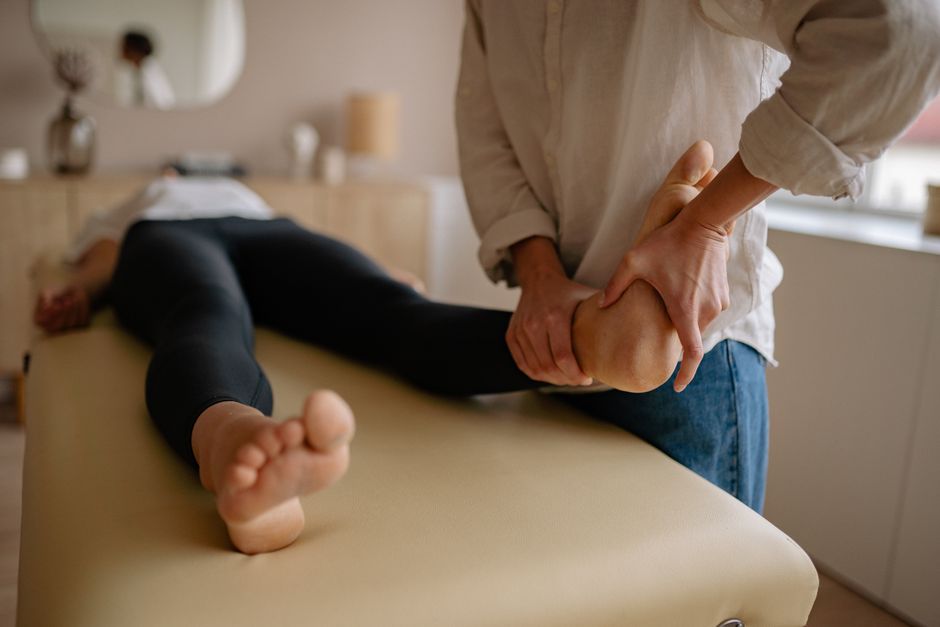
Palpating the sacroiliac joint requires finding specific bony landmarks on the back of the pelvis. The two most reliable landmarks are the posterior superior iliac spine (PSIS) and the sacral dimples, which sit directly over the joint line. To locate the joint, place your thumbs on the PSIS and slide them slightly inward and downward toward the midline, where you will feel a depression that marks the posterior aspect of the sacroiliac joint.
What Are the Key Bony Landmarks for the Sacroiliac Joint?
The sacroiliac joint connects the sacrum to the ilium, the large wing-shaped bone of the pelvis. You cannot feel the joint directly because thick ligaments and muscle cover it, but you can find its edges through specific landmarks.
The posterior superior iliac spine (PSIS) is the most important landmark. It is the bony point you can feel at the back of the pelvis, just above the buttock. Most people have a small dimple here, and the dimples are often visible as two symmetrical indentations just above the buttocks.
The sacral dimples (also called Venus dimples) sit directly over the PSIS. If you place your fingers in these dimples, you are touching the area over the sacroiliac joint. The joint line runs vertically, roughly 1 to 2 centimeters medial to the PSIS.
Another useful reference is the iliac crest. This is the top edge of the pelvis that you can feel along your side. If you slide your hands down from your ribs, you will feel this bony ridge. The PSIS sits at the back end of the iliac crest, and the joint lies just medial to it.
How Do You Palpate the Sacroiliac Joint Step by Step?
Start with the person standing or lying on their stomach. Standing is often easier because the landmarks are more accessible and the muscles are relaxed. Ask the person to remove any thick clothing around the lower back.
Place your hands on the top of the pelvis, feeling for the iliac crest. Slide your hands backward along the crest until you feel the bone end. That endpoint is the PSIS.
Once you have found the PSIS, place your thumbs on it. Then slide both thumbs medially, toward the spine, about 1 to 2 centimeters. You should feel a slight depression or groove. This groove is the posterior sacroiliac joint line.
Press gently but firmly. The joint itself is deep, so you will feel the edge of the sacrum medially and the ilium laterally. The space between them is the joint. In most people, this area feels like a subtle dip or soft spot compared to the surrounding bone.
For a more precise approach, use your index fingers instead of thumbs. Some clinicians find that finger pads are more sensitive than thumbs for detecting subtle differences in bony contour. Place your index fingers on the PSIS, then walk them medially until you feel the sacral edge.
What Does the Sacroiliac Joint Feel Like Under the Fingers?
The sacroiliac joint does not feel like a wide gap. It is a narrow, curved line that runs vertically. Under palpation, it feels like a slight depression or groove between two bony surfaces.
The lateral side (the ilium) feels harder and more prominent. The medial side (the sacrum) feels flatter and slightly more posterior. The groove between them is the joint line.
In some people, especially those with more muscle mass or body fat, the joint is harder to feel. The gluteal muscles cover the lower part of the joint, and the erector spinae muscles cover the upper part. Only the middle portion near the PSIS is accessible to palpation.
Do not expect to feel movement at the joint. The sacroiliac joint moves only a few millimeters, and that movement is not detectable through palpation. What you are feeling is the bony contour, not joint motion.





Why Is the PSIS the Most Reliable Landmark?
The PSIS is the only part of the sacroiliac joint that is consistently palpable in most people. It is a superficial bony prominence with minimal muscle covering, which makes it accessible even in individuals with higher body mass.
Other landmarks are less reliable. The posterior inferior iliac spine (PIIS) is deeper and covered by the gluteal muscles, making it difficult to feel. The sacral sulcus, a groove just lateral to the sacrum, can be felt in some people but is less distinct than the PSIS.
The PSIS also serves as a reference for symmetry. In a healthy pelvis, both PSIS points should be level with each other. If one is higher or lower than the other, it may indicate pelvic asymmetry, though this finding alone does not diagnose sacroiliac joint dysfunction.
What Are the Common Mistakes When Palpating the Sacroiliac Joint?
The most common mistake is palpating too far laterally. Many people place their hands over the buttock rather than on the PSIS. Remember that the PSIS is at the back end of the iliac crest, not on the side of the pelvis.
Another mistake is pressing too hard. Firm pressure is fine, but excessive pressure causes muscle guarding, which makes the landmarks harder to feel. Use enough pressure to feel bone, then ease off.
Confusing the sacroiliac joint with the lumbar spine is also common. The lumbar spinous processes are midline, while the sacroiliac joints are lateral. If you are feeling midline structures, you are not on the sacroiliac joint.
A final mistake is expecting to feel a large gap. The sacroiliac joint space is narrow, typically 2 to 4 millimeters wide. You are feeling a subtle groove, not a canyon.
How Do You Palpate the Sacroiliac Joint in Different Positions?
Standing is the most practical position for palpation. The pelvis is stable, and the landmarks are accessible. Have the person stand with their weight evenly distributed on both feet.
Prone (lying on the stomach) is another option. In this position, the gluteal muscles relax, which can make the lower part of the joint slightly more accessible. However, the PSIS remains the primary landmark in both positions.
Side-lying is sometimes used but is less ideal. In side-lying, the pelvis rotates, and the landmarks shift. This position is more useful for assessing pelvic symmetry than for locating the joint itself.
Regardless of position, the technique is the same: find the iliac crest, trace it back to the PSIS, then move medially to the joint line.
What Is the Clinical Relevance of Sacroiliac Joint Palpation?
Sacroiliac joint palpation is a standard part of a physical examination for lower back pain. However, it is important to understand that palpation alone cannot diagnose sacroiliac joint dysfunction.
Research on the accuracy of sacroiliac joint palpation is mixed. Some studies suggest that palpation for tenderness has limited reliability, meaning different examiners may get different results. Tenderness at the joint can also be caused by other structures, including ligaments, muscles, or referred pain from the lumbar spine.
Clinicians typically combine palpation with other tests, such as the sacroiliac joint compression test, distraction test, or thigh thrust test. A cluster of positive findings is more meaningful than palpation alone.
If you are learning to palpate the sacroiliac joint for clinical purposes, practice on multiple people. Body type, muscle mass, and age all affect how the landmarks feel. There is no substitute for hands-on experience.
Can You Palpate the Sacroiliac Joint on Yourself?
Yes, you can palpate your own sacroiliac joint, though it is slightly more awkward. Stand and place your hands on your hips with your thumbs pointing backward. Your thumbs should rest in the dimples above your buttocks.
Those dimples are your PSIS points. From there, slide your thumbs inward toward your spine. You should feel a small depression, which is the sacroiliac joint line.
Self-palpation is useful for understanding where the joint is located, but it has limitations. You cannot assess symmetry on yourself, and your posture while reaching backward may alter the landmarks. For accurate assessment, a trained clinician is necessary.
Frequently Asked Questions
Where exactly is the sacroiliac joint located?
The sacroiliac joint sits where the sacrum meets the ilium, on both sides of the lower spine. You can find it by locating the dimples above your buttocks and moving your fingers about 1 to 2 centimeters toward your spine.
Can you feel the sacroiliac joint with your fingers?
You can feel the joint line as a subtle depression between the PSIS and the sacrum. The joint itself is deep and covered by ligaments, so you are feeling the bony edges rather than the joint space.
Is sacroiliac joint palpation painful?
Light to moderate pressure should not be painful. If pressing on the area causes sharp pain, that may indicate inflammation or dysfunction, but palpation alone cannot confirm a diagnosis.
How do you distinguish the sacroiliac joint from the lumbar spine?
The lumbar spine spinous processes are in the midline, while the sacroiliac joints are lateral, about 1 to 2 centimeters from the spine. If you are feeling midline bone, you are on the vertebrae, not the sacroiliac joint.
