
A green coconut is easier to open than most people think. The trick is to work with the coconut’s natural seams instead of fighting the shell. With a sturdy knife, a stable surface, and a few firm strikes, you can cut through the top in about a minute and reach the water inside without hurting yourself.
Unlike the hard brown coconut sold in stores, a green coconut has a softer husk and a thinner shell. That makes it far more forgiving. The main risks are a slipping knife and an unstable coconut, both of which you can control with good technique and a little patience.
What Is a Green Coconut and Why Is It Different?
A green coconut is the young, unripe fruit of the coconut palm. It is harvested for its water and soft flesh, not for the hard meat found in mature brown coconuts.
At this stage, the outer husk is still green and relatively soft. Inside that husk sits a thin white shell that holds the coconut water. The flesh is a translucent jelly that thickens over time. As the coconut matures, the husk turns brown and fibrous, the shell hardens, and the water is gradually replaced by solid meat.
This is why the opening method differs. A mature brown coconut often needs a heavy cleaver or a hammer and a nail. A green coconut can usually be opened with a single sharp knife and a few controlled cuts. The softness that makes it easier to open is also why you need a sharp blade rather than a dull one. A dull knife forces you to press harder, which is when slips happen.
How To Open A Green Coconut Safely And Easily?
The safest method uses the coconut’s own structure. Green coconuts are typically sold with the top already trimmed into a pointed or angled shape by the vendor. That trimmed area is where you work.
Here is the sequence that keeps your hand out of the blade’s path:
- Set the coconut on a stable cutting board on a flat counter. Never hold it in your hand while cutting.
- Use a sharp, heavy chef’s knife or a cleaver. A thin paring knife is more likely to slip.
- Identify the pointed or angled top. This is the softest part of the shell.
- Make firm, angled cuts into the top, working around the point in a circle. Let the weight of the knife do the work.
- Cut down toward the board, away from your body, keeping your free hand behind the blade at all times.
- After several cuts, a small cap of shell will loosen. Pry it off with the tip of the knife or your fingers.
- Pour the water into a glass, or drink it directly through the opening.
Some vendors sell green coconuts with a small plug already cut at the top. If yours has one, you can often push a straw straight through or pry the plug out with a knife tip. That is the simplest version of all.
If the top is not pre-trimmed, you can slice a flat base first. Cut a thin slice off the bottom so the coconut sits steady. A coconut that rocks while you cut is the most common cause of accidents.
What Tools Do You Actually Need?
You do not need special equipment. A sharp knife and a stable surface cover almost every situation.
A heavy chef’s knife or a cleaver works best because the weight carries the blade through the soft husk. A serrated bread knife can also work on the fibrous outer layer, though it is less precise. Avoid thin, flexible blades. They bend and slip.
A cutting board with a damp towel underneath stops the board from sliding. This matters more than most people expect. If the board moves, the coconut moves, and your cut goes off course.
A bowl or glass to catch the water is useful if you plan to pour it out rather than drink it on the spot. Fresh coconut water starts to lose its characteristic flavor within hours of opening, so it is best consumed the same day.





Is There a Way to Open It Without a Knife?
Yes, though it takes longer and is not always practical. Some people use a heavy object to crack the trimmed top, but this is unpredictable and can send shell fragments into the water.
A cleaner no-knife approach works only if the coconut already has a soft “eye” or a pre-cut plug. On a green coconut, the three soft spots found on mature coconuts are not always easy to locate. If you can find a soft spot, you can push a clean straw or a skewer through it. This is more of a convenience method than a reliable one.
For a green coconut with no pre-cut opening and no knife available, there is no safe method that avoids some risk of injury or contamination. The most sensible option is to wait until you have a proper knife.
How Do You Avoid Cutting Yourself?
Most coconut injuries come from three mistakes: a dull knife, a moving coconut, and a hand placed in the blade’s path. Fix those three and the risk drops sharply.
Keep the knife sharp. A sharp blade bites into the husk and stays where you put it. A dull blade glances off and travels toward whatever is nearby, which is often your hand.
Keep the coconut still. Cut a flat base if needed. Use a damp cloth under the board. Never cut a coconut while holding it in the air or resting it on your knee.
Keep your free hand back. The hand not holding the knife should never be in front of the blade. If you need to steady the coconut, do it from the side, well away from the cutting line.
Cut away from your body, toward the board. Pull the knife toward you only when the blade is already buried in the husk and your hand is clear. When in doubt, stop and reset your grip.
What About the Coconut Water Inside?
Fresh coconut water is mostly water with small amounts of naturally occurring sugars, electrolytes, and minerals. It is often marketed as a hydration drink, and it does contain potassium, which is an electrolyte the body needs.
It is not a replacement for medical rehydration solutions. Oral rehydration solutions are formulated with specific ratios of sodium, potassium, and glucose for treating dehydration from illness. Coconut water does not match those ratios. For everyday thirst, it is a pleasant drink. For dehydration from vomiting, diarrhea, or intense illness, it is not the right tool.
The amount of water in a single green coconut varies widely by size and ripeness, so there is no fixed figure that applies to all of them. Drink it fresh. Once opened, it should be refrigerated if not consumed right away and used within a day.
Can You Eat the Flesh of a Green Coconut?
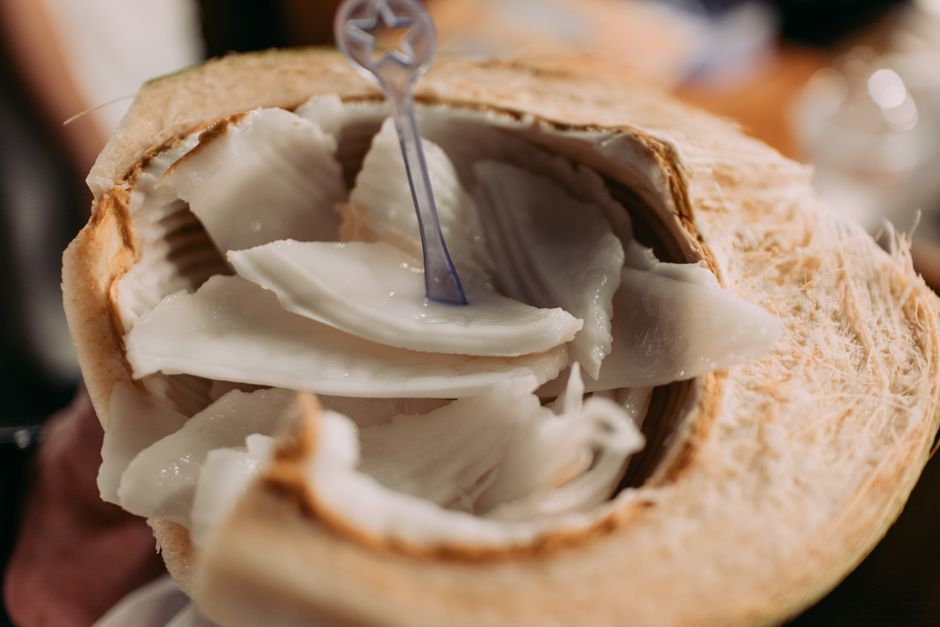
Yes. The flesh of a green coconut is soft, translucent, and jelly-like. It is edible and mild in flavor.
Once the water is poured out, you can scoop the flesh with a spoon. It is easiest to reach right after opening, while the shell is still in one piece. As the coconut matures, this flesh thickens and eventually becomes the firm white meat of a brown coconut.
There is no established nutritional requirement or recommended amount for green coconut flesh. It is simply a food, and it can be eaten the way you would eat any fresh fruit.
How Do You Store a Green Coconut Before Opening?
An unopened green coconut keeps best in a cool place. Refrigeration slows the natural changes inside the fruit and helps preserve the water’s fresh taste.
A whole green coconut can typically be stored for several days to a couple of weeks, depending on how fresh it was when you bought it. The husk may turn slightly yellow or brown over time, which is normal and does not mean it has spoiled. A sour smell, mold, or a cracked shell are signs to discard it.
Once opened, the clock speeds up. Coconut water and flesh are exposed to air and begin to change quickly. Refrigerate what you do not drink and use it within a day.
Frequently Asked Questions
Do you need a special knife to open a green coconut?
A heavy, sharp chef’s knife or cleaver works best because its weight carries through the soft husk. A thin or dull knife is more likely to slip and cause injury.
Can you open a green coconut without a knife?
Only if it already has a soft spot or a pre-cut plug you can push through. Otherwise there is no safe no-knife method, and it is best to wait until you have a proper blade.
Is coconut water a good rehydration drink?
It is fine for everyday thirst and contains some potassium. It does not match the specific sodium, potassium, and glucose ratios of oral rehydration solutions used for treating illness-related dehydration.
How long does an opened green coconut last?
Once opened, refrigerate the water and flesh and use them within about a day. Fresh coconut water loses its flavor quickly after the shell is cut.
