
Facial volume loss is a normal part of aging, and it happens for reasons that have nothing to do with how well you care for your skin. Collagen production declines gradually from your mid-20s onward. Fat pads under the skin shift and thin. Bone density in the face decreases. Fillers address these changes by adding volume directly. Without fillers, you are working with hydration, circulation, muscle tone, and skin barrier health — which can make a real difference to how full your face looks, even if the mechanism is different.
What Actually Causes Facial Volume Loss?
Facial aging is not one process. It is at least four happening at once, and they do not all respond to the same strategies.
The first is collagen and elastin decline. Collagen gives skin its structural support. Starting in the mid-20s, the body produces roughly 1% less collagen per year. By the time you are in your 50s, that adds up. Elastin, which lets skin snap back, degrades too — and unlike collagen, elastin is not efficiently replaced once it is damaged.
The second is fat pad displacement. The face has several distinct fat compartments. Over time, some thin out and some descend. The mid-face (cheeks) tends to lose volume. The lower face can accumulate it. This is why some people look gaunt in the cheeks while developing jowls at the same time.
The third is bone remodeling. The jawbone and cheekbones actually change shape with age. The maxilla — the upper jaw bone — can recede, which changes how the mid-face is supported.
The fourth is skin barrier and hydration changes. Hyaluronic acid, which holds water in the skin, decreases with age. The skin’s ability to retain moisture drops. This makes the face look flatter and can make fine lines more visible.
Understanding which of these is driving your particular concern matters, because no topical product or lifestyle habit reverses fat pad displacement or bone remodeling. What you can influence is collagen synthesis (to a degree), hydration, circulation, and muscle tone.
Can You Actually Increase Facial Collagen Naturally?
Some evidence supports specific interventions for collagen, but the effect sizes are modest compared to what fillers achieve.
Retinoids are the most studied topical ingredient for collagen. Tretinoin, a prescription retinoid, has been shown in multiple studies to increase collagen synthesis and reduce fine lines. Over-the-counter retinol is weaker but works through the same pathway. The evidence here is strong. This is not marketing.
Vitamin C is a cofactor for collagen synthesis. Without it, the body cannot properly form collagen — this is the mechanism behind scurvy. Whether topical vitamin C significantly boosts collagen in already well-nourished skin is less clear. Some studies suggest it helps. The evidence is not as strong as for retinoids.
Sun protection matters more than most people realize. UV exposure breaks down collagen and elastin directly. Daily sunscreen does not add collagen, but it slows the rate at which you lose it. Research consistently shows that people who use sunscreen regularly show less skin aging over time than those who do not.
What does not have strong evidence for facial collagen: collagen supplements taken orally. When you eat collagen, your digestive system breaks it into amino acids. There is no strong evidence that these amino acids preferentially rebuild facial collagen. Some small studies have shown minor improvements in skin elasticity, but the research is mixed and the effect sizes are small.
Does Facial Exercise or Massage Make a Difference?
Facial exercises can increase muscle tone, and some small studies suggest they may improve facial appearance. But the evidence is limited and the results are not dramatic.
A few small trials have looked at facial exercise programs and found modest improvements in cheek fullness and upper face appearance. These studies were short, had small participant numbers, and have not been widely replicated. The honest position: facial exercise may help somewhat, but it is not a substitute for volume that has been lost from fat or bone.
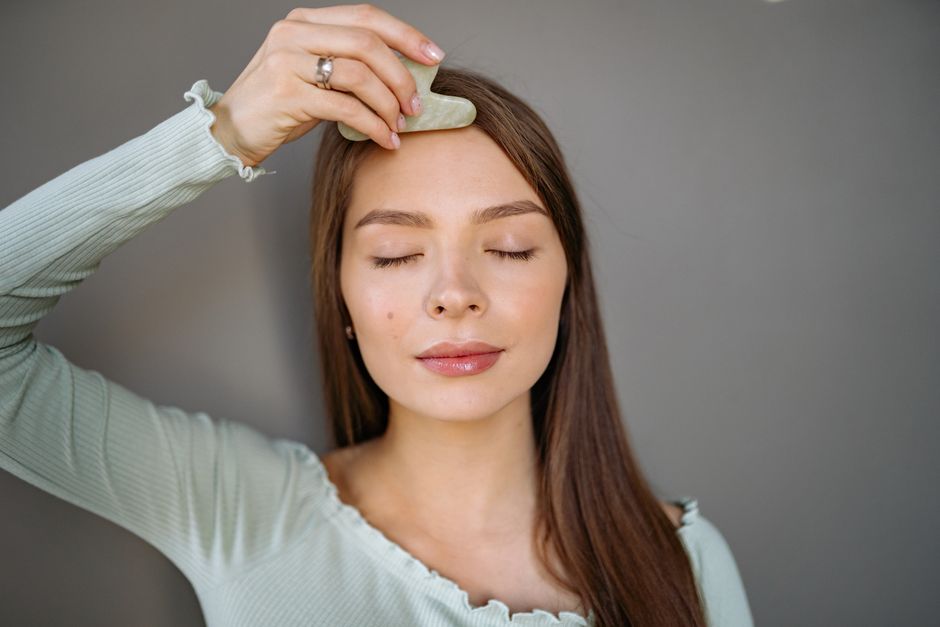
Facial massage is different. It does not build muscle. What it can do is temporarily improve circulation and reduce fluid retention, which may make the face look slightly less puffy or more refreshed. The effect is short-lived — hours, not weeks.
One thing worth knowing: aggressive or frequent facial massage can theoretically stretch skin over time. The evidence here is anecdotal, but it is a reasonable caution. Gentle is better than vigorous.





What Role Does Hydration Play in Facial Fullness?
Hydration affects how plump your skin looks, but the relationship is not as simple as “drink more water.”
Skin hydration depends on two things: water content in the skin and the barrier that keeps it there. Drinking water helps maintain overall body hydration, but if your skin barrier is compromised, the water does not stay in the skin regardless of how much you drink.
Hyaluronic acid is a molecule that holds water. It occurs naturally in skin. Topical hyaluronic acid can temporarily plump the skin by drawing in moisture — but only if there is moisture to draw from and if it is applied to damp skin and sealed with a moisturizer. Applied to dry skin in a dry environment, it can actually pull water out of the skin and make things worse.
Glycerin is another humectant, often less expensive and more reliable than hyaluronic acid for hydration. It draws water into the skin and helps hold it there.
Occlusives like petrolatum, squalane, and certain oils sit on top of the skin and prevent water loss. They do not add water, but they keep it from escaping.
The practical approach: apply a humectant to damp skin, then seal it with an occlusive. This is basic barrier care, and it is well established.
Do Lifestyle Factors Affect Facial Volume?
Several lifestyle factors influence facial aging, and the evidence for some is stronger than for others.
Smoking is one of the most consistent factors associated with accelerated facial aging. Research has found that smokers tend to develop wrinkles earlier and have more pronounced facial volume loss than non-smokers. The mechanism involves reduced blood flow to the skin, collagen breakdown, and oxidative stress.
Sleep position may contribute to asymmetry and creasing over time. Sleeping on your side or stomach puts pressure on one side of the face. The evidence is not strong enough to say this causes significant volume loss, but it is a plausible contributor to uneven appearance.
Diet matters for skin health, but the specifics are often overstated. Adequate protein intake supports collagen synthesis. Adequate fat intake supports the skin barrier. Antioxidant-rich foods may help protect against oxidative damage. But no single food or diet has been shown to restore facial volume.
Alcohol is dehydrating and can cause temporary puffiness followed by dryness. Chronic heavy alcohol use is associated with accelerated skin aging, though the evidence for moderate drinking and facial volume is less clear.
Stress has been linked to skin aging in some studies, likely through cortisol and its effects on collagen. The evidence is not as strong as for smoking, but it is plausible.
What About Supplements and Topical Products That Claim to Plump?
This is where marketing often outpaces evidence.
Oral collagen supplements are widely marketed for skin plumping. The research is mixed. Some small studies have shown improvements in skin elasticity and hydration, but many are industry-funded, short-term, and use measures that are hard to interpret. No strong evidence shows that oral collagen rebuilds facial fat pads or restores volume lost to aging.
Topical collagen is a different story. Collagen molecules are too large to penetrate the skin. When you see collagen listed as a topical ingredient, it functions as a moisturizer, not as a way to add collagen to the skin.
Peptides are short chains of amino acids. Some evidence suggests certain peptides may stimulate collagen production in the skin, but the research is preliminary and specific to certain peptide sequences. Not all peptides work the same way.
Growth factors in skincare are marketed for their potential to stimulate collagen. The evidence is limited, and there are theoretical concerns about long-term use. This is not a well-established category.
Red light therapy has some evidence for improving skin texture and possibly stimulating collagen. The studies are small and the devices vary widely. It is not a proven method for restoring facial volume.
The pattern here: some ingredients have real evidence for improving skin quality, but none have been shown to replace lost facial fat or bone. If a product claims to “restore volume,” that claim is not supported by clinical evidence.
What Actually Works — and What Does Not
Here is the honest summary.
What has reasonable evidence:
- Retinoids (prescription tretinoin or OTC retinol) for collagen support
- Daily sunscreen to slow collagen breakdown
- Barrier hydration (humectant plus occlusive) for temporary plumping
- Not smoking
What has some evidence but is not well established:
- Facial exercise for modest muscle tone improvement
- Topical vitamin C for collagen support
- Certain peptides for collagen stimulation
- Red light therapy for skin quality
What has weak or no evidence for facial volume:
- Oral collagen supplements for restoring facial fat
- Topical collagen as a volumizer
- Facial massage for long-term volume
- Any product claiming to “restore” lost facial fat
None of these approaches replicate what fillers do. Fillers add volume directly. Natural methods support the skin you have and may slow further loss. That is a real but limited benefit.
If your concern is significant volume loss — hollow cheeks, deep folds, a flattened mid-face — no topical product or lifestyle change will restore that. That is not a failure of effort. It is biology.
Frequently Asked Questions
Can you plump your face naturally without fillers?
You can improve skin hydration, support collagen with retinoids and sun protection, and maintain muscle tone with facial exercise, but these methods do not restore lost fat pads or bone. The effect is modest compared to fillers.
Does drinking water plump your face?
Drinking water supports overall hydration, but skin hydration depends more on barrier function than on how much water you drink. Applying a humectant to damp skin and sealing it with a moisturizer is more effective for temporary plumping.
Do facial exercises actually work for volume?
Some small studies suggest facial exercise may improve muscle tone and appearance modestly, but the evidence is limited and not well replicated. It does not replace volume lost from fat or bone.
What is the most effective natural ingredient for facial plumping?
Retinoids have the strongest evidence for supporting collagen and improving skin appearance over time. Hyaluronic acid and glycerin provide temporary hydration-based plumping but do not change underlying volume.
