
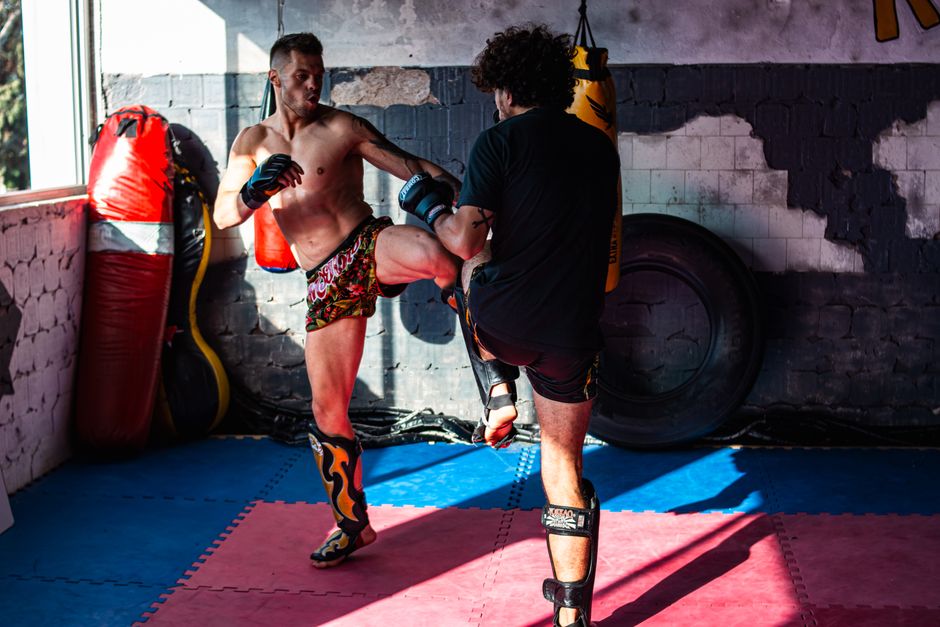
The Muay Thai roundhouse kick is one of the most powerful strikes in martial arts. It uses the entire body—not just the leg—to generate force. Power comes from rotating the hips, pivoting the standing foot, and snapping the shin through the target. Proper form protects your joints and maximizes the force delivered on impact.
What Makes a Muay Thai Kick Powerful?
Power in a Muay Thai kick comes from a kinetic chain. It starts at the floor and moves up through the body. The standing foot pivots, the hips rotate, and the kicking leg swings through like a baseball bat. The shin is the striking surface, not the foot or the instep.
Your arms also matter. The arm on the kicking side swings down and across your body. The opposite arm stays up to guard your face. This counterbalance keeps you stable and adds rotational speed to your hips.
Weight transfer is the missing piece for most beginners. You do not kick with the leg alone. You push off the standing leg and drive your hip forward into the target. The movement is similar to throwing a punch with your hip behind it.
How To Muay Thai Kick With Power And Proper Form?
Start in a fighting stance with your hands up and your weight evenly distributed. Step your lead foot outward at about a 45-degree angle. This step sets the distance and starts your hip rotation.
Pivot hard on the ball of your standing foot. Your heel should face the target when the kick lands. This pivot is what opens your hips and allows them to rotate fully. Without this pivot, your knee and lower back absorb the force instead of the target.
Raise your kicking knee first, then rotate your hips and extend your leg. The knee leads the kick and the shin follows. Strike with the lower third of your shin. This area is the strongest and most conditioned part of the leg.
Your torso leans back slightly as the kick lands. This is normal and necessary. The lean counters the weight of your leg and keeps you balanced. Do not lean so far back that you lose your balance or turn the kick into a crane kick.
Return the leg to the ground in the same path it traveled up. Do not drop it straight down. Bring the knee back to your chest first, then plant your foot. This keeps you balanced and ready to defend or throw another strike.
What Is the Correct Hip and Shoulder Position?
The hips are the engine of the kick. You want your hips to rotate past the target, not stop at it. Think of swinging through the target rather than at it. This follow-through is what separates a heavy kick from a slap.
Your shoulder on the kicking side should rotate with your hips. As your hip drives forward, the same-side shoulder comes forward slightly. This keeps your upper body connected to the strike. Do not swing your shoulder wildly—keep it controlled and aligned with your hip.
Your rear hand stays up near your face. Your lead hand can drop slightly for balance, but keep it close enough to return to guard quickly. Many fighters swing the lead arm down hard across the body. This adds torque but leaves you open if you miss.
Keep your chin tucked. Your eyes stay on the target the entire time. If you close your eyes or look away, you lose both accuracy and the ability to see counters.




How Do You Condition the Shin for Kicking?
Shin conditioning is a gradual process. You are not building bone density as much as desensitizing the nerves and strengthening the tissue around the bone. This takes months, not weeks.
Start by lightly tapping your shins together. Do this for a few minutes daily. As the pain decreases, increase the force slowly. Never kick a heavy bag at full power until your shins have adapted. Bruising is normal early on, but sharp pain or swelling that lasts more than a few days is a sign to back off.
Kicking the heavy bag is the best conditioning tool. It is safer than kicking a Thai pad held by a partner because the bag does not move toward you. Start at 30-40 percent power. Build up over several weeks.
Some fighters use a rolling pin or a bottle to massage the shin. This is common in Thailand but has limited scientific support. The evidence is stronger for actual impact, like hitting the bag, than for massage. Do not use hard objects to beat the shin—this can cause microfractures or periostitis, an inflammation of the tissue around the bone.
What Mistakes Reduce Power and Increase Injury Risk?
The most common mistake is kicking with the foot or instep instead of the shin. This is painful and can break small bones in the foot. Always strike with the lower third of the shin.
Another common mistake is not pivoting the standing foot. If your heel stays flat on the ground, your hip cannot rotate fully. Your knee twists instead, which puts stress on the joint. You lose power and risk injury at the same time.
Chambering the knee too late is also a problem. If you swing your leg straight up without bending the knee first, the kick is slow and easy to read. It also puts strain on the hip flexors. Bring the knee up first, then extend.
Leaning too far back is a third issue. A slight lean is correct. A dramatic lean turns the kick into a crescent motion and sacrifices power. Your spine should stay relatively straight, with your upper body angled back only slightly.
How Do You Build More Power Over Time?
Strength training helps, but the most important factor is technique. A skilled 60-kilogram fighter kicks harder than an untrained 90-kilogram fighter. Refine your form first, then add strength work.
Exercises that build hip and glute strength are most relevant. Squats, lunges, and hip thrusts all transfer well to kicking. Core work matters too—your obliques and transverse abdominis connect your upper and lower body during the rotation.
Flexibility is often overlooked. Tight hip flexors limit your hip rotation and reduce power. Tight hamstrings limit your kicking height and can pull on your lower back. Stretch after training, not before. Static stretching before a workout reduces power output for up to an hour.
Practice both sides. Most people have a dominant kicking side. Training the weaker side balances your muscle development and makes you less predictable. It also prevents the overuse injuries that come from always kicking with one leg.
How Often Should You Practice Kicks?
Quality beats quantity. Ten well-executed kicks with full rotation are better than fifty sloppy ones. Your body needs time to learn the movement pattern, and that happens faster with focused repetition than with high-volume fatigue.
Most Muay Thai classes run three to five times per week. If you train that often, you can practice kicks every session. If you train less frequently, add a short shadowboxing session at home to keep the movement fresh.
Shadowboxing is an underrated tool. Without a bag or pads, you can focus entirely on your technique. Film yourself shadowboxing on your phone. Watch the video and compare your hip rotation and foot pivot to a reference. You will see mistakes you cannot feel while doing it.
What Should You Do If a Kick Hurts Your Knee or Hip?
Pain is a signal, not a challenge. Sharp pain in the knee or hip during a kick means something is wrong with your technique. Stop and check your foot pivot and hip rotation. Most joint pain in kicking comes from a locked knee or a hip that is not rotating properly.
If the pain persists after correcting your technique, rest for a few days. If it continues after rest, see a sports medicine professional. Do not train through joint pain. Unlike muscle soreness, joint pain does not go away with movement.
Shin pain is different. Mild shin soreness after bag work is normal, especially in the first few months. Pain on the inside of the shin that gets worse with activity could be shin splints. If you have swelling, redness, or pain that does not improve with rest, see a doctor.
Frequently Asked Questions
How long does it take to develop a powerful Muay Thai kick?
Most people see meaningful improvement in three to six months of consistent training. Technique development takes longer than strength development, so prioritize form over power in the first year.
Is it better to kick with the shin or the foot?
Always kick with the shin. The shin is a dense bone designed to absorb impact, while the foot contains many small bones that break easily. Striking with the foot also reduces power because the ankle absorbs the force.
Can you build shin conditioning without a heavy bag?
Yes, but it is slower. Light shin taps and partner drills with Thai pads can work, but the heavy bag is the most effective tool because it provides consistent resistance. Never condition your shins by kicking hard objects like trees or metal poles—this causes microfractures and long-term damage.
Why does my kick hurt my lower back?
This usually means you are not pivoting your standing foot. Without the pivot, your lower back twists to compensate for the lack of hip rotation. Check your foot position and reduce your kicking power until the movement feels smooth.
