
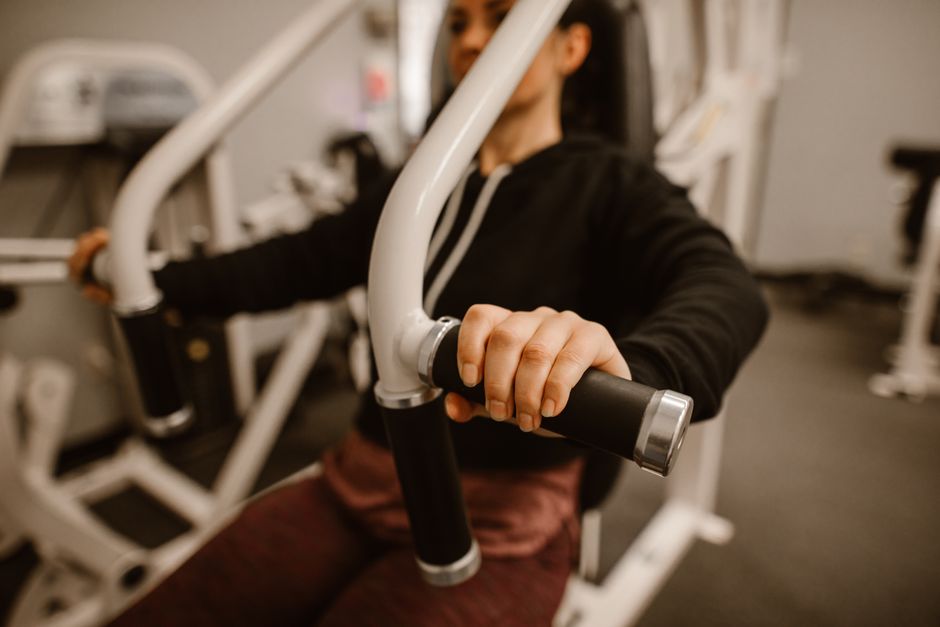
To move your chest muscles and feel them work, you have to do two things at once: use the pectorals to push your upper arm across the front of your body, and slow the movement down enough that your brain registers the tension. The chest muscles — the pectoralis major and the smaller pectoralis minor underneath it — pull the arm toward the body and inward. If you push with your shoulders and triceps instead, the chest barely participates. Feeling the work is mostly about setup, control, and where you place your attention.
What Do the Chest Muscles Actually Do?
The pectoralis major is a large, fan-shaped muscle that runs from your breastbone, collarbone, and upper ribs to the upper arm bone. Its main jobs are to bring the arm forward, pull it across the body, and rotate it inward.
When people talk about “feeling the chest work,” that is the action they mean. Any movement where the upper arm travels forward and inward against resistance loads the pectoralis major.
The pectoralis minor sits underneath and connects the upper ribs to a bony projection on the shoulder blade. It helps move the shoulder blade forward and downward. You cannot isolate it with conscious effort, and it is not a muscle you need to “target” in a workout.
Here is a point that surprises many people: the chest is not one muscle doing one job. The upper fibers near the collarbone and the lower fibers near the ribs have somewhat different lines of pull. That is why changing the angle of a push — incline versus flat versus decline — shifts which region does more of the work. The difference is real but modest. No single angle is required for a complete chest.
How To Move Your Chest Muscles And Feel Them Work
The single most reliable way to feel your chest is to slow the lowering phase of a push and keep your shoulder blades set. Most people rush the movement and let the shoulders roll forward. That transfers the work to the front of the shoulder and the triceps.
Try this sequence to build the connection:
- Set the shoulder blades. Pull them gently down and back, then keep them there. This gives the chest a stable base to pull from.
- Keep the elbows at roughly 45 degrees from your body rather than flared straight out to the sides. This is a more comfortable position for most shoulders and keeps the chest in the line of pull.
- Lower slowly — about three seconds. The lowering phase is where you can feel the muscle lengthen under load. Rushing it is the fastest way to lose the sensation.
- Think “squeeze the arms together,” not “push the weight away.” Bringing the upper arms toward each other is the pectoralis major’s job. Pushing straight out is more of a triceps and shoulder task.
- Pause briefly at the point where your arms are closest together. This is where the muscle is shortest and the contraction is easiest to sense.
If you still feel nothing in the chest, the weight is probably too heavy. Drop it substantially. A lighter load moved with control teaches the pattern far better than a heavy load moved by whatever muscles will take over.
Why Can’t I Feel My Chest When I Push?
Not feeling a muscle during an exercise is common and usually has a mechanical explanation, not a mysterious one. The chest is a powerful muscle, and the body is efficient at recruiting the strongest available muscles for a task.
The most frequent reasons:
- Shoulders rolling forward. When the shoulder blades are not set, the front of the shoulder takes over the push.
- Elbows too close to the body. This shifts work toward the triceps.
- Elbows flared too wide. This loads the shoulder joint more and the chest less, and can be uncomfortable.
- Speed. Fast reps reduce the time under tension and make the movement harder to sense.
- Attention. Where you focus genuinely affects which muscles you recruit. Paying attention to the chest during a set tends to increase its activity compared with thinking about the weight or the outcome.
That last point is not motivational filler. Studies using muscle activity monitoring have found that directing attention to a specific muscle during exercise can change how much that muscle contributes. The effect is modest, not magic, but it is measurable.
Which Exercises Make the Chest Easiest to Feel?
Movements where the upper arm travels across the body are the easiest place to start. A cable or band fly, a dumbbell fly, and a machine chest press all keep the arm in a position where the pectoralis major is the primary mover.
Push-ups and bench presses work the chest too, but they give the triceps and shoulders more opportunity to take over — especially if form slips. If your goal is to feel the muscle, start with a movement that constrains the arm path, then carry that sensation back into the bigger lifts.
| Movement | How easy is it to feel the chest? | Why |
|---|---|---|
| Cable or band fly | Relatively easy | Arm travels across the body; the chest is the main mover |
| Dumbbell fly | Relatively easy | Same pulling action, though the load is hardest at the bottom |
| Machine chest press | Moderate | Fixed path reduces balance demands; triceps still assist |
| Push-up | Moderate | Easy to set up, but the shoulders can take over if the shoulder blades are not set |
| Barbell bench press | Variable | Heavy loads let the triceps and shoulders dominate |
One clarification worth making: feeling a muscle burn or “pump” is not the same as that muscle doing the most work, and it is not required for a muscle to grow. Sensation is a useful feedback tool for learning a movement. It is not a measure of whether the exercise is effective.
Does the Mind-Muscle Connection Really Matter?
Yes, but modestly. Research using electromyography — which measures electrical activity in a muscle — has found that focusing on a target muscle during a lift tends to increase its activity compared with focusing on the weight or on moving through the rep.
What the research does not show is that this focus produces meaningfully more muscle growth over time. The evidence on long-term outcomes is limited. Treat the mind-muscle connection as a skill for learning a movement and for making a set feel controlled, not as a proven growth strategy.
There is also a practical limit. Very heavy loads demand so much from the nervous system that fine attention to one muscle becomes difficult. That is one reason lighter, controlled sets are better for building the connection.
What If I Feel It in My Shoulder or Neck Instead?
Feeling a push in the front of the shoulder or the neck usually points to a positioning issue. The most common culprit is a shoulder blade that is not set, which lets the shoulder roll forward and take the load.
Neck tension often comes from shrugging or bracing the upper traps during the push. Consciously let the shoulders drop away from the ears before each rep.
If discomfort is sharp, or if it persists after you adjust position and reduce the load, stop the exercise and get it checked by a clinician. Muscle soreness is one thing. Joint pain or pain that radiates is another, and it is not something to push through.
Some people also find that tightness in the chest itself limits how well they can set their shoulders. Gentle stretching of the chest doorway can help with positioning, though stretching alone does not strengthen anything. It is a setup aid, not a training method.
How Long Does It Take to Feel the Connection?
Most people notice a difference within a few sessions of slowing down and setting the shoulder blades. There is no reliable timeline that applies to everyone, and progress depends on how much the old pattern is ingrained.
The key variable is repetition with attention. Practicing the movement slowly and deliberately, a few sets at a time, teaches the pattern faster than adding weight. Once the sensation is reliable, you can gradually increase the load.
Frequently Asked Questions
How do I know if I’m using my chest muscles?
You should feel tension across the front of your chest as your upper arm moves forward and inward, not just at the front of the shoulder or the back of the arm. Slowing the lowering phase makes this easier to detect.
Why can’t I feel my chest during push-ups?
Most often the shoulder blades are not set, so the shoulders and triceps take over the push. Setting the shoulder blades down and back and slowing the descent usually changes this.
Is it bad if I don’t feel my chest during a workout?
No — sensation is a feedback tool, not a requirement. A muscle can be working and growing without you feeling a distinct burn or pump.
Should I squeeze my chest at the top of a press?
A brief pause where your arms are closest together can help you sense the contraction. It is a useful learning cue, not a mandatory part of every rep.
