
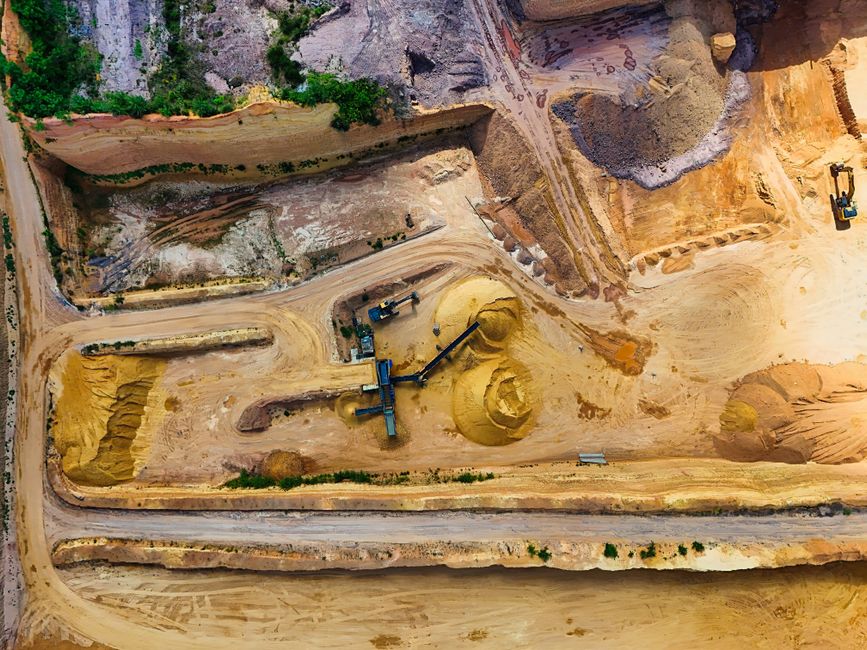
Bauxite is the main ore used to make aluminum, and it is mined in shallow, open pits rather than deep underground shafts. Mining it involves clearing topsoil, digging the ore, washing and drying it, then shipping it to a refinery. The work carries real hazards — silica dust, caustic chemicals at the processing stage, and heavy machinery — which is why dust control, protective equipment, and land rehabilitation are central to doing it safely.
What Is Bauxite and Where Does It Come From?
Bauxite is not a single mineral. It is a mix of aluminum-bearing minerals, iron oxides, clay, and quartz that formed when intense tropical weathering leached silica out of parent rock and left aluminum behind. That process, called laterization, takes millions of years and needs a hot, wet climate with good drainage.
Because of how it forms, bauxite deposits cluster near the equator. Guinea, Australia, Brazil, Indonesia, and Jamaica hold some of the largest known reserves. The ore typically sits in flat, shallow layers just below the surface — often only a few meters down. That shallow placement is the single biggest reason bauxite is almost always surface-mined.
Colors range from off-white to reddish-brown depending on how much iron oxide is present. The iron content also matters commercially, since it affects how the ore behaves during refining.
How Is Bauxite Mined?
Open-pit mining is the standard method. There is no practical way to extract shallow, blanket-like deposits using underground techniques, so the industry strips the land in stages.
The sequence usually looks like this:
- Clearing and topsoil removal. Vegetation is cleared and topsoil is scraped off and stockpiled for later rehabilitation.
- Drilling and blasting. Where the ore is hard, holes are drilled and loaded with explosives to break it up. Softer deposits may be dug directly.
- Excavation. Large excavators and front-end loaders scoop the ore into trucks or onto conveyors.
- Hauling. Trucks move ore to a crushing and washing facility, or directly to a stockpile.
After excavation, the pit is typically backfilled with waste material and the stockpiled topsoil is spread back over the surface. Revegetation follows. This is called rehabilitation, and how well it works varies widely between operations and jurisdictions.
How Is Bauxite Processed Into Alumina?
Raw bauxite is not useful on its own. It has to be refined into alumina (aluminum oxide), and then smelted into aluminum metal. The refining step is where most of the chemistry happens.
Nearly all alumina is produced using the Bayer process, developed in the late 1800s and still the dominant method today. The steps are:
- Crushing and grinding. Ore is reduced to fine particles to expose more surface area.
- Digestion. The ground ore is mixed with hot sodium hydroxide (caustic soda) under pressure. This dissolves the aluminum-bearing minerals.
- Clarification. Undissolved solids — mostly iron oxide and silica — settle out as “red mud.”
- Precipitation. The clear liquor is cooled and seeded so aluminum hydroxide crystals form.
- Calcination. The crystals are heated in a kiln to drive off water, leaving white alumina powder.
Red mud is the main waste stream and it is alkaline, which makes its storage and handling a genuine environmental concern. How it is managed depends heavily on local regulation and company practice.
Alumina then goes to a smelter, where the Hall–Héroult process uses electric current to separate aluminum metal from the oxygen in alumina. That smelting step is energy-intensive and is usually located near cheap power, not near the mine.





What Are the Main Health and Safety Risks?
The hazards differ by stage. Mining exposes workers to dust and machinery. Refining exposes them to caustic chemicals and heat. Both stages carry physical injury risks.
Dust and crystalline silica. Bauxite ore and the overburden above it often contain quartz. Breathing fine crystalline silica dust is a well-established cause of silicosis, a permanent lung disease, and is linked to lung cancer and chronic obstructive pulmonary disease. This is one of the most serious risks in bauxite mining. Dust suppression — water sprays, enclosed conveyors, ventilation, and respirators — is the standard control.
Caustic soda. Sodium hydroxide used in the Bayer process can cause severe chemical burns to skin and eyes on contact. It is also corrosive if inhaled as mist or swallowed. Engineering controls, eye protection, and chemical-resistant gloves and clothing are standard.
Heat stress. Refineries run at high temperatures, and many bauxite mines are in tropical climates. Heat exhaustion and heat stroke are recognized occupational risks in both settings.
Machinery and falls. Haul trucks, conveyors, crushers, and heavy equipment create crush, struck-by, and fall hazards. These are managed through training, guarding, traffic rules, and lockout procedures.
Noise and vibration. Drilling, blasting, and crushing generate high noise levels that can cause hearing loss over time without protection.
What Does Safety Look Like on a Bauxite Operation?
Effective safety programs in this industry combine engineering controls, administrative rules, and personal protective equipment — in that order of priority. The idea is to remove or isolate the hazard before relying on a worker to wear something.
Common measures include:
- Water sprays and dust collectors to control airborne particles
- Enclosed or ventilated cabins on heavy equipment
- Respiratory protection where dust cannot be fully controlled
- Regular air monitoring for silica and other dusts
- Chemical handling procedures and emergency showers near caustic areas
- Hearing protection and noise monitoring
- Heat management plans with rest breaks and hydration
- Training, signage, and traffic control on haul roads
Occupational exposure limits for crystalline silica vary by country and by agency. Employers are generally required to keep exposures below the applicable limit and to monitor workers who may be exposed. If you work in this industry and are unsure what limits apply to you, your workplace safety officer or a local occupational health authority is the right source — not general articles.
What About Environmental and Community Impacts?
Bauxite mining disturbs land, and the effects extend beyond the pit. Clearing removes vegetation and topsoil, which can increase erosion and change how water moves through the landscape. Runoff carrying sediment can affect nearby streams and rivers.
Dust from mining and haul roads can settle on nearby communities. Silica and other particulate matter in ambient air is a recognized public health concern, though exposure levels and health outcomes depend on local conditions and controls.
Red mud storage is the most closely watched environmental issue on the refining side. Its high alkalinity means a spill or failure of a storage facility can be serious. How strictly these facilities are regulated and inspected varies by country.
Rehabilitation — returning mined land to forest, farmland, or another productive use — is required in many jurisdictions. Success rates differ. Some sites recover well; others show slow regrowth and persistent changes to soil and water. The honest position is that outcomes depend on climate, soil, planning, and long-term commitment, and results are not uniform across the industry.
Is Aluminum Production Sustainable?
Aluminum is highly recyclable, and recycling uses far less energy than making new metal from ore. That is a genuine advantage. But global demand for aluminum continues to grow, and recycling alone does not currently meet it, so bauxite mining continues.
Efforts to reduce impact include better dust control, improved red mud management, and research into using red mud in construction materials or recovering residual metals from it. Some of these approaches are established; others are still experimental. No single method has solved the red mud problem at scale.
The bigger picture is that bauxite mining is not going away soon, and the practical question is not whether it happens but how well it is regulated, monitored, and cleaned up afterward.
Frequently Asked Questions
Is bauxite mining dangerous for workers?
Yes, it carries real occupational hazards, especially crystalline silica dust that can cause silicosis, plus machinery, heat, and noise risks. Proper dust control, protective equipment, and monitoring substantially reduce — but do not eliminate — these risks.
Why is bauxite mined in open pits instead of underground?
Most bauxite deposits sit in shallow, flat layers just below the surface, so open-pit mining is simpler and cheaper than tunneling. Underground mining is not practical for deposits of this shape.
What is red mud and why is it a concern?
Red mud is the alkaline waste left after alumina is extracted from bauxite using the Bayer process. It is produced in large volumes and must be stored carefully, since spills or storage failures can harm the environment.
Can bauxite dust cause health problems in nearby communities?
Airborne dust from mining and haul roads can affect local air quality, and fine particulate matter is a recognized health concern. Actual exposure and health effects depend on local conditions, dust controls, and monitoring.
