
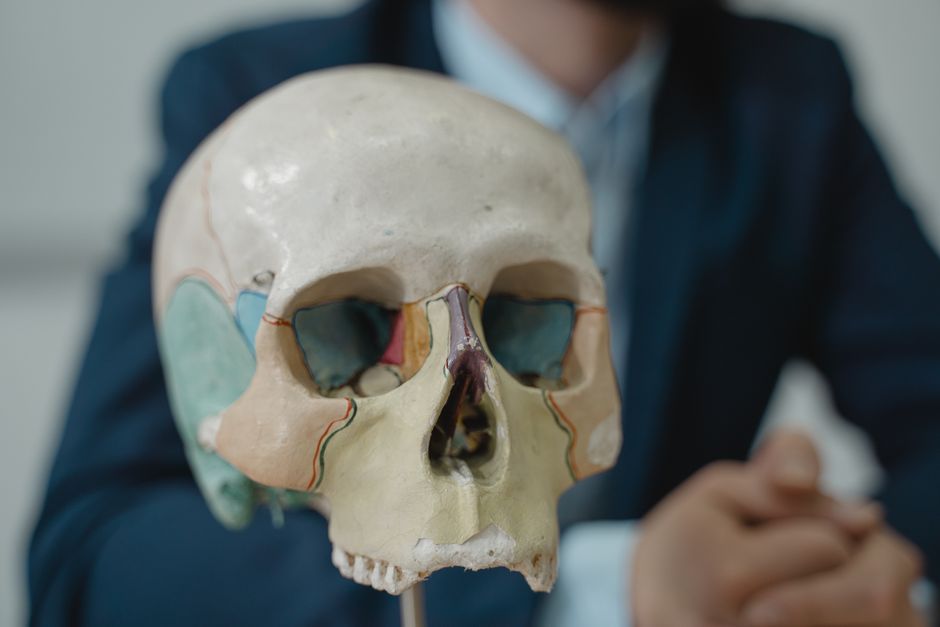
You can memorize all 206 bones in the human body by learning them in groups, not as one long list. The adult skeleton has 206 bones, and most of them sit in just two places: the skull and the hands and feet. Break the skeleton into regions, learn the major bones in each region first, then add the smaller ones over several short study sessions. That approach works because it uses the way memory actually functions — connecting new names to structure, location, and meaning rather than repeating a raw list.
How Is the 206-Bone Skeleton Organized?
The adult skeleton divides into two main parts: the axial skeleton and the appendicular skeleton. The axial skeleton has 80 bones. It includes the skull, the vertebral column, the rib cage, and the hyoid bone in the throat. The appendicular skeleton has 126 bones. It includes the arms, legs, shoulder girdle, and pelvis.
That split alone gives you a useful mental map. If you learn which region each bone belongs to, you always have a place to file the name. Memory researchers call this “chunking” — grouping small pieces of information into larger meaningful units. It is one of the most consistently supported strategies in learning science.
Here is the regional breakdown of the adult skeleton:
- Skull: 22 bones (8 cranial, 14 facial), plus 6 tiny ear bones (3 in each middle ear) and the hyoid
- Vertebral column: 26 bones in adults (24 vertebrae plus the sacrum and coccyx)
- Rib cage: 24 ribs plus the sternum
- Shoulder girdle: 4 bones (2 clavicles, 2 scapulae)
- Arms and hands: 6 bones per arm (humerus, radius, ulna, plus 3 in the wrist region counted separately), then 27 bones in each hand and wrist
- Pelvis: 2 hip bones
- Legs and feet: 4 bones per leg (femur, patella, tibia, fibula), then 26 bones in each foot and ankle
Notice that the hands and feet together account for more than half of all 206 bones. That single fact changes how you should study. Most of your memorization effort will go into the small bones of the wrist, hand, ankle, and foot.
How To Memorize All 206 Bones In The Human Body Without Cramming
Spaced repetition beats cramming. That finding is one of the most reliable in cognitive psychology. Reviewing material across several days produces stronger long-term recall than studying the same total time in one session.
A practical schedule looks like this: learn one region per session, then review the previous regions at the start of each new session. Keep sessions short — 20 to 30 minutes is enough. The goal is repeated contact, not marathon study.
Three techniques work well together:
- Use a labeled diagram. Point to each bone and say its name out loud. Naming while pointing links the word to a physical location in your mind.
- Handle a model if you can. A physical or digital 3D skeleton helps you understand how bones fit together. Anatomy students who work with models tend to remember spatial relationships better than those who only read lists.
- Test yourself. Cover the labels and try to recall each name before checking. Retrieval practice — pulling information out of memory — strengthens recall more than re-reading does. This is well established in the learning research.
Do not try to memorize all 206 names in one sitting. That approach feels productive and rarely sticks. Region-by-region learning with regular self-testing is slower on day one and far faster by week two.
What Are the Best Memory Tricks for Bone Names?
Mnemonics help, but only after you understand the structure. A mnemonic attached to a bone you cannot picture is just another word to memorize.
Several well-known mnemonics are used in anatomy courses:
- Carpal bones: “Some Lovers Try Positions That They Can’t Handle” stands for scaphoid, lunate, triquetrum, pisiform, trapezium, trapezoid, capitate, hamate.
- Cranial bones: “OldPeople From Texas Eat Spiders” stands for occipital, parietal, frontal, temporal, ethmoid, sphenoid.
- Vertebrae regions: Remember the counts — 7 cervical, 12 thoracic, 5 lumbar. Breakfast at 7, lunch at 12, dinner at 5 is a common classroom aid.
Mnemonics are a bridge, not the destination. Use them to get the names into memory, then practice recalling the bones by location so you no longer need the phrase.
One clarification worth knowing: the “206” figure applies to adults. Babies are born with more separate bone elements — roughly 270 — because many bones fuse during growth. The skull, spine, and pelvis all involve fusion. So if you learned a different number as a child, both figures can be correct depending on age.





Which Bones Should You Learn First?
Start with the bones you can feel on your own body. The clavicle, sternum, ribs, humerus, radius, ulna, femur, patella, tibia, and fibula are all easy to locate by touch. Learning them first builds confidence and gives you an anchor for everything else.
After that, move to the skull. The 8 cranial bones and 14 facial bones are the next most useful group because they appear constantly in anatomy study and medical terminology.
Save the small bones for last. The 8 carpal bones of the wrist and the 7 tarsal bones of the ankle are the hardest to keep straight. They are also the ones most likely to blur together if you learn them too early.
A reasonable order looks like this:
- Major long bones of the arms and legs
- Skull and jaw
- Spine and rib cage
- Shoulder girdle and pelvis
- Hands and wrists
- Feet and ankles
Each region builds on the last. By the time you reach the wrist bones, you already have a mental picture of the skeleton as a whole, which makes the small names easier to place.
How Long Does It Take to Learn All 206 Bones?
Most people can learn the major bones within a week or two of regular short sessions. The full set of 206 names, including the small bones of the hands and feet, typically takes several weeks of consistent practice. That is a general observation from how anatomy is taught, not a fixed timeline — individual results vary widely with study time and background.
The limiting factor is usually not intelligence. It is repetition over time. Someone who studies 20 minutes a day for a month will almost always outperform someone who studies four hours the night before an exam.
If your goal is professional — nursing, physical therapy, medicine, or fitness certification — expect to revisit the skeleton repeatedly. Anatomy knowledge fades without use. Brief periodic review keeps it sharp.
Do You Need to Memorize All 206 Bones?
For most people, no. Knowing the major bones and their locations covers what you need for general health literacy, fitness training, or understanding a medical report. The tiny bones of the wrist and foot matter mainly to students and clinicians who need them for professional practice.
That said, learning the skeleton has real practical value. It helps you understand injuries, describe pain to a doctor, and follow along with imaging results. It also makes anatomy in general far easier to learn, because the skeleton is the framework everything else attaches to.
If you only learn 30 to 40 bones well, you will already know more than most people. The remaining names can wait until you actually need them.
Frequently Asked Questions
How many bones are in the human body?
An adult human body has 206 bones. Babies are born with more separate bone elements — roughly 270 — because many fuse together during growth.
What is the fastest way to memorize the 206 bones?
Learn the skeleton region by region and test yourself regularly instead of re-reading a list. Spaced review over several days works better than one long cramming session.
Which bones are hardest to memorize?
The small bones of the wrist and ankle are the hardest, because there are many of them and their names are unfamiliar. They are easier to learn after you know the larger bones.
Are there really 206 bones in every adult?
206 is the standard count for a typical adult skeleton. Small variations exist — some people have extra ribs or fused bones — so the exact number can differ slightly from person to person.
