
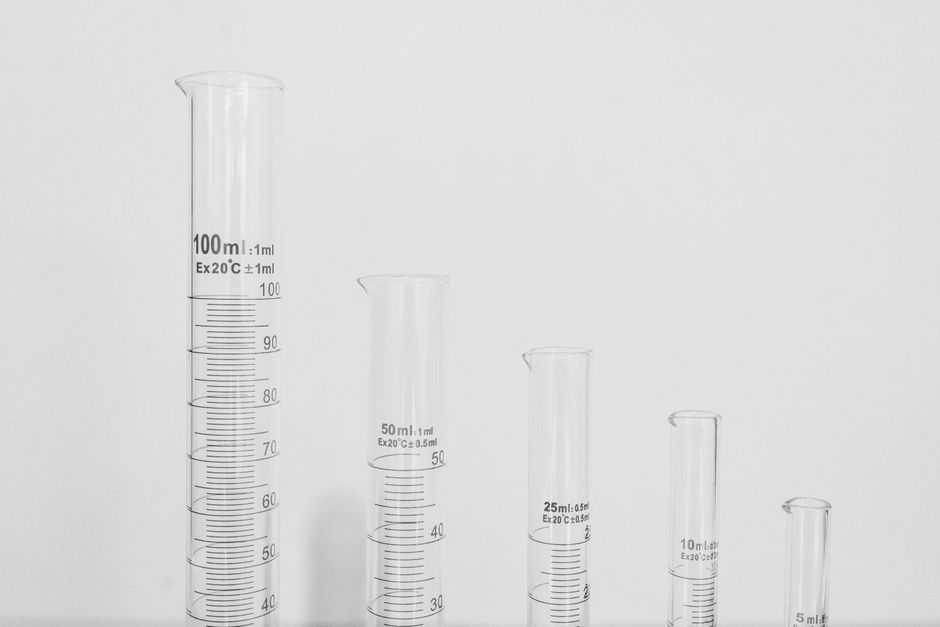
Reading the exact volume of liquid in a graduated cylinder takes more than just looking at the numbers. The key is to get your eyes level with the liquid’s surface and read the bottom of the curve, called the meniscus. For most water-based liquids, this curve dips in the middle, so you read the lowest point of that dip.
Why the Meniscus Matters
Liquid inside a narrow glass tube does not sit perfectly flat. Water and most water-based solutions cling to the sides of the glass. This creates a curve at the surface, with the edges slightly higher than the center. That curve is the meniscus.
For water, the meniscus curves downward, like a shallow bowl. For some other liquids, like mercury, the curve flips and bulges upward. For typical lab work and home science projects, you will almost always be dealing with the downward-curving meniscus of water.
Reading the wrong part of this curve is the most common source of error. Reading the top edge instead of the bottom can add several tenths of a milliliter to your measurement.
How To Measure Liquid In A Graduated Cylinder Correctly
Place the graduated cylinder on a flat, level surface. Do not hold it in your hand. A slight tilt changes the angle of the liquid surface and ruins the reading.
Wait a moment for the liquid to settle. If you just poured liquid in, the surface may still be moving. Give it a few seconds to calm down.
Now lower your head so your eyes are exactly level with the liquid surface. This is called reading at eye level. If you look from above or below, the curve appears to shift, and you will record an incorrect volume.
Read the number at the bottom of the meniscus. Find the lowest point of the curved surface and line it up with the scale markings on the cylinder. That number is your volume.
How To Read the Scale Lines
Graduated cylinders have lines printed or etched on the side. The largest lines are labeled with numbers. Between those lines are smaller, unlabeled marks.
First, identify what each small line represents. Look at the difference between two labeled lines. For example, if the marks go from 20 mL to 30 mL, and there are 10 spaces between them, each small line equals 1 mL. If there are 5 spaces, each line equals 2 mL.
Once you know the value of each line, estimate to one decimal place beyond it. If your smallest lines are 1 mL apart, you can reasonably estimate the volume to the nearest 0.5 mL or 0.1 mL. This estimated digit is not exact, but it is standard practice and makes your measurement more useful.
Do not try to read a value more precise than the cylinder allows. A 100 mL graduated cylinder with 1 mL markings cannot give you an accurate reading to 0.01 mL. The equipment simply is not that precise.




Common Mistakes That Ruin Readings
Reading from above or below eye level is the biggest error. When your eye is above the liquid, the meniscus appears higher on the scale. When your eye is below, it appears lower. This error is called parallax.
Holding the cylinder instead of placing it on a flat surface causes tilting. Even a small tilt changes the shape of the liquid surface and shifts the reading.
Reading the top edge of the meniscus happens when people do not know which curve to follow. Always use the bottom of the curve for water-based liquids.
Using a dirty cylinder can cause droplets to stick to the sides. This leaves an uneven surface and makes the meniscus hard to read. Rinse the cylinder with the liquid you plan to measure before taking your final reading.
Choosing the wrong cylinder size also reduces accuracy. A 10 mL cylinder with 0.1 mL markings is far more precise than a 500 mL cylinder with 5 mL markings. Pick the smallest cylinder that can hold your full volume. You want the liquid level to fall in the upper half of the cylinder’s range for the best accuracy.
What to Do With Bubbles and Foam
Bubbles clinging to the inside of the glass can push the liquid surface up and distort the meniscus. If you see bubbles, tap the side of the cylinder gently to release them. Let the foam settle before reading.
Some liquids, like soapy water or certain chemicals, form foam that sits on top of the liquid. Do not read the top of the foam. The foam is not part of the liquid volume. Wait for it to break down, or read the meniscus below the foam layer if you can see it clearly.
How To Read a Cylinder With a Plastic Meniscus Reader
Some lab equipment includes a small plastic ring or collar that slides up and down the cylinder. This device is designed to block out the glare and make the meniscus easier to see.
Slide the reader so its bottom edge lines up exactly with the bottom of the meniscus. Then read the scale at that point. This tool is helpful when lighting conditions make the meniscus hard to spot, but it does not change the basic rule: read the bottom of the curve at eye level.
Why Precision Matters in Real Life
Accurate liquid measurement matters outside the lab. Cooking, baking, and mixing cleaning solutions all depend on getting volumes right. In baking, too much liquid changes the texture of the final product. In cleaning, the wrong ratio of water to chemical can make a solution ineffective or even dangerous.
For medications, precision is critical. Liquid medicine doses are measured in milliliters, and an incorrect reading can mean taking too much or too little. Always use the measuring device that comes with the medication when one is provided. These devices are calibrated for that specific medicine.
In science classrooms and professional labs, inaccurate readings lead to failed experiments and wasted materials. The skill of reading a graduated cylinder correctly is foundational for any chemistry or biology work.
How To Clean and Store a Graduated Cylinder
Rinse the cylinder with warm water immediately after use. For most water-based liquids, this is enough. For oily or sticky substances, use a mild detergent and a soft brush designed for lab glassware.
Do not use abrasive scrubbers. They scratch the glass, and scratches make the scale harder to read and trap residue. Rinse thoroughly with distilled water after washing to remove any detergent film.
Dry the cylinder by letting it air dry upside down on a clean rack. Do not dry the outside with a cloth that leaves lint. Store the cylinder upright in a safe place where it will not be knocked over.
Frequently Asked Questions
What is the meniscus in a graduated cylinder?
The meniscus is the curved surface of the liquid inside the cylinder. For water, it curves downward, and you read the volume at the bottom of that curve.
Do you read a graduated cylinder from the top or bottom?
You read from the bottom of the meniscus for water and most water-based liquids. The only exception is liquids like mercury that curve upward, in which case you read the top of the curve.
Why do you need to read at eye level?
Reading at eye level eliminates parallax error. When your eye is above or below the liquid surface, the meniscus appears to line up with a different number on the scale.
How do you estimate between the lines on a graduated cylinder?
Identify the value of each small line first, then estimate one decimal place beyond it. For example, if lines are 1 mL apart, estimate to the nearest 0.1 mL.
