
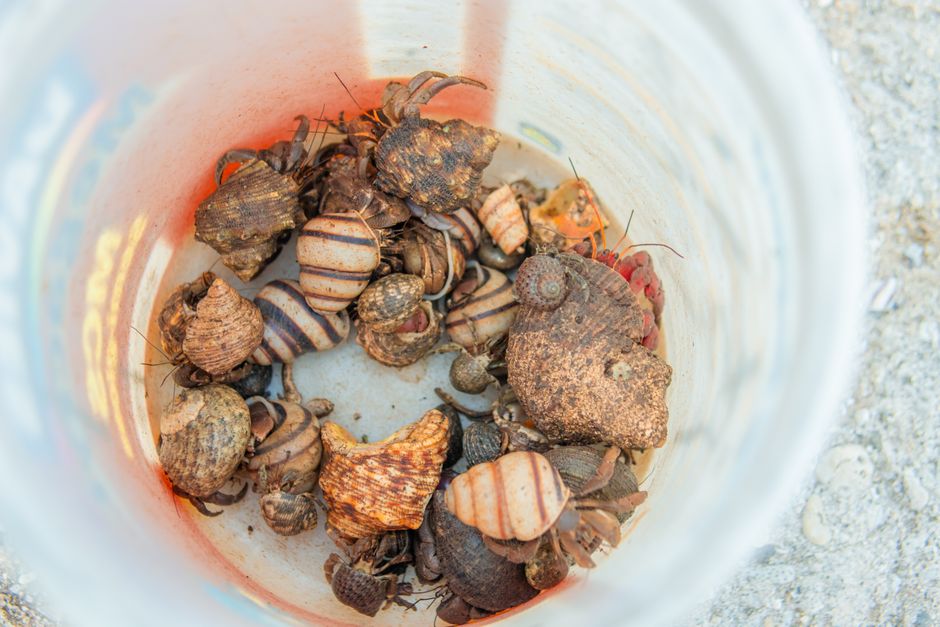
To measure a hermit crab for a new shell, you measure the crab’s shell opening, not the crab itself. Use digital calipers to measure the widest inside diameter of the shell opening the crab currently lives in, in millimeters. Then look for replacement shells with an opening about 2 to 4 millimeters larger than that number.
That is the whole method. It takes about a minute, and it is far more accurate than holding a shell up to your crab and guessing. Getting the size right matters more than most owners realize, because a shell that is too small can trap a crab, and one that is too large gets dragged around like dead weight.
Why You Measure The Shell Opening And Not The Crab
The shell opening is the only dimension that has to match. A hermit crab’s body is soft and flexible in the middle, so it can fold and squeeze into a shell that looks far too small from the outside. The hard parts are the problem.
The crab’s claw and its walking legs are rigid. They do not compress. The opening of the shell is the doorway those hard parts have to pass through and then sit in. If the doorway is the right size, the crab fits. If it is not, nothing else about the shell matters.
This is why measuring the crab’s body is the wrong approach. A crab sitting in your hand has its legs tucked or splayed depending on how stressed it is. Its apparent width changes. The shell opening, by contrast, is a fixed, hard-edged measurement you can read off a tool.
One clarification that surprises many owners: the shell your crab is wearing right now is the best measuring instrument you have. It is a shell the crab chose and is living in. Its opening is by definition in the right size range. Every other shell you buy should be judged against that one number.
What You Need To Measure Accurately
Digital calipers are the tool that works. You can find them at hardware stores and online for a modest price, and the cheap ones are accurate enough for this job. They read out in millimeters, which is the unit you want.
A ruler can work in a pinch, but it is genuinely worse. Shell openings are often oval, and the lip is rounded, so a flat ruler tends to sit on top of the curve rather than across the true width. That introduces error of a few millimeters, which is the entire margin you are working with.
If you have no calipers and no plans to buy any, a ruler is better than nothing. Just be aware you are estimating, and lean toward buying a small range of shell sizes rather than betting on one.
You will also want a way to record numbers. A note on your phone is fine. Once you have several crabs and a box of shells, written sizes stop being optional.
How To Measure Hermit Crab Shells For A Perfect Fit
Measure the inside of the opening, at its widest point. That is the single most important instruction in this article, and it is the step most people get wrong.
Here is the sequence:
- Pick up the shell with the crab inside it. Do not pull the crab out.
- Hold the shell so you are looking straight into the opening.
- Open the caliper jaws and place them inside the opening, touching the inner walls.
- Find the widest span across the opening. Openings are usually oval, so the long axis is wider than the short one.
- Read the number in millimeters and write it down.
The widest span is the number that matters because that is the space the crab’s claw and legs have to move through. Measuring the narrow axis will give you a number that is too small and lead you to buy shells that do not fit.
Do not measure the outside of the shell. The outside includes the shell wall, which can be several millimeters thick. A shell with a 25 mm outside opening might have an inside opening of only 20 mm. If you shop by outside measurement, you will consistently buy shells that are too small.





What Size Shell Should You Buy
Aim for an opening roughly 2 to 4 millimeters wider than the current shell’s inside opening. That range gives the crab room to grow without handing it a shell it cannot manage.
This range is practical guidance rather than a laboratory-derived rule. There is no published clinical standard for hermit crab shell sizing, so treat it as a sensible starting window and adjust based on what your crab actually does.
What you are looking for is a shell the crab can enter, turn around in, and retreat fully into. If the crab puts the shell on and then cannot withdraw its body past the opening, the shell is too small regardless of what the calipers said.
Buying a few shells across a small range is smarter than buying one perfect shell. Crabs grow, and they also have preferences about shape and weight that you cannot predict from a number.
Signs A Shell Is Too Small Or Too Large
A crab in a shell that is too small will often look like it is bursting out of the opening. You may see the top of its legs or the edge of its claw pressed against the lip even when it is trying to hide. It may also be unusually aggressive about defending the shell, or unusually quick to investigate new ones.
A shell that is too large shows different signs. The crab drags it slowly. It may tip forward when walking. Some crabs abandon oversized shells entirely and go back to the old one, which tells you the size was wrong.
The clearest signal of a good fit is behavior. A crab in a well-fitting shell moves normally, can withdraw completely, and does not spend its time obsessively checking other shells. If your crab is constantly measuring every shell in the tank, that is worth paying attention to.
Sizing Shells For Very Small Crabs
Small crabs need small shells, and the same rules apply. Measure the inside opening of the current shell and add 2 to 4 millimeters.
The complication is that small shells are harder to measure accurately with a ruler, and a 2 millimeter difference is a much larger proportion of the total for a tiny crab than for a large one. Calipers matter more here, not less.
For very small crabs, some owners find it easier to buy a batch of shells in graduated sizes and let the crab choose. A crab will almost always pick the right one if given options. That is a reasonable fallback when precise measurement is difficult.
Common Mistakes When Measuring
The most common error is measuring the outside of the shell. It is easier to do, because the outer edge is right there, but it produces a number that is consistently too large and leads to shells that are too small.
The second most common error is measuring the short axis of an oval opening. Shell openings are rarely perfectly round. The long axis is the one the crab’s body has to clear.
The third is measuring once and assuming it stays the same. Crabs molt and grow. A measurement from six months ago may no longer be accurate. Re-measure whenever you are buying shells.
Finally, many owners skip measurement entirely and buy shells by the crab’s apparent size. This works sometimes, which is exactly what makes it a trap. It fails often enough that having a number is worth the two minutes.
How Often Should You Check Shell Sizes
Check whenever you notice the crab looking cramped, and any time you are restocking shells. There is no fixed schedule that fits all crabs, because growth rate depends on species, age, diet, and temperature.
Young crabs molt more often and grow faster, so they need more frequent shell checks. Older crabs may go long stretches without needing a change. Watching the crab is more useful than following a calendar.
If you keep several crabs, measure and label each shell in the tank. When a crab switches shells, you will want to know which sizes are now occupied and which are free.
Frequently Asked Questions
Do you measure a hermit crab shell inside or outside?
Measure the inside of the shell opening at its widest point. Measuring the outside includes the shell wall thickness and will give you a number that is too large.
How much bigger should a new shell be than the old one?
Aim for an opening about 2 to 4 millimeters wider than the current shell’s inside opening. This is practical guidance rather than a published standard, so adjust based on how your crab behaves in the new shell.
Can I measure a hermit crab shell with a ruler instead of calipers?
You can, but a ruler is less accurate because shell openings are usually oval and the lip is rounded. Digital calipers read the true inside width in millimeters and are the better tool.
What if my hermit crab will not change shells?
Crabs often reject shells based on shape, weight, and texture rather than size alone. Offer several options in the correct size range and give the crab time to choose.
