
You can measure your own pupillary distance at home with a millimeter ruler and a mirror, but you cannot measure the fitting height of a progressive lens without a frame on your face. That second number is the one that actually determines whether a progressive lens works for you. Online sellers often ask only for pupillary distance, then leave the rest to guesswork. That gap is where most do-it-yourself progressive lens orders go wrong.
So here is the honest breakdown. Pupillary distance is measurable at home with reasonable accuracy if you are careful. Seg height, also called fitting height, is not reliably measurable by yourself. Pantoscopic tilt and vertex distance are not measurable at home at all. Understanding which measurements you can take and which you cannot is the difference between a lens that works and one that gives you headaches.
What Measurements Does a Progressive Lens Actually Need?
A progressive lens needs more than a distance between your eyes. It needs a set of positional measurements that describe where your eyes sit relative to the frame you will wear.
The core measurements are pupillary distance (PD), fitting height (also called seg height), pantoscopic tilt, and vertex distance. Each one changes how the lens aligns with your line of sight.
- Pupillary distance: the distance between the centers of your pupils, in millimeters. This can be single (one number for both eyes) or dual (a separate number for each eye).
- Fitting height: the vertical distance from the bottom of the lens to your pupil, measured with the frame sitting on your face. This is the measurement that places the progressive corridor in front of your eye.
- Pantoscopic tilt: the angle of the lens plane relative to vertical when the frame sits on your nose. Typically a few degrees.
- Vertex distance: the gap between the back of the lens and the front of your eye, usually measured in millimeters.
Of these four, only PD is realistically measurable at home. Fitting height requires the frame on your face and a second person or a very steady setup. Pantoscopic tilt and vertex distance are measured by an optician with tools during a fitting.
How Do You Measure Pupillary Distance at Home?
Pupillary distance can be measured at home with a millimeter ruler and a mirror, and the result is usually close enough for many single-vision and some progressive orders. Accuracy depends entirely on how still you hold your head and how precisely you read the ruler.
Here is a method that works for most people.
- Stand about 8 inches from a mirror in good light.
- Hold a millimeter ruler flat against your brow, just above your eyes, with the zero mark lined up over the center of your right pupil.
- Close your right eye. Look straight ahead with your left eye and read the millimeter mark that lines up with the center of your left pupil.
- That number is your PD.
Repeat it two or three times. If your readings vary by more than a millimeter or two, you are moving your head or the ruler. A difference of one to two millimeters between attempts is normal. Larger swings mean the measurement is not trustworthy.
Average adult PD falls roughly between 54 and 74 millimeters, with most people in the 58 to 68 range. Children and some adults fall outside that range, which is one reason a self-measurement should not be treated as final.
Dual PD — a separate number for each eye — is harder to self-measure because you need to find the center of each pupil relative to the bridge of your nose, not relative to each other. Many online sellers accept a single PD. Progressive lenses generally work best with a dual PD, because the two eyes are rarely perfectly symmetric.
Why Can’t You Measure Fitting Height Yourself?
Fitting height cannot be measured accurately on yourself because it requires the frame to be on your face, sitting exactly as it will when you wear it, while someone else reads the vertical position of your pupil.
Here is why that matters. A progressive lens has three zones stacked vertically: distance vision at the top, a narrow corridor in the middle, and near vision at the bottom. The corridor is the part that lets you read. If the corridor is placed too high or too low, your eye lands in the wrong zone when you look down to read.
The fitting height is measured from the lowest point of the lens to the center of your pupil, with the frame adjusted to sit where it will sit in daily wear. If the frame slides down your nose, the fitting height changes. If you tilt your head back, it changes again.
You cannot hold a frame steady on your own face and simultaneously read a ruler against your own pupil without moving your head. The act of looking changes the measurement. This is not a technique problem you can solve with practice. It is a geometry problem.
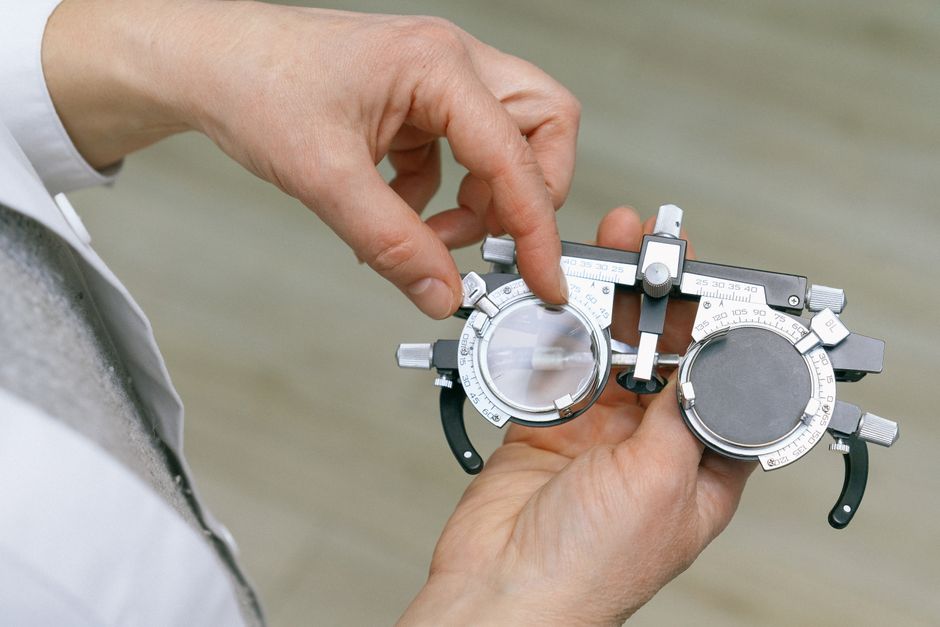
Opticians measure fitting height with the frame on your face, often using a marker or a digital measuring device, while you look straight ahead at a target. Some use a pupilometer or a digital centration system. The number that comes out is specific to that frame on that face.



What Happens If Your Progressive Measurements Are Off?
Measurements that are off by a small amount can cause noticeable problems. The most common complaints are blurred vision in one zone, eyestrain, headaches, and a feeling that you have to move your head to find the right part of the lens.
PD errors shift the optical center of the lens sideways. If the lens center does not line up with your pupil, you look through the wrong part of the lens, and the image can feel distorted or doubled at the edges.
Fitting height errors are usually worse. If the corridor is placed too high, you may not be able to read comfortably. If it is too low, distance vision can feel wrong. In either case, the lens may be technically correct but functionally unusable for you.
Some people adapt to small errors over a week or two. Others never do. There is no reliable way to predict who will adapt and who will not, which is why opticians measure carefully in the first place.
Can You Order Progressive Lenses Online Without a Fitting?
You can order progressive lenses online, and many people do. Whether the result works depends on how much of the fitting process the seller replaces with a form and a photo.
Some online sellers ask only for PD and your prescription. They then use a default fitting height based on average facial proportions. That default works for some people and fails for others. There is no way to know in advance which group you are in.
Other sellers ask you to take a photo with the frame on your face and a reference object, then they calculate fitting height from the image. This can work if the photo is taken correctly, but the accuracy depends on the quality of the photo and the seller’s method. It is not the same as an in-person measurement.
A few sellers ship the frame first, then have you send a photo or a video with the frame on, then make the lenses. This is closer to an in-person fitting, but still relies on your camera angle and lighting.
If you have a strong prescription, a high astigmatism correction, or a large difference between your two eyes, the margin for error shrinks. In those cases, a self-measured or remotely measured progressive lens is more likely to disappoint.
What Should You Do Before Ordering Progressive Lenses at Home?
Before you order, get your prescription from an eye doctor and ask for your PD to be written on it. Many providers will include it if you ask. That gives you one accurate number to start with.
If you are ordering online, read the seller’s measurement instructions carefully. Some require a photo, some require a video, some ask only for PD. Know which one you are getting.
Consider whether your prescription is simple or complex. A mild single-vision prescription with a small reading add is more forgiving of measurement error than a strong prescription with a large add.
If you have worn progressives before and they worked well, you have a reference point. If this is your first pair, the stakes are higher. A first progressive lens that is measured wrong can make you think progressives do not work for you, when the real problem was the fit.
An in-person fitting with an optician remains the most reliable way to get progressive lenses that work. That is not a knock on online sellers. It is a statement about what the measurements require.
Frequently Asked Questions
Can I measure my pupillary distance at home?
Yes, you can measure your pupillary distance at home with a millimeter ruler and a mirror. Repeat the measurement a few times and use a consistent number, but expect some variation of one to two millimeters.
Can I measure my fitting height for progressive lenses myself?
No, fitting height cannot be measured accurately on yourself because it requires the frame on your face and a steady view of your pupil from the side. An optician measures this in person with the frame adjusted to sit as it will in daily wear.
What happens if my progressive lens measurements are wrong?
Wrong measurements can cause blurred vision, eyestrain, headaches, or a feeling that you have to hunt for the right part of the lens. Small errors sometimes resolve with adaptation, but larger errors usually do not.
Is it safe to order progressive lenses online?
It is possible, but the result depends on how the seller handles fitting height and other measurements. Sellers that rely only on pupillary distance use a default fitting height that works for some people and not others.
