
Astigmatism is measured with a refraction test, a corneal topography scan, or a keratometry reading. The refraction tells your eye doctor what lens power corrects your vision, while topography and keratometry map the actual shape of your cornea. Together, these tests show not just whether you have astigmatism, but how much and in which direction.
Most people meet astigmatism during a routine eye exam without realizing a specific test was even happening. The doctor flips lenses, asks “which is better, one or two,” and writes a number down. That number is the measurement. Understanding what it means takes about five minutes and can change how you read your own prescription for years.
What Is Astigmatism and Why Does It Need Measuring?
Astigmatism is a refractive error caused by an irregular curve in the cornea or lens. A perfectly round cornea bends light evenly, focusing it to a single point on the retina. A cornea shaped more like a football than a basketball bends light unevenly, creating two focal points instead of one. The result is blurred or distorted vision at all distances, not just up close or far away.
This is different from nearsightedness or farsightedness, which involve where light focuses, not how evenly. Someone can have astigmatism alone or alongside either of those conditions. That is why the measurement matters: it determines the cylinder and axis values in a glasses or contact lens prescription, which are separate from the sphere value that corrects nearsightedness or farsightedness.
Astigmatism is common. Many people have a small amount that causes no noticeable symptoms and needs no correction. Larger amounts cause blur, eye strain, headaches, or difficulty seeing at night. The threshold for treating it depends on symptoms and daily demands, not a fixed number.
How To Measure Astigmatism Tests And What They Mean?
The main tests fall into two groups: subjective refraction, which relies on your responses, and objective measurement, which uses instruments to map the eye without your input. Most comprehensive eye exams use both.
Subjective Refraction
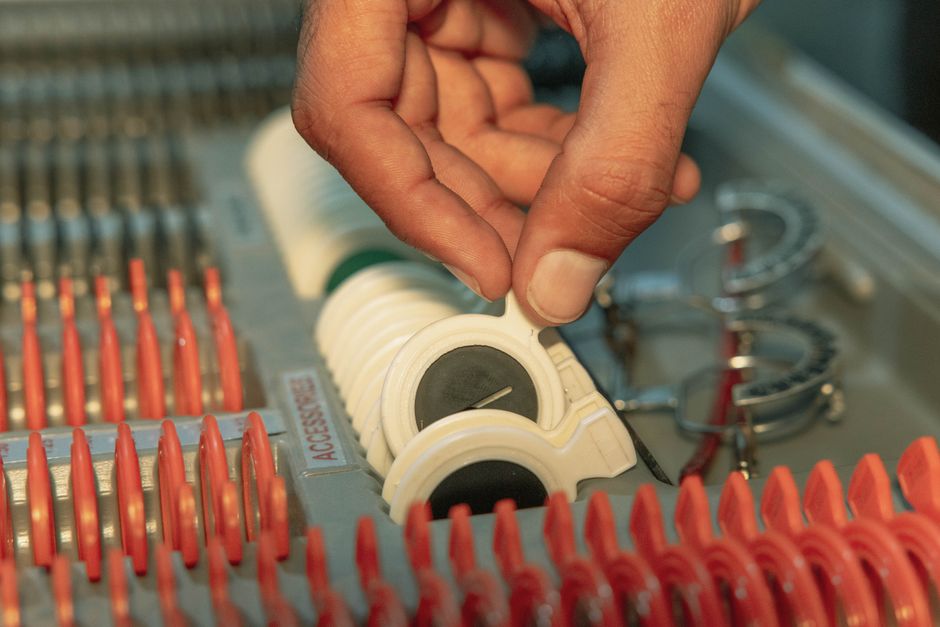
This is the “which is better, one or two” test. You sit behind a phoropter, a device holding many lenses, and the doctor changes lenses while you report which view is clearer. The goal is to find the lens combination that gives you the sharpest vision. The result is written as sphere, cylinder, and axis.
Subjective refraction depends on your answers, so it is only as accurate as your responses. It works well for most people but can be less reliable for young children, people with communication difficulties, or anyone who struggles to judge small differences in clarity.
Autorefraction
An autorefractor is a machine that shines light into the eye and measures how it reflects back. It produces a starting estimate of your prescription in seconds. Eye doctors use it as a baseline, then refine the result with subjective refraction. Autorefraction alone is not usually enough to write a final prescription, but it speeds up the process and helps with patients who cannot respond verbally.
Keratometry
Keratometry measures the curvature of the central cornea. It reports two values: the steepest and flattest curves, plus the axis between them. The difference between those two curves is the amount of corneal astigmatism. Keratometry is often used before contact lens fitting and cataract surgery, where the shape of the cornea directly affects the outcome.
Corneal Topography
Topography creates a detailed color map of the entire corneal surface, not just the center. It shows where the steep and flat areas are, whether the astigmatism is regular or irregular, and whether the pattern suggests a condition like keratoconus. This test is standard before LASIK and other refractive surgeries because it reveals problems that a simple refraction would miss.
What Do the Numbers on Your Prescription Mean?
An eyeglass prescription for astigmatism has three parts: sphere, cylinder, and axis. Each tells the optician something different.
- Sphere corrects nearsightedness or farsightedness. It is measured in diopters. A minus sign means nearsighted, a plus sign means farsighted.
- Cylinder corrects the astigmatism itself. It is also in diopters and describes the difference in focusing power between the two curves of the cornea.
- Axis is a number from 0 to 180 degrees. It tells the lens maker where to place the cylinder correction. It is a direction, not a strength.
A prescription might read “-2.00 -1.25 x 180.” The sphere is -2.00, the cylinder is -1.25, and the axis is 180. A higher cylinder number means more astigmatism. A cylinder of 0.50 or less is often left uncorrected if it causes no symptoms. There is no universal cutoff for when correction is needed. It depends on how much the astigmatism affects your daily vision.
One detail people often miss: the axis number is not a measure of severity. An axis of 180 is not worse than an axis of 90. It simply describes the orientation of the correction. Two people can have identical cylinder values and very different axis numbers, and neither is inherently better or worse.



How Is Astigmatism Measured in Children?
Measuring astigmatism in children is harder because they cannot always describe what they see. Eye doctors use objective tests first, especially retinoscopy and autorefraction. Retinoscopy involves shining a light into the eye and watching how it reflects off the retina. The doctor can estimate the refractive error without any response from the child.
Photoscreening is another option for young children. A special camera takes a picture of the eyes and software estimates whether a refractive error may be present. It is a screening tool, not a diagnosis. Any abnormal result needs a full exam by an eye care professional.
The American Academy of Ophthalmology and the American Optometric Association recommend vision screening starting in early childhood, with full eye exams if screening suggests a problem. The exact schedule can vary, so ask your child’s doctor what they follow. Early detection matters because uncorrected astigmatism in young children can contribute to amblyopia, sometimes called lazy eye, if the brain does not receive clear images during visual development.
What Is the Difference Between Regular and Irregular Astigmatism?
Regular astigmatism means the two corneal curves are perpendicular to each other, like the two main curves of a football. This type is correctable with standard glasses and soft contact lenses. Most astigmatism is regular.
Irregular astigmatism means the curves are not perpendicular, or the surface is uneven in a way that does not follow a simple pattern. This type is often linked to conditions such as keratoconus, corneal scarring, or prior eye surgery. Standard glasses usually cannot fully correct it. Rigid gas permeable contact lenses or scleral lenses are often used instead because they create a new, smooth optical surface over the irregular cornea.
Topography is the test that distinguishes the two. A refraction alone cannot reliably tell regular from irregular astigmatism, which is one reason topography is used before refractive surgery. Operating on an eye with undetected irregular astigmatism can lead to poor outcomes.
When Should You Get Your Astigmatism Measured?
Adults with no vision problems are generally advised to have a comprehensive eye exam at least every two years, and more often after age 60 or if they have risk factors like diabetes. People who wear glasses or contacts usually have their refraction checked at every visit. There is no single test schedule that fits everyone, so follow the guidance from your eye doctor.
See an eye doctor sooner if you notice new blurring, double vision, frequent headaches after reading, or difficulty seeing at night. These symptoms have many possible causes, and astigmatism is only one of them. A proper exam sorts out which is which.
Astigmatism itself tends to be stable in adults, but it can change after eye surgery, injury, or with conditions like keratoconus. A sudden shift in your vision is worth checking rather than waiting for your next scheduled visit.
Frequently Asked Questions
Can I measure my astigmatism at home?
No reliable home test exists for measuring astigmatism. Online vision tests and phone apps can screen for possible problems but cannot replace a refraction or topography performed by an eye care professional.
What cylinder number means I have astigmatism?
Any cylinder value other than zero indicates some astigmatism. Small amounts under 0.50 diopters are common and often need no correction, but the decision depends on symptoms rather than the number alone.
Does astigmatism get worse over time?
In most adults, astigmatism stays fairly stable. It can change after eye surgery, injury, or with conditions like keratoconus, so a sudden change in vision should be evaluated by an eye doctor.
Is corneal topography painful?
No, corneal topography is painless and non-invasive. You simply rest your chin on the device and look at a light while the machine captures images of your cornea, which takes only a few seconds per eye.
