
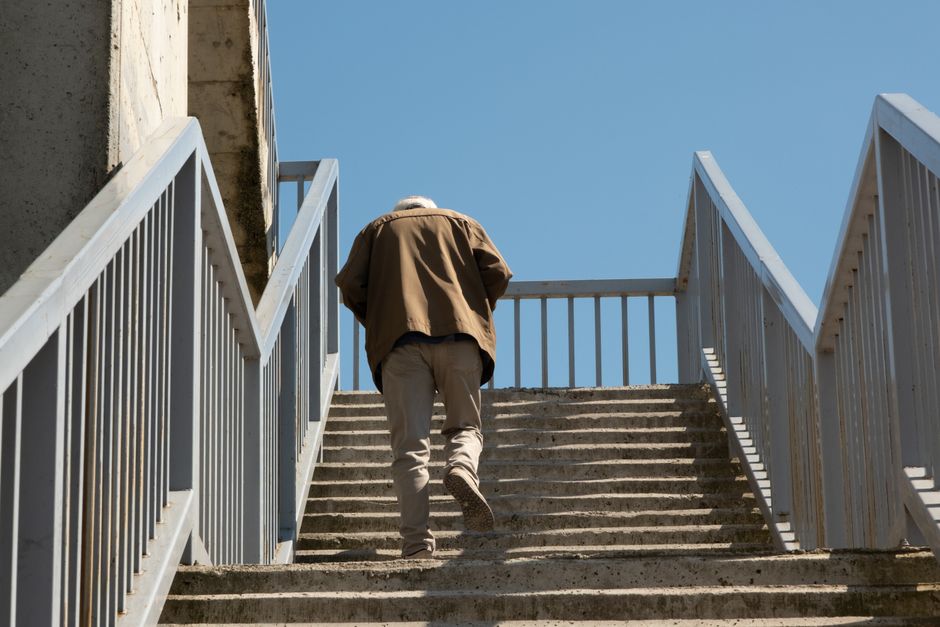
Stairs are one of the most dangerous spots in any home, and the risk grows with age. The most effective way to make stairs safer for an elderly person is to combine three things: steady handrails on both sides, good lighting with switches at the top and bottom, and a clear, uncluttered walking path with high-contrast markings on the edges of each step. Add non-slip surfaces and remove loose rugs or carpet, and you remove most of the hazards that cause falls.
Falls are the leading cause of injury in older adults, and stairs are a common place for them to happen. The good news is that most stair hazards are fixable, often for modest cost. What follows is a practical, evidence-informed guide to reducing stair risk at home.
Why Are Stairs So Risky For Older Adults?
Stair falls happen because several age-related changes line up at once. Muscle strength declines, balance reactions slow, and vision changes make it harder to judge step height and depth. A stairway demands all of these at the same time.
Going down is riskier than going up. Descending requires controlled lowering of body weight against gravity, and it depends heavily on the quadriceps and on steady balance. Many older adults find down-stairs harder than up, even when they feel strong.
The environment compounds the problem. Poor lighting, missing handrails, worn carpet, and clutter turn a manageable task into a dangerous one. A stairway that was fine at 55 can become genuinely hazardous at 75 without anything about the person changing. That is why the fix is often about the stairs themselves, not just the person using them.
What Handrail Setup Makes The Biggest Difference?
Handrails are the single most important safety feature on a staircase. A solid rail gives the body something to grip and lean on when balance falters, and it reduces the load on the legs.
Install rails on both sides of the stairs. One rail helps, but two give a person a rail on whichever side they need and allow a two-handed grip if balance fails. Research on stair safety consistently identifies continuous handrails on both sides as a key protective feature.
A few details matter for the rail itself:
- It should run the full length of the stairs without a break.
- The rail should be easy to grip fully — a rounded shape roughly an inch and a quarter to two inches across works well for most hands.
- It should be firmly anchored into wall studs or a solid structure so it does not wobble.
- Mount it at a comfortable height, typically around 34 to 38 inches above the stair treads, though the right height depends on the person using it.
- Extend the rail slightly beyond the top and bottom steps so there is something to hold as you start and finish.
If a rail feels loose or moves when pulled, that is a hazard, not a minor annoyance. Fix it or replace it. A rail that gives way is worse than no rail, because it invites a person to put their full weight on something that will not hold.
How Does Lighting Reduce Stair Falls?
Many stair falls happen because people cannot see the edge of a step clearly. Good lighting makes the edges of each step visible, which helps the brain judge where to place the foot.
Light the whole staircase, not just the top and bottom. Shadows on stairs hide step edges and create false edges. A light that is too dim, or placed so it casts glare, can be as bad as no light at all.
Put switches at both the top and bottom of the stairs, so no one has to walk into a dark stairway to find a switch. Motion-sensor lights can help too, especially for nighttime trips.
Nighttime is a particular risk. Older adults often get up to use the bathroom in the dark, and a dimly lit stairway on the way is dangerous. A small night light along the route, or a light that comes on automatically, reduces that risk.
One detail worth noting: contrast matters as much as brightness. Marking the front edge of each step with a contrasting strip — light on dark treads or dark on light treads — makes the step edge easier to see. This is a simple, low-cost change that directly targets the visual problem behind many stair falls.
What Surface Changes Make Stairs Safer?
The surface of the stairs themselves is where many falls begin. Slippery treads, loose carpet, and worn edges all increase risk.
Non-slip surfaces are the priority. Bare wood and tile can be slippery, especially in socks or smooth-soled shoes. Non-slip strips or treads on each step improve grip. Make sure whatever you add is firmly fixed and does not itself become a trip hazard at the step edge.
Carpet can help or hurt. Well-installed, low-pile carpet with a firm backing adds grip. But loose, worn, or curling carpet is a serious hazard, because a foot can catch on a fold or a person can slide on a loose edge. If carpet is loose, repair or replace it.
Avoid polishing or waxing stair treads. A shiny, slick finish on stairs is an invitation to a fall. Keep the surface clean but not glossy.
Check the step edges for wear. Over time, the front edge of a wooden or carpeted step can round off or fray, reducing the surface a foot can land on. Repairing worn edges restores a safer footing.
How Do You Keep The Stairway Clear?
Clutter on stairs is a leading and preventable cause of falls. Anything left on a step — shoes, boxes, laundry, books — turns a safe stair into a trip hazard.
Make the stairs a no-storage zone. Nothing should sit on the steps or the landing. This sounds obvious, but in busy homes it is one of the first things to slip.
Keep the path at the top and bottom of the stairs clear too. A chair, a plant, or a pile of items near the bottom step can catch a person as they finish descending. Clear space at both ends gives room to start and stop safely.
If the household includes others, make the rule apply to everyone. A stairway is only as safe as its most cluttered day.
What About Footwear And Habits?
The stairs are only part of the picture. How a person uses them matters too, and small habits reduce risk.
Wear supportive, non-slip shoes or slippers with a firm sole and a closed back on the stairs. Loose slippers, socks, and backless footwear increase the chance of a slip or of the foot sliding off a step.
Use the handrail every time, even for a single step. Many falls happen on short trips when someone does not bother to hold on. Making handrail use automatic removes the decision.
Take the stairs slowly and deliberately, one step at a time, and use the light. Rushing, carrying large loads that block the view of the steps, or navigating in the dark all raise risk. If carrying something heavy, it may be safer to make two trips than to descend with a blocked view and one hand.
For anyone with significant balance problems or a history of falls, it is worth talking with a doctor or physical therapist. Some people benefit from strength and balance exercises that improve stair confidence. Others may need to consider whether a one-level living arrangement is safer. These are individual decisions best made with clinical input, not from a general rule.
When Should You Consider A Stairlift Or Ramp?
For some people, physical changes to the stairs are not enough. If walking stairs has become genuinely unsafe — because of severe balance problems, weakness, or a recent fall — a stairlift or moving key living spaces to one level may be the safer choice.
This is a decision to make with a doctor or physical therapist, who can assess strength, balance, and fall risk. A stairlift is a significant expense and is not right for everyone, but for some households it prevents a serious injury. The goal is not to keep using stairs at any cost, but to keep the person safe.
There is no single answer that fits every home. The right combination depends on the person’s abilities and the specific stairs. But the core principles — solid rails, good light, clear steps, and non-slip surfaces — apply almost everywhere, and they are where most of the risk reduction comes from.
Frequently Asked Questions
What is the most important change to make stairs safer for an elderly person?
A firmly anchored handrail on both sides of the stairs is the single most important change. A continuous rail gives steady support when balance falters and reduces the load on the legs.
Are stairs safer going up or down?
Going down is generally riskier than going up, because descending requires controlled lowering of body weight and steady balance. Many older adults find down-stairs harder even when they feel strong.
Should I put carpet or non-slip strips on the stairs?
Either can work if it is firmly installed and in good condition. Loose or worn carpet is a serious hazard, so repair or replace it, and add non-slip strips to bare wood or tile treads.
When should an elderly person stop using stairs?
There is no fixed rule, and the decision depends on balance, strength, and fall history. A doctor or physical therapist can assess whether stairs have become unsafe and whether a stairlift or one-level living is the safer choice.
