
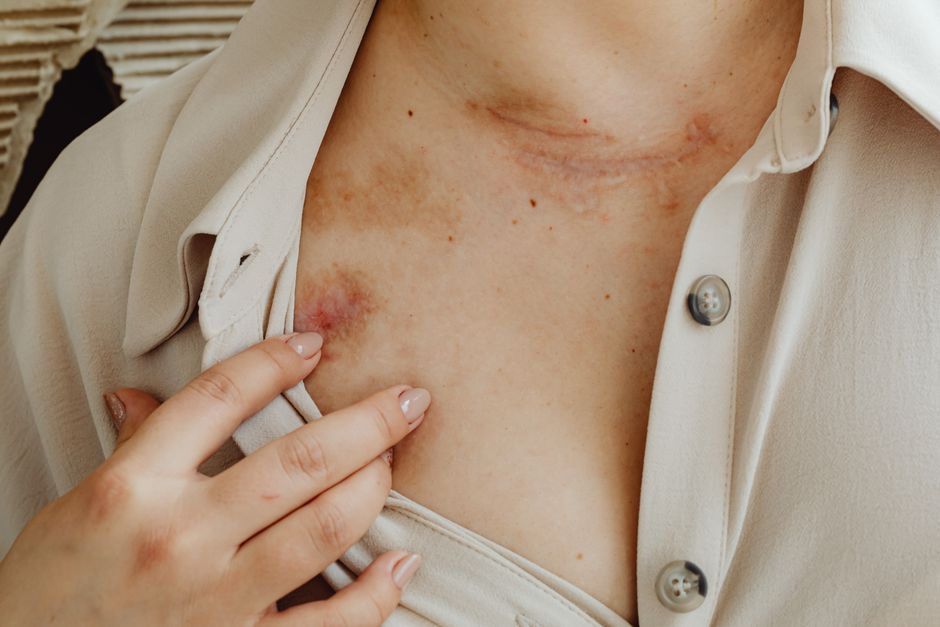
Scars fade on their own, but how much they fade varies widely from person to person. No treatment erases a scar completely. What silicone gels, steroid injections, microneedling, and lasers can realistically do is make a scar flatter, softer, lighter, and less noticeable — and the earlier you treat a scar that is still forming, the more difference treatment tends to make. The right option depends on the scar type, its age, and where it sits on your body.
Why Do Scars Look the Way They Do?
A scar is not repaired skin. It is a patch of collagen laid down fast to close a wound. Normal skin has a woven, basket-like collagen pattern. Scar tissue has collagen aligned in one direction, which is why it looks and feels different from the skin around it.
Three things shape how a scar turns out: how deep and wide the wound was, how much tension pulls on it during healing, and your own genetics. Wounds that cross a joint or sit on the chest or shoulder are under constant pull, and tension is one of the strongest drivers of a raised scar.
There are a few main scar types, and they respond differently to treatment:
- Flat scars — the most common. They may be pink or darker than surrounding skin at first and often fade over months to years.
- Raised scars (hypertrophic) — stay within the original wound boundary and often improve with time and treatment.
- Keloids — grow beyond the wound edges and can keep enlarging. These are harder to treat and tend to recur.
- Atrophic scars — sunken, from acne or chickenpox, caused by lost tissue rather than excess collagen.
- Contracture scars — from burns, where tightening skin can restrict movement.
Scars also change color. Many start red or purple because of extra blood vessels, then turn brown as pigment settles in, then gradually lighten. This timeline matters because a treatment that works on a red scar may do little for a brown one.
How To Make Scars Less Noticeable From Gels To Lasers?
Treatments fall into three broad groups: topical products, office procedures, and surgical revision. They work on different parts of the problem, so the best approach often combines more than one.
Silicone gels and sheets
Silicone is the most studied topical option for scars, and it has the strongest evidence base of any over-the-counter product. It works by keeping the scar hydrated and by applying mild pressure and occlusion, which is thought to reduce collagen overproduction. Silicone gel and silicone sheets appear to have similar effectiveness.
Silicone is used most often on new, raised, or red scars and after surgery. It is not a strong option for sunken acne scars. Evidence for silicone is best for hypertrophic and keloid scars; for flat scars that would fade anyway, the benefit is harder to separate from natural healing.
Other topical products
Onion extract gel, vitamin E, and various creams are widely sold for scars. The evidence for these is weak or mixed. Vitamin E in particular has been studied and has not shown a clear benefit, and it can cause skin irritation in some people. No topical product has been shown to remove a scar or flatten a keloid on its own.
Steroid injections
Intralesional corticosteroid injections are a standard treatment for raised scars and keloids. They reduce collagen production and inflammation, and can flatten a scar over a series of sessions. They are usually given by a dermatologist. Common side effects include skin thinning, lightening, and small blood vessels becoming visible. Results vary, and keloids often need repeated treatment.
Microneedling
Microneedling uses fine needles to create controlled micro-injuries, which triggers collagen remodeling. It is used mainly for acne scars and some surgical scars. Multiple sessions are typically needed. Evidence supports benefit for certain atrophic acne scars, though results are modest and vary by scar type. It is generally not used on active keloids, since new injury can worsen them.
Lasers and light devices
Lasers target specific problems. Vascular lasers target the red color of a new scar by acting on blood vessels. Fractional lasers resurface the skin and stimulate collagen, which can improve texture and flatten raised scars. Pigment lasers target brown discoloration.
Lasers can meaningfully improve scar appearance, but they carry real risks. In people with darker skin tones, some lasers can cause burns, blistering, or permanent lightening or darkening. Choosing a provider experienced with your skin type matters more than the specific device.
Surgical revision
Sometimes the best option is to cut out the old scar and close the wound with better technique and less tension. This does not remove the scar — it replaces a worse scar with a better one. It is often combined with other treatments afterward to prevent the new scar from becoming raised.
Does Treatment Timing Really Matter?
Yes, and it is one of the most practical things to understand. A scar goes through a remodeling phase that can last a year or more. During the early months, the scar is actively forming and is more responsive to treatment. Once a scar is mature and pale, options are more limited.
This is why surgeons often start scar care soon after a wound closes. Silicone, sun protection, and sometimes pressure or steroid treatment may begin early, depending on the scar. Waiting years and then expecting a mature scar to respond like a fresh one is a common source of disappointment.
That said, mature scars are not untreatable. Lasers, microneedling, and steroid injections can still improve them. The realistic ceiling on improvement is just lower.





Why Sun Protection Is Not Optional
Ultraviolet light darkens scars and can make them more visible for longer. Scars have less melanin protection than normal skin in some cases and more pigment activity in others, and sun exposure can push a fading scar back toward brown.
Daily sun protection over a healing scar is one of the simplest, best-supported steps you can take. It is not glamorous, but it is one of the few things almost every dermatologist agrees on.
What Actually Works, and What Does Not
Here is a plain summary of where the evidence stands. This is not a ranking of how well each option works for every person — it is a rough guide to how much clinical support each has.
| Approach | Best suited for | Strength of evidence |
|---|---|---|
| Silicone gel or sheets | New, raised, or keloid scars | Strongest of the topical options |
| Steroid injections | Raised scars, keloids | Well established for flattening |
| Microneedling | Atrophic acne scars | Some evidence, modest results |
| Vascular laser | Red, new scars | Some evidence for color |
| Fractional laser | Texture and raised scars | Some evidence, risk in darker skin |
| Vitamin E, onion extract | Widely marketed | Weak or mixed |
The single most important factor in any of these is not the product. It is matching the treatment to the scar type and getting it started at the right time.
Can You Prevent a Scar From Forming?
You cannot prevent a scar from forming after a wound that reaches the deeper layer of skin. Once the dermis is injured, a scar is the result. What you can influence is how noticeable it becomes.
Wound care matters. Keeping a healing wound clean, moist, and protected supports better healing. Avoiding unnecessary tension on the wound, and protecting it from the sun, both help. For people prone to keloids, a doctor may recommend starting treatment early rather than waiting.
Some things are largely out of your control, including your genetics and skin tone. People with darker skin are at higher risk of both keloids and of pigment changes around scars.
When to See a Doctor
See a dermatologist if a scar keeps growing beyond the original wound, becomes painful or itchy, restricts movement, or changes appearance after being stable for a long time. A scar that bleeds or ulcerates without a clear cause should be evaluated.
For most people, a dermatologist or plastic surgeon is the right starting point for keloids, contracture scars, and any scar that is causing distress. Many treatments are more effective when planned together than tried one at a time.
Frequently Asked Questions
Can scars go away completely?
No. Once the deeper layer of skin is injured, scar tissue forms and cannot be fully removed. Treatment can make a scar much less noticeable, but not invisible.
What is the best treatment for a raised scar?
Silicone and steroid injections have the strongest evidence for raised scars and keloids. The best choice depends on the scar’s size, location, and whether it is a keloid, so a dermatologist should assess it.
Does vitamin E cream really help scars?
The evidence does not show a clear benefit for vitamin E on scars. It can also irritate the skin in some people, so it is not a reliable option.
How long does it take to see results from scar treatment?
It varies by treatment and scar type, and many options need weeks to months of consistent use or several sessions. Early treatment on a still-forming scar tends to show results sooner than treatment on a mature scar.
