
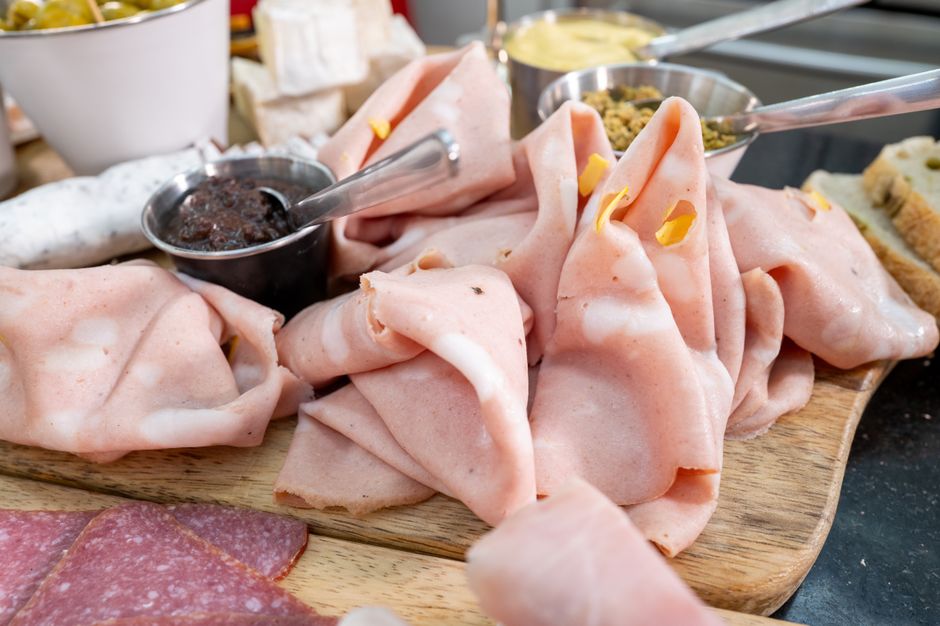
Mortadella is a large Italian cooked sausage made from finely ground pork, seasoned with spices, studded with cubes of fat, and gently cooked until firm but sliceable. To make it at home, you emulsify lean pork with ice-cold water and salt into a smooth paste, fold in fat cubes and optional pistachios, stuff the mixture into a casing, and poach it at a low temperature until it reaches a safe internal temperature. The process is closer to making a fine sausage emulsion than to grinding meat for burgers.
What Is Mortadella and How Is It Different From Bologna?
Mortadella is a cooked, emulsified pork sausage with roots in the Italian city of Bologna. It is defined by a very fine, pale pink paste and visible pieces of white fat scattered throughout, often along with whole black peppercorns or pistachios.
Bologna, as sold in the United States, is a close relative but a different product. American bologna is typically a smoother, more uniform sausage with a finer texture and often a smokier flavor. Mortadella is coarser in its fat distribution, larger in diameter, and seasoned with a distinct spice blend that often includes black pepper, nutmeg, and coriander.
Traditional Italian mortadella has a protected status in Europe, meaning only product made in certain regions under specific rules can carry the name. For home cooks, that distinction matters less than understanding the technique: a stable meat emulsion, large fat cubes, and gentle cooking.
What Ingredients Do You Need for Mortadella?
The core ingredients are simple. Lean pork provides the protein that forms the emulsion, pork fat provides the characteristic cubes and richness, salt helps extract and bind the protein, and cold water keeps the mixture from overheating during processing.
- Lean pork — shoulder or similar cut with visible fat trimmed away works well. Aim for cold meat straight from the refrigerator.
- Pork fat — back fat or fatback cut into small cubes. This creates the signature white specks.
- Salt — essential for both flavor and protein extraction. Do not reduce it casually; salt is functional here, not just seasoning.
- Ice-cold water — added gradually to keep the emulsion cool and smooth.
- Spices — commonly black pepper, nutmeg, coriander, and sometimes garlic or mace.
- Curing salt — a blend of salt and sodium nitrite. This is optional but widely used in traditional recipes for color and safety.
- Pistachios — optional, but a classic addition in many regional versions.
The curing salt question deserves an honest note. Sodium nitrite is what gives cured meats their pink color and adds protection against certain bacteria, including the one that causes botulism. The evidence on nitrites and health is genuinely mixed, and the topic is debated among researchers. If you choose to skip curing salt, understand that you are changing both the color and the safety profile of the product. Follow a tested recipe rather than improvising.
How To Make Mortadella: Step by Step
Making mortadella at home is a multi-step process that rewards patience and cold temperatures. The single most important rule is to keep everything cold. Warm meat will not form a stable emulsion.
Step 1: Chill Everything
Place your grinder parts, mixing bowl, and meat in the freezer for a short time before starting. The meat should be cold but not frozen solid. Cold keeps the fat from breaking down and separating.
Step 2: Grind the Lean Meat
Grind the lean pork through a fine die. Some recipes call for grinding twice for a smoother texture. Keep the ground meat in the refrigerator between steps.
Step 3: Build the Emulsion
Combine the ground pork with salt in a chilled bowl. Mix vigorously, then gradually add ice-cold water while continuing to mix. The mixture should become sticky, pale, and smooth. This step is where the sausage either succeeds or fails. A properly formed emulsion holds together when cooked; a broken one turns grainy and leaks fat.
Step 4: Fold In the Fat and Flavorings
Gently fold in the cubed fat, spices, and pistachios if using. Stir just enough to distribute them evenly. Overmixing at this stage can smear the fat cubes and lose the signature look.
Step 5: Stuff the Casing
Pack the mixture into a large casing — natural hog casing or a synthetic cooking casing. Press out air pockets as you fill. Tie off the ends firmly.
Step 6: Poach Gently
Cook the sausage in water held at a low simmer, not a rolling boil. High heat will cause the emulsion to break and the casing to split. The sausage is done when it reaches a safe internal temperature. For pork, the USDA recommends a minimum internal temperature of 145°F (63°C) followed by a rest period. Many sausage makers cook mortadella to a higher internal temperature for a firmer slice, but 145°F is the established safety floor.
Step 7: Cool and Slice
Chill the cooked mortadella thoroughly before slicing. Cold firms the fat and makes clean slices possible. Slice thin.
Why Does Temperature Control Matter So Much?
The emulsion is the whole game in mortadella. An emulsion is a stable mixture of two liquids that normally separate, in this case fat and water, held together by protein. Salt draws out a protein called myosin from the pork, and that protein coats the fat particles and keeps them suspended.
Heat breaks this arrangement. If the mixture gets too warm during grinding or mixing, the fat melts and the protein network cannot hold it. The result is a greasy, crumbly sausage instead of a smooth one. This is why every serious sausage recipe insists on cold meat, cold equipment, and cold water.
The same principle explains why gentle poaching matters. A hard boil cooks the outside faster than the inside and can cause the casing to burst. Slow, even heat lets the protein set gradually and keeps the fat locked in place.
What Are the Safety Risks of Making Mortadella at Home?
Home sausage making carries real food safety risks, and it is worth being direct about them. The main concerns are bacterial growth during preparation and the risk of botulism in the finished product if it is stored improperly.
Botulism is rare but serious. The bacteria that cause it thrive in low-oxygen, low-acid environments — exactly the conditions inside a sealed sausage casing. Sodium nitrite is used in cured meats partly to inhibit this bacteria. If you make mortadella without curing salt, keep the product refrigerated and eat it within a short window rather than storing it long-term.
Cleanliness matters throughout. Wash hands, sanitize equipment, and keep raw and cooked items separate. Cook pork to at least 145°F as measured with a food thermometer. Cool cooked mortadella quickly and refrigerate it promptly.
Pregnant women, young children, older adults, and people with weakened immune systems should be cautious with any home-cured or home-fermented meat product. The established guidance for these groups is to avoid certain raw and cured meats unless they have been cooked to a safe temperature. When in doubt, consult a healthcare provider.
Can You Make Mortadella Without Special Equipment?
You can make a simplified version without a meat grinder or stuffer, though the texture will differ from traditional mortadella. A food processor can create a fine paste from cubed cold pork, and you can shape the mixture into a log wrapped tightly in plastic or a cooking casing.
The trade-off is real. Without a proper grinder, achieving the classic smooth emulsion is harder, and without a stuffer, filling a large casing evenly is difficult. The flavor can still be good, but the texture will be closer to a coarse pâté or a firm meatloaf than to sliced mortadella.
If you plan to make sausage regularly, a grinder and a stuffer are worth the investment. For a one-time experiment, the food processor approach is a reasonable compromise.
How Should You Store and Serve Homemade Mortadella?
Store homemade mortadella in the refrigerator, wrapped tightly or in a sealed container. Because it is a cooked product, it does not keep as long as dry-cured meats. Eat it within a few days for best quality and safety.
For longer storage, freezing works but changes the texture. The fat and water can separate slightly on thawing, making the slices less smooth. If you freeze it, slice first and thaw only what you plan to use.
Serve mortadella thinly sliced on its own, in sandwiches, or as part of an antipasto plate. It pairs well with crusty bread, sharp cheese, and something acidic like pickled vegetables to cut the richness. Traditional Italian serving often keeps it simple — good bread, a little olive oil, and the mortadella itself.
Frequently Asked Questions
How long does homemade mortadella last in the fridge?
Homemade mortadella keeps for about three to five days in a sealed container in the refrigerator. Because it is a cooked product without the preservation of dry curing, it does not keep as long as commercial versions.
Do you have to use curing salt to make mortadella?
No, curing salt is optional, but skipping it changes both the color and the safety profile. Sodium nitrite helps protect against botulism bacteria, so if you leave it out, refrigerate promptly and eat the product within a short window.
What internal temperature should mortadella reach when cooking?
Cook mortadella until it reaches at least 145°F (63°C) internally, which is the USDA minimum for pork. Many recipes cook it higher for a firmer slice, but 145°F is the established safety floor.
Can you make mortadella without a meat grinder?
Yes, a food processor can create a fine paste from cold cubed pork, though the texture will be less smooth than traditional mortadella. Shaping it into a log in a cooking casing is a workable substitute for a stuffer.
