
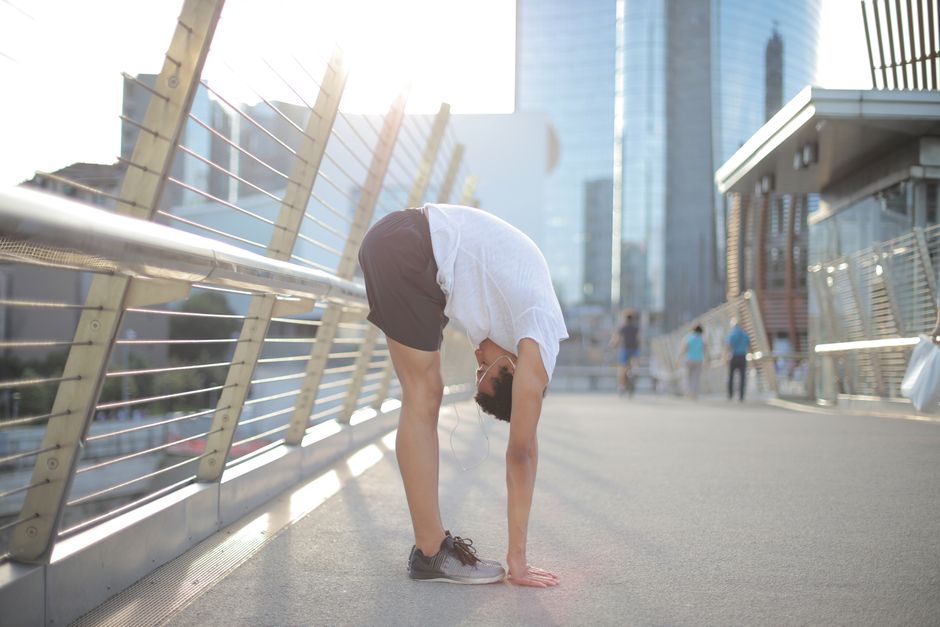
If your hip flexors feel tight, the fix is not just stretching them. It is a combination of lengthening the muscle, strengthening it through its full range, and addressing the daily habits that keep it short in the first place. The hip flexors are a group of muscles at the front of the hip that connect your pelvis, lower spine, and thigh. Because most people spend hours sitting each day, these muscles adapt to a shortened position. Stretching alone can help, but it rarely fixes the problem on its own.
What Are the Hip Flexors and Why Do They Get Tight?
The hip flexors are not one muscle. They are a group that includes the iliacus, psoas major, rectus femoris, and sartorius. The iliopsoas — the iliacus and psoas together — is the strongest hip flexor and the one most people mean when they say their hip flexors are tight.
These muscles lift your knee toward your chest. You use them every time you walk, climb stairs, or stand up from a chair. They also play a role in stabilizing your lower back and pelvis.
Tightness usually develops from position, not from lack of stretching. When you sit for long periods, your hip stays bent at roughly 90 degrees. Over time, the muscle fibers and surrounding connective tissue adapt to that shortened length. This is a mechanical adaptation, not a permanent change to the muscle itself. The tissue is not truly shorter in a structural sense — it has simply become accustomed to a limited range, and your nervous system may guard against moving beyond it.
There is a second factor that gets overlooked. A muscle can feel tight because it is weak or because it is working too hard to compensate for other muscles that are not doing their job. The glutes, for example, extend the hip. If they are underactive, the hip flexors may stay switched on more than they should. In that case, stretching a muscle that is already overworked can make the feeling worse, not better.
How To Make Hip Flexors More Flexible Stretches Fixes
The most effective approach combines three things: stretches that lengthen the muscle, exercises that strengthen it through a full range, and changes to how you sit and move during the day. Stretching is the starting point, not the whole answer.
Static stretching — holding a position for a period of time — is the most studied method for improving flexibility. Research consistently shows that regular static stretching increases range of motion. The key word is regular. A single session gives a temporary gain. Consistent practice over weeks is what produces lasting change.
Here is what the evidence supports:
- Hold stretches long enough to matter. Most research on static stretching uses holds in the range of 15 to 60 seconds per stretch, repeated for several sets. Longer holds within that range tend to produce more lasting gains than very brief ones.
- Stretch often. Frequency matters more than intensity. Daily or near-daily stretching produces better results than one long session per week.
- Stay in a comfortable range. A stretch should feel like tension, not sharp pain. Pushing into pain triggers a protective response that works against you.
- Breathe. Holding your breath increases muscle tension. Slow breathing helps the muscle relax into the stretch.
One clarification worth making: the old advice to stretch before activity to prevent injury is not well supported. Static stretching before a workout does not reliably prevent injury and can briefly reduce power output. Stretching is best used to build flexibility over time, not as a warm-up.
Which Stretches Actually Target the Hip Flexors?
The half-kneeling hip flexor stretch is the most direct. Kneel on one knee with the other foot flat in front of you. Tuck your pelvis under — think about tilting your tailbone toward the floor — and shift your weight forward slightly until you feel a stretch at the front of the kneeling hip. The pelvic tilt is the part most people skip, and it is the part that makes the stretch work. Without it, you are mostly arching your lower back.
The couch stretch is a more intense version. Place the back of your kneeling leg against a wall or couch with your knee near the wall and your shin vertical. Keep your torso upright. This position puts the hip flexor under a deeper stretch. It is not for beginners and is easy to overdo.
The standing lunge stretch works the same muscles with less knee pressure. Step one foot forward and lower your back knee toward the floor, keeping your torso tall and your pelvis tucked.
A supine stretch on the edge of a bed or table lets you control the range. Lie on your back with one leg hanging off the edge. Pull the other knee toward your chest. The hanging leg drops into extension, stretching the hip flexor. This one is gentle and easy to adjust.
For the rectus femoris specifically — which crosses both the hip and the knee — you need to bend the knee during the stretch. A straight-knee hip stretch misses part of this muscle. This is a detail that separates a stretch that works from one that just feels like it should.





Why Stretching Alone Often Fails
If you stretch every day for a month and your hips still feel tight, the problem is probably not the stretch. It is likely one of a few things.
The muscle may be weak, not short. A weak muscle can feel tight because it is constantly working. Strengthening it through a full range — not just stretching it — often resolves the sensation. Exercises like split squats, step-ups, and hip flexion against resistance train the muscle to work through a longer range.
The glutes may be underactive. If your hip extensors are not pulling their weight, your hip flexors compensate. Glute bridges, hip thrusts, and deadlift variations address this. When the back of the hip does more, the front does less.
Your daily posture may be undoing your work. Stretching for ten minutes and then sitting for eight hours is an uphill battle. Standing up regularly, adjusting your chair height, and taking movement breaks throughout the day all help. The stretch is not the whole picture.
Your nervous system may be limiting the range. Flexibility has a neural component. Your brain decides how far it will let a joint move based on what it considers safe. Progressive, patient stretching teaches the nervous system that a longer range is safe. This takes time and consistency, not force.
How Long Before You See Results?
You can feel a temporary increase in range after a single stretching session. That effect usually fades within an hour or so.
Lasting change takes weeks of consistent practice. Most people notice meaningful improvement somewhere in the range of several weeks to a couple of months of regular stretching, though this varies widely between individuals. There is no single timeline that applies to everyone, and anyone who promises a specific number of days is overstating what the evidence shows.
Progress also depends on how much you sit, how often you move, and whether you are also strengthening the muscles involved. Stretching plus strengthening plus daily movement changes things faster than stretching alone.
When Hip Tightness Is Not Just Tightness
Sometimes the feeling of tight hip flexors is not a flexibility issue at all. Pain at the front of the hip, a clicking or catching sensation, or pain that radiates into the groin or thigh can point to other causes. These include hip impingement, labral tears, hip osteoarthritis, or referred pain from the lower back.
Stretching can make some of these conditions worse. If you have sharp pain, pain that limits your daily activities, or pain that does not improve with gentle movement, see a healthcare provider or physical therapist before continuing to stretch. A proper assessment can tell the difference between a muscle that needs lengthening and a joint that needs a different approach entirely.
This is not a reason to avoid stretching in general. It is a reason to pay attention to what your body is telling you and to get help when the usual approach is not working.
Frequently Asked Questions
How often should I stretch my hip flexors?
Daily or near-daily stretching produces better results than once or twice a week. Frequency matters more than how hard you stretch in any single session.
Can tight hip flexors cause lower back pain?
They can contribute to it. Tight hip flexors can pull the pelvis into an anterior tilt, which increases the curve in the lower back and can add strain. But back pain has many causes, and hip flexors are only one possible factor.
Does stretching alone fix tight hip flexors?
Not usually. Stretching helps, but lasting change typically requires strengthening the hip flexors and glutes and reducing the amount of time you spend sitting in a shortened position.
Should I stretch before or after exercise?
After is generally better for building flexibility, and static stretching before activity does not reliably prevent injury. Save longer holds for after your workout or as a separate session.
