
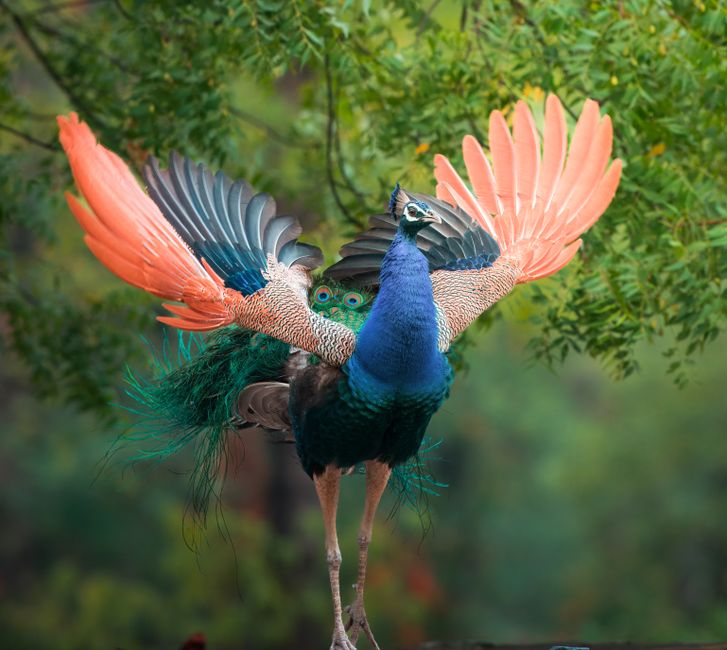
You cannot force a peacock to fan its tail. The display is a courtship and territorial behavior triggered by specific conditions, and the bird decides when to perform it. What you can do is set up the right circumstances: put a male peafowl near a female, give it space, and let breeding season do the rest. Forcing the issue, chasing the bird, or making loud noises usually does the opposite.
This article explains what actually triggers the display, why some birds fan constantly and others rarely do, and what the honest limits are on any “tips” you might read online.
What Actually Makes a Peacock Spread Its Wings?
The train fan is a courtship display, and it runs on hormones and social cues, not on commands.
Peafowl are seasonal breeders. In the northern hemisphere, males typically begin growing their train in late winter and early spring, and the display peaks during the breeding months. The trigger is a combination of lengthening daylight, rising testosterone, and the presence of a female. Remove any one of those and the display becomes much less likely.
What you see during the fan is more than feathers. The male raises and spreads the train, tilts it forward toward the hen, and often shivers the quills. The feathers produce a low-frequency rattling sound. The eye-spots create a shimmering pattern that shifts as the bird moves. Hens appear to respond to the number and arrangement of eye-spots, though research on exactly what they prefer is still debated.
A common misconception is that the peacock spreads the train to look bigger for predators. That is not the main function. The train is a sexual signal. Predator response in peafowl is more often alarm calling and running than fanning.
How To Make A Peacock Spread Its Wings Tips That Actually Work
The reliable way to see a display is to recreate the conditions that trigger it naturally.
- Have a female present. A male peafowl kept alone rarely fans. A hen nearby is the single strongest trigger.
- Wait for breeding season. Late winter through spring is when most displays happen in temperate climates. Off-season displays are possible but uncommon.
- Give the bird space. Peafowl fan most readily when they feel safe and have room to move. Cramped enclosures suppress display behavior.
- Keep the setting calm. Loud noise, dogs, and constant foot traffic reduce displays.
- Feed a balanced diet. A healthy bird with adequate protein and body condition is more likely to display than a malnourished one.
- Be patient. Even under ideal conditions, a male may fan only a few times a day, or not at all on some days.
None of these are guarantees. They raise the odds. They do not control the bird.
Why Won’t My Peacock Spread Its Wings?
If a male is not fanning, the cause is usually one of a few things: no female, wrong season, stress, illness, or age.
Young males do not have a full train until they are roughly two to three years old, and some do not display reliably until later. A male in his first year simply does not have the feathers yet, no matter what you do.
Molting is another common reason. Peafowl shed and regrow the train annually, and during the molt the display is either absent or visibly poor. This is normal and not a sign of a problem.
Stress suppresses courtship behavior in most birds. If the enclosure is small, if there is a predator nearby, or if the bird is handled frequently, displays may stop. Illness can do the same. A bird that stops fanning and also shows weight loss, dull plumage, or reduced activity should be checked by a veterinarian who works with poultry or exotic birds.
Some males are simply less demonstrative than others. Individual variation in peafowl is real, and a quiet male is not necessarily an unhealthy one.
Does the Peacock Spread Its Wings or Just Its Tail?
The famous display is the tail, not the wings, and this trips up a lot of people.
The long, eye-spotted feathers are the train, which is made of elongated upper tail coverts. They are not the true tail feathers. The actual tail feathers sit underneath and support the fan. The wings stay mostly at the sides during the display, though the bird may lift them slightly.
So when someone asks how to make a peacock spread its wings, the honest answer is that the wings are not really the point. The train is. If you want the fan, you are looking for the train display, and that is what the tips above are aimed at.
There is a separate behavior where a peacock lifts and shakes its wings, often after landing or when settling onto a roost. That is not the courtship display and it does not look like the fan.
Can You Train a Peacock to Display on Command?
No reliable method exists, and claims otherwise should be treated with skepticism.
Peafowl are not domesticated in the way chickens are. They can become accustomed to a keeper and may approach for food, but the courtship display is driven by hormones and the presence of a hen. It is not a trick that responds to cues the way a dog responds to “sit.”
Some keepers report that a specific sound, such as a feed call, brings the birds running. That is a feeding response, not a display response. The bird may fan shortly after if a hen is nearby and the season is right, but you are not commanding the display. You are bringing the bird into a situation where it might happen.
Anyone selling a “peacock training” method that promises on-demand displays is overstating what is possible. There is no clinical or behavioral literature supporting that claim.
What Time of Year Do Peacocks Display Most?
Display activity peaks in the breeding season, which for most peafowl in temperate climates runs from early spring into early summer.
The exact window depends on latitude and climate. In warmer regions, breeding can start earlier and last longer. In colder regions, it is compressed into the warmer months. Day length is the main driver, with temperature and food availability playing secondary roles.
Outside the breeding season, a male may still fan occasionally, especially if a hen is nearby or if he is startled. These off-season displays tend to be shorter and less intense than breeding-season ones.
Is It Safe to Try to Trigger a Display?
Watching a peacock fan on its own is safe. Trying to provoke one is where people get into trouble.
Peafowl are large birds with sharp spurs on their legs, and males can be aggressive during breeding season. Cornering a bird to get a photo, waving objects at it, or blocking its path can lead to a defensive strike. That is a real injury risk, especially for children.
There is also an animal welfare side. Repeatedly stressing a bird to force a display is not good for the bird. It can suppress the behavior you are trying to see and, over time, cause chronic stress that affects health and plumage.
The better approach is to observe from a distance and let the bird decide. If you are visiting a farm, park, or zoo, ask staff where and when displays are most likely. They usually know the individual birds and their habits.
What About Wild Peafowl?
In areas where peafowl live wild or feral, displays follow the same rules: breeding season, females present, calm conditions.
Feral populations exist in parts of the United States, the United Kingdom, and elsewhere, usually descended from introduced birds. In those settings, the best tip is simply to be in the right place at the right time of year and to keep your distance. Wild birds are less tolerant of close approach than captive ones, and pushing closer usually ends the display.
Early morning and late afternoon tend to be more active times for many birds, though peafowl do not follow a strict schedule. If you are hoping to see a display in the wild, patience and quiet matter more than any specific technique.
Frequently Asked Questions
How do you get a peacock to open its feathers?
Put a male near a female during breeding season and keep the setting calm. The display is triggered by hormones and the presence of a hen, not by anything you do directly.
Do peacocks spread their wings or their tail?
The famous display is the train, which is made of elongated upper tail coverts, not the wings. The wings stay mostly at the sides during the fan.
Why is my peacock not spreading its feathers?
Common reasons include no female nearby, off-season timing, molting, stress, or a male that is still too young to have a full train. Illness can also suppress display behavior.
Can you train a peacock to fan on command?
No reliable method exists. Peafowl displays are driven by hormones and social cues, and there is no behavioral literature supporting on-demand training.
