
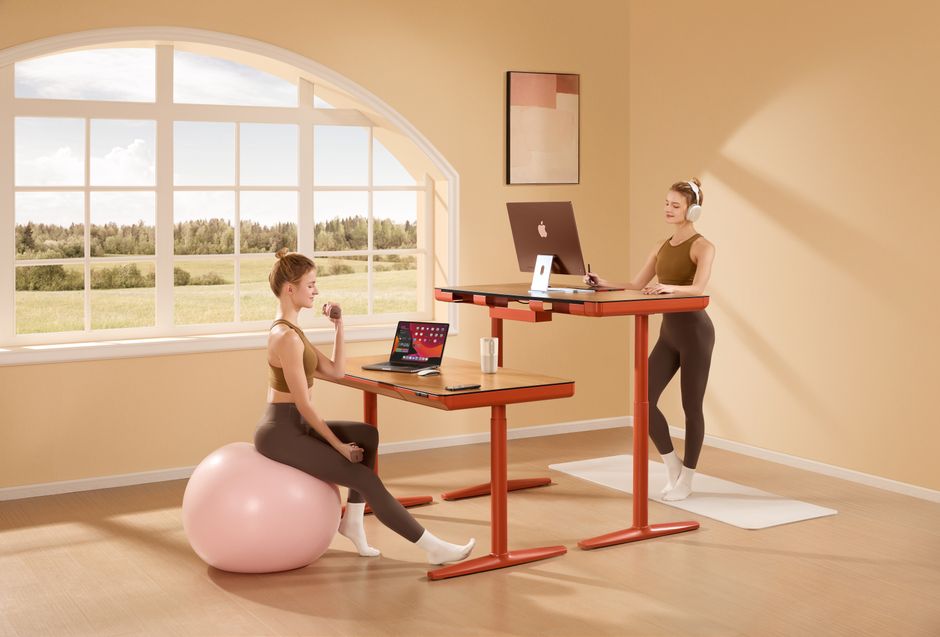
Standing desks have two main ways to lower: an electric motor that does the work for you, or a manual crank that requires your own arm strength. For an electric desk, you press the down arrow button until the desk reaches your desired height. For a manual desk, you turn the crank handle clockwise or counterclockwise, depending on the model, until the surface drops to the right level. Knowing which type you own is the first step, and this guide covers both systems in detail.
How Do I Lower My Electric Standing Desk?
Electric standing desks use a motor to move the legs up and down. The controls are usually a small keypad mounted on the edge of the desktop. Look for a button with a downward arrow or the word “down.” Press and hold it until the desk reaches the height you want.
Most electric desks also have preset memory buttons. These let you save your sitting height and standing height. To use a preset, press the corresponding number button, and the desk will automatically move to that saved position. If your desk stops moving or moves slowly, check the power cord and make sure the desk is plugged into a working outlet.
Some electric desks have a safety feature that stops the motor if it detects an obstruction. If your desk stops before reaching the bottom, clear any objects under the desk and try again. If the desk is not level, the motor may struggle. Check that both legs are on a flat surface.
How Do I Lower My Manual Standing Desk?
Manual standing desks use a hand crank or a winding mechanism. The crank is usually located on the side of the desk or under the desktop. To lower the desk, turn the crank in the direction indicated by the label or arrow on the unit. Many models lower when you turn the crank counterclockwise, but this varies by brand.
If there is no label, test the crank in one direction for a few turns. If the desk moves up, reverse direction. If the desk does not move at all, the crank may be disengaged. Some manual desks require you to pull the crank out slightly to engage the gears before turning. Others have a locking pin that must be released before the desk will move.
Manual desks take more time and effort than electric ones. A full range of motion, from standing to sitting height, may take 15 to 30 full rotations of the crank. This is normal. If the crank becomes very hard to turn, stop. Forcing it can strip the gears or damage the lifting mechanism.
Why Is My Standing Desk Not Lowering?
Several common problems can prevent a standing desk from lowering. For electric desks, the most frequent cause is a power issue. Check that the power cord is fully plugged into both the desk and the wall outlet. If the desk has a battery backup, make sure it is charged.
Another common issue is an uneven load. If one side of the desk is holding a heavy monitor or shelf, the motor may struggle to lower that side evenly. Remove heavy items and try again. Some desks have a reset function that recalibrates the motors. Refer to your owner’s manual for the specific reset procedure for your model.
For manual desks, the most common problem is a jammed or disengaged crank. Inspect the crank mechanism for visible damage. If the crank spins freely but the desk does not move, the gears are not engaged. Look for a clutch or release lever. If the crank will not turn at all, something is blocking the desk legs. Check for cables, boxes, or debris underneath.
If neither solution works, the lifting mechanism may be broken. This is less common but happens with heavy use. Contact the manufacturer for replacement parts. Do not attempt to disassemble the lifting columns yourself unless you have technical experience. Gas springs and lead screws are under tension and can cause injury if released improperly.





What Is the Best Height for Sitting and Standing?
Your desk height should match your body proportions. When sitting, your elbows should rest at a 90-degree angle when your hands are on the keyboard. Your feet should be flat on the floor, and your thighs should be parallel to the ground. For most people, this means a desk height between 22 and 28 inches.
When standing, the same elbow rule applies. Your elbows should be at 90 degrees, and your wrists should be straight. The desk surface should be at or slightly below your elbow height. For most adults, this is between 36 and 46 inches from the floor. If you are taller or shorter than average, adjust accordingly.
A quick way to find your ideal standing height: stand up straight with your arms relaxed at your sides. Bend your elbows to 90 degrees. Measure from the floor to your fingertips. That measurement is close to your ideal standing desk height. You can fine-tune from there based on comfort.
If you wear different shoes at work versus home, your standing height will change. Athletic shoes add about one inch. Dress shoes may add more. Re-adjust your desk height when you change footwear.
How Often Should I Alternate Between Sitting and Standing?
Research consistently shows that prolonged sitting is linked to higher risks of back pain, poor posture, and metabolic issues. However, standing all day has its own problems, including leg fatigue, joint strain, and varicose veins. The goal is movement, not stillness.
Most ergonomics experts recommend alternating every 30 to 60 minutes. Sit for 30 to 45 minutes, then stand for 15 to 30 minutes. There is no single perfect ratio. Listen to your body. If your legs ache, sit. If your back hurts from slouching, stand.
Some studies indicate that the health benefits of standing desks come primarily from breaking up long periods of stillness. Simply changing posture every hour may be more important than the exact ratio of sitting to standing. Even brief walking breaks every 30 minutes can reduce the negative effects of prolonged sitting.
How To Lower A Standing Desk Electric Manual — Quick Reference
Here is the fastest way to lower your desk, depending on the type you own:
- Electric desk: Press and hold the down arrow button on the control pad. Release when the desk reaches the desired height.
- Electric desk with presets: Press the preset button saved for your sitting height. The desk will lower automatically.
- Manual desk with crank: Turn the crank counterclockwise (or in the direction indicated on the label) until the desk is at the right height.
- Manual desk with release lever: Pull the lever to disengage the locking mechanism, then guide the desk down slowly. Release the lever to lock it in place.
If your desk has a gas spring assist, lowering is often easier than raising. The spring supports the weight of the desktop, so you only need to apply light downward pressure. Do not let the desk drop freely. Control the descent to prevent damage to the mechanism.
Frequently Asked Questions
How do I lower a standing desk with a hand crank?
Turn the crank handle in the direction that moves the desk downward, usually counterclockwise. If the desk moves up instead, reverse the direction.
Why is my electric standing desk not going down?
Check the power connection first, then clear any objects blocking the desk legs. If the desk still will not move, perform a factory reset using the procedure in your owner’s manual.
Can I lower a standing desk manually if the motor is broken?
Some electric desks have a manual override feature, but most do not. Check your owner’s manual for a manual crank port or release valve. If neither exists, the motor or gearbox will need professional repair.
What is the lowest height for a standing desk?
Most standing desks lower to between 22 and 25 inches. The exact minimum depends on the model and the thickness of the desktop. Check your product specifications for the precise range.
