
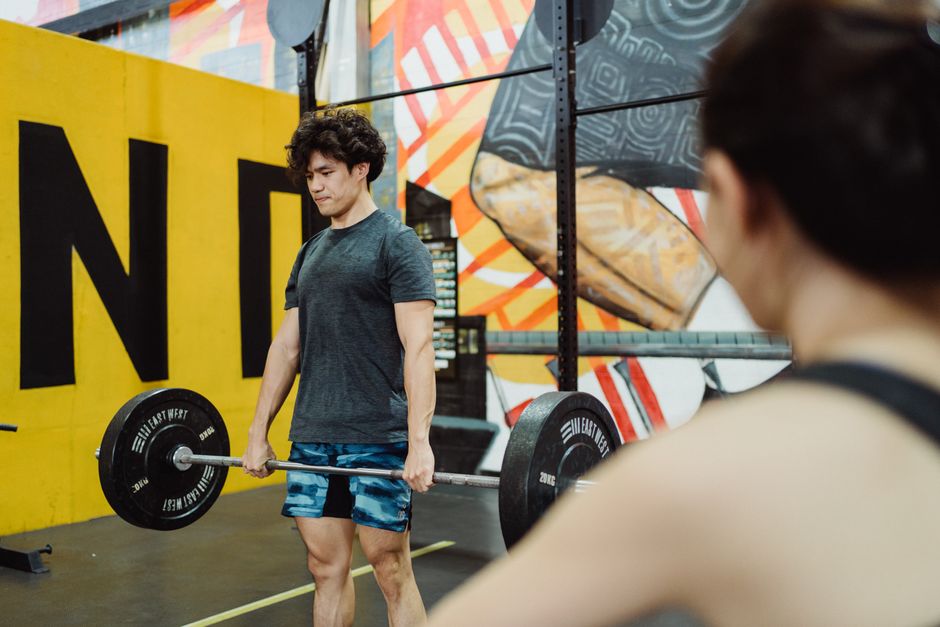
Loading a deadlift bar correctly takes about a minute once you know the sequence, and it protects your back, your plates, and the bar itself. The short answer: roll the bar over the plates already on the floor, load the heaviest plate first on each side, alternate sides, and secure every plate with a collar before you pull. The bar stays on the floor the whole time — you never lift the bar to add weight.
Most people get hurt loading, not lifting. A 45-pound plate held at arm’s length while you bend and twist is a worse position for your spine than the deadlift itself. The methods below are the ones that keep the load close, keep your spine neutral, and keep the bar from tipping.
Why Does Loading Order Matter On A Deadlift Bar?
Because a bar with uneven weight can flip off the floor and land on a foot.
If you slide a 45-pound plate onto one end of an empty bar and nothing on the other, the loaded end drops. On a standard Olympic bar, the unloaded sleeves are light enough that a single heavy plate creates a real tipping hazard. This is the most common way people get hurt in a gym — not from the lift, but from a bar that pivoted while they were reaching for another plate.
The fix is simple. Load one plate per side, alternating, until the bar is heavy enough to sit stable on the floor. Once there are plates on both sleeves, the bar is balanced and you can load the rest in whatever order is convenient.
Plate order on the sleeve matters less than people think for a standard barbell. A 45-pound plate is 45 pounds whether it sits closest to the collar or on the outside. What does matter is that the heaviest plates go on first if you are using a bar with limited sleeve length, because smaller plates may not fit if the sleeve fills up.
What Is The Safest Way To Load A Deadlift Bar?
The roll-over method. The bar never leaves the floor.
Here is the sequence most strength coaches teach:
- Stand the plate upright on the floor, close to the sleeve.
- Roll the bar sleeve into the center hole of the plate using your foot.
- Slide the plate down the sleeve by pushing the bar, not by lifting the plate.
- Repeat on the other side before adding more weight.
- Add a collar once the last plate is on.
The advantage is that your hands never hold a heavy plate at arm’s length. Your feet do the work. Your spine stays close to neutral because you are not bent over holding load.
If you are loading a plate you cannot roll, that is a signal the plate is too heavy for you to handle safely by yourself. Ask for a spot or use a plate jack.
How Do You Load A Deadlift Bar Without A Jack?
You roll the bar. A jack is convenient, not required.
A deadlift jack lifts the bar off the floor so you can slide plates on without rolling. It is a useful tool in a busy gym, and it saves time when you are working up to a heavy single. But the roll technique works with any bar and any plate, and it is what most lifters used before jacks were common.
The one situation where a jack genuinely helps is when you are loading a bar that is already very heavy and you need to add a small plate to a crowded sleeve. Rolling still works, but the sleeve may be too full to roll cleanly. In that case, a jack or a pair of blocks under the plates is the practical answer.
Some lifters use a “deadlift wedge” — a small ramp you push under the innermost plate to lift the bar an inch. It does the same job as a jack in a smaller package. Neither is necessary. Both are fine.





Does Plate Order On The Bar Affect The Deadlift?
Not for the lift itself. It matters for bar whip and for how the bar feels in your hands.
Competition plates are calibrated to tight tolerances, and in most federations the order on the sleeve is specified for consistency. In a regular gym with iron plates, the order does not change how much weight you are pulling. It can change how the bar flexes, because a bar loaded with the heaviest plates near the collars flexes slightly differently than one loaded with them on the outside.
This is a small effect. It is not something most lifters need to think about unless they are training for competition and want to replicate meet conditions.
What does matter is that the plates are the same on both sides. A 45 on one side and a 35 on the other is a 10-pound imbalance that will make the bar tilt as you pull. Always match sides.
What Equipment Makes Loading A Deadlift Bar Easier?
Three things help, and only one of them is close to essential.
- Collars. They keep plates from sliding on the sleeve during the pull. Spring collars are common; clamp-style collars hold better under heavy load.
- A jack or wedge. Saves your back on heavy sets and speeds up plate changes. Optional.
- Calibrated plates. Not easier to load, but they make the weight accurate. Useful if you are tracking progress closely.
Collars are the one piece of equipment worth insisting on. A plate that slides outward mid-pull shifts the load and can throw off your balance at the worst moment.
How To Load A Deadlift Bar Methods That Actually Work For Heavy Weight
Heavy loading is a technique problem, not a strength problem.
The mistake most people make is trying to muscle a heavy plate into place with their arms while bent over. That position — rounded spine, load far from the body, twisting to one side — is exactly the position that produces back injuries in gyms.
Better approach:
- Get the plate close to the sleeve before you start pushing.
- Use your legs to drive the bar through the plate, not your arms to lift the plate.
- Keep your torso upright. If you have to bend, bend at the hips with a flat back, not by rounding.
- Load one side fully, then the other, rather than alternating every single plate when the weight gets heavy.
That last point runs against the alternating advice for light loading. The reason is practical: alternating is safer when the bar is light and unstable, but once the bar is heavy and balanced, loading one side completely and then the other is faster and involves less bending. Both approaches are used by experienced lifters. Neither is wrong.
If a plate is too heavy to handle safely, use a smaller plate. Two 25s weigh the same as one 50. The bar does not care.
Common Loading Mistakes That Cause Injuries
Most loading injuries come from four habits.
- Lifting a plate off the floor with a rounded back instead of rolling it.
- Holding a plate at arm’s length while twisting to place it on the sleeve.
- Loading one side of an empty bar and reaching across to the other.
- Skipping collars and letting plates shift during the lift.
None of these feel dangerous in the moment. That is what makes them easy to repeat until something goes wrong. A single 45-pound plate held away from the body puts meaningful load on the lower back, and a twist under that load is a well-known mechanism for disc injury.
The roll technique removes the lift entirely. That is why coaches teach it.
Frequently Asked Questions
Can you load a deadlift bar without lifting the plates?
Yes. Rolling the bar into an upright plate and sliding it down the sleeve means you never lift the plate off the floor. This is the standard technique taught in most strength programs.
Should you load both sides evenly?
Yes, always. An uneven bar will tilt and can flip off the floor, and it also changes how the lift feels. Match the plates on each side before you pull.
Do you need a deadlift jack to load a bar?
No. A jack makes loading faster and easier, especially with heavy weight, but the roll technique works with any bar and any plate. A jack is a convenience, not a requirement.
Does plate order on the sleeve change the lift?
For most gym training, no. In competition, federations often specify plate order for consistency, and the order can slightly change how the bar flexes, but the total weight is the same.
