
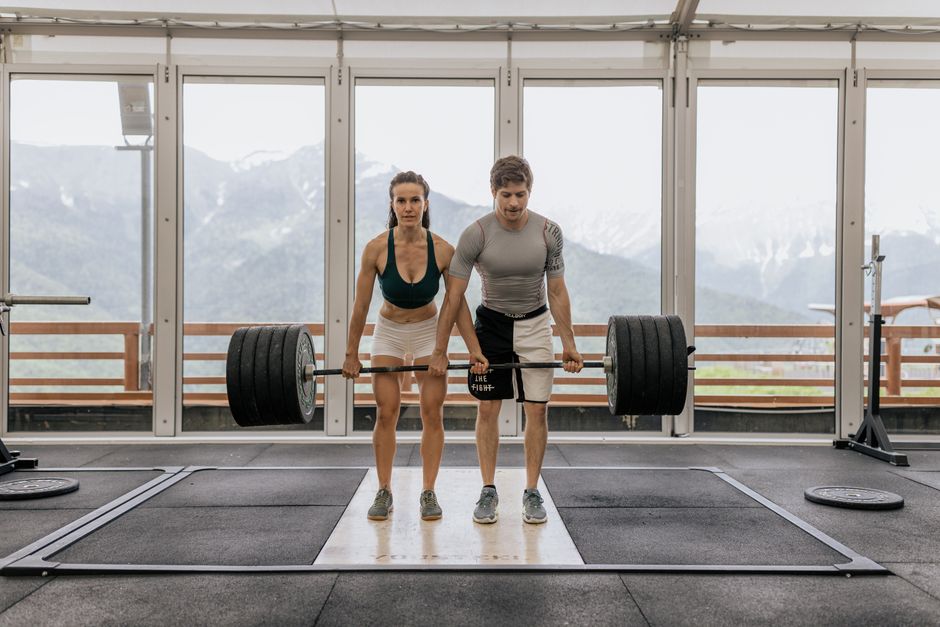
Lifting heavy at home without a spotter is possible if you change how you train. Instead of relying on someone to bail you out of a failed rep, you build safety into your setup and your exercise choices. Use a rack with adjustable safety arms, learn how to fail a lift properly, and pick variations that don’t trap you under a bar. The goal is not to avoid heavy weight. It is to make heavy weight safe when no one is standing there.
How To Lift Heavy At Home Without A Spotter?
The core principle is simple: never put yourself in a position where a failed rep leaves you trapped or crushed. A spotter’s main job is to help you finish a rep you can’t complete or to lift the bar off you if you fail. You can replace that function with equipment and technique.
Three things do most of the work:
- Safety arms or pins set at the right height so a failed rep lands on them, not on you.
- Exercise selection that avoids positions where you can get stuck under a load.
- A practiced bail technique for every lift you do, so failure is a planned event, not a panic.
The safety arms matter most for barbell work. On a squat or bench press, the arms catch the bar if you can’t finish. Set them so the bar touches them just below your bottom position. Too high and you cut your range of motion short. Too low and the bar may not reach them before it reaches you.
For a bench press, this is the difference between a minor inconvenience and a serious injury. A failed bench press with no rack and no spotter is one of the more dangerous situations in a home gym. If you don’t have a rack with arms, don’t bench press heavy alone. That is not a caution born of caution itself. It is a basic mechanical reality: the bar is over your neck and chest, and you cannot get out from under it.
What Equipment Makes Heavy Lifting Safe At Home?
A power rack or squat stand with adjustable safety arms is the single most useful piece of home equipment for lifting heavy alone. It lets you squat, bench, and press with a built-in backup.
What to look for:
- Adjustable safety arms or pins. Fixed-height arms only work for one body position.
- A stable base. A rack that shifts or tips under load is worse than no rack.
- J-cups that hold the bar securely so racking and unracking don’t become their own risk.
Beyond the rack, a few items reduce risk:
- Clips or collars to keep plates from sliding. Some lifters deliberately leave one side unclipped so they can dump the bar, but that only works on one side and creates its own hazards. Clipping both sides and using safety arms is the more controlled approach.
- A floor that can take a dropped load. Rubber mats or a platform protect your floor and reduce bounce.
- Chalk or a good bar so your grip doesn’t fail before your muscles do.
You do not need a spotter for every lift. You need a system that catches failure. Dumbbells, for example, can simply be dropped to the side if a rep fails, which is why they are often safer than a barbell when you train alone.
Which Exercises Are Safe To Do Alone And Which Are Not?
Some lifts are naturally self-spotting. Others are genuinely risky without a second person. Knowing the difference is most of the battle.
Generally safer alone:
- Dumbbell presses and rows. If a rep fails, you drop the weight.
- Goblet squats and front-loaded carries. The load is in front of you and easy to release.
- Trap bar deadlifts. The bar path is centered and you can set it down at any point.
- Machine and cable work. The weight stack can be lowered safely.
Riskier alone without a rack:
- Barbell bench press. The classic trap. If you fail at the bottom, the bar sits on your chest or throat.
- Barbell back squat. Failing forward or backward with a heavy bar is hard to control.
- Overhead barbell press. Less deadly than a bench, but a failed rep can still bring the bar down on you.
With a rack and properly set safety arms, the risky list becomes much safer. The bench press in a rack with arms is a different exercise from a bench press on a flat bench with nothing around it.
One clarification worth making: a spotter does not just catch failed reps. They also help you safely attempt a weight you couldn’t otherwise try. Without one, your ceiling is set by what you can control and bail from. That is a real limit, and it’s fine. Training slightly below your absolute max, consistently, builds strength over time.



How Do You Fail A Lift Safely?
Practice failing before you need to. A bail you have rehearsed is a bail you can execute when your muscles give out and your judgment is compromised.
For a squat in a rack: if you can’t stand up, let the bar settle onto the safety arms. Lean forward slightly and step out from under it, or lower yourself and set the bar down. Do not try to muscle a rep that has already stalled. Know where the arms are before you start.
For a bench press in a rack: if the bar stalls, guide it down to the safety arms rather than fighting it. Lower it under control to your chest, then to the pins. This is why the arms need to be at a height that catches the bar just below your chest position.
For dumbbells: if a press fails, don’t try to guide the weight back to the rack. Push it away from your body and to the floor, ideally onto mats. A dropped dumbbell is far better than a torn shoulder from fighting a weight you can’t control.
A few rules that apply to everything:
- Never use a weight you can’t control on the way down.
- Stop a set when your form breaks, not one rep later.
- Train alone at a time when someone could hear you if something went wrong.
- Tell someone you’re training if you’re attempting something heavy.
That last point is not paranoia. It is the same reason solo climbers log their routes. If something goes wrong, someone knows where you are.
How Do You Program Heavy Lifting Without A Spotter?
Without a spotter, your training should lean on methods that don’t require a maximal single attempt to be productive. Most strength comes from consistent hard sets, not from testing one-rep maxes.
Approaches that work well alone:
- Leave a rep or two in reserve. Stop a set when you could have done one or two more reps with good form. This keeps you away from the failure zone where a spotter would normally help.
- Use the rack for your heaviest work. Save your riskiest lifts for when safety arms are set and you’ve warmed up thoroughly.
- Build with volume and moderate loads. Muscle and strength respond to total hard work over weeks, not to a single heroic set.
- Test maxes rarely, and only in a rack. If you want to know your one-rep max, do it with safety arms set.
This is not a compromise. Many experienced lifters train this way on purpose, spotter or not, because it reduces injury risk and keeps them training consistently. Consistency over months is what builds strength. A single missed rep that ends in injury can cost you weeks or months.
If you’re following a program that calls for near-maximal singles on the bench press and you have no spotter and no rack, that program is not a good fit for your setup. Pick a different one, or add the equipment.
What Are The Real Risks Of Lifting Heavy Alone?
The main risk is being trapped under a load you can’t move. On a bench press, that can mean pressure on the chest or airway. On a squat, it can mean a fall with a bar on your back. These are uncommon, but they are the reason the equipment matters.
Other risks are less dramatic but more common:
- Pushing past form failure because there’s no one to tell you to stop.
- Ego lifting a weight you can’t handle, since no one is watching.
- Training in a place where no one would hear you if you needed help.
The evidence on injury rates in home versus gym training is limited, and much of what people repeat about it is anecdotal. What is well established is mechanical: a bar you can’t move, in a position you can’t escape, is dangerous. Safety arms and smart exercise selection remove most of that danger.
If you have a heart condition, uncontrolled blood pressure, or another medical issue, talk to a clinician before starting heavy lifting. No article can assess your individual risk, and this one isn’t trying to.
Frequently Asked Questions
Can you bench press alone safely without a spotter?
Yes, if you use a rack with safety arms set just below your chest position. A heavy bench press on a flat bench with no rack and no spotter is genuinely dangerous and should be avoided.
What is the safest heavy lift to do alone at home?
Trap bar deadlifts and dumbbell variations are among the safest, because you can set the weight down or drop it at any point. Barbell lifts become safe when done in a rack with proper safety arms.
How do you fail a squat without a spotter?
Let the bar settle onto the safety arms and step or lower yourself out from under it. Set the arms at a height that catches the bar just below your bottom squat position before you start the set.
Do you need a spotter to build strength?
No. Most strength comes from consistent hard sets done with good form, not from maximal single attempts. Training a rep or two short of failure builds strength while keeping you out of the risky zone.
