
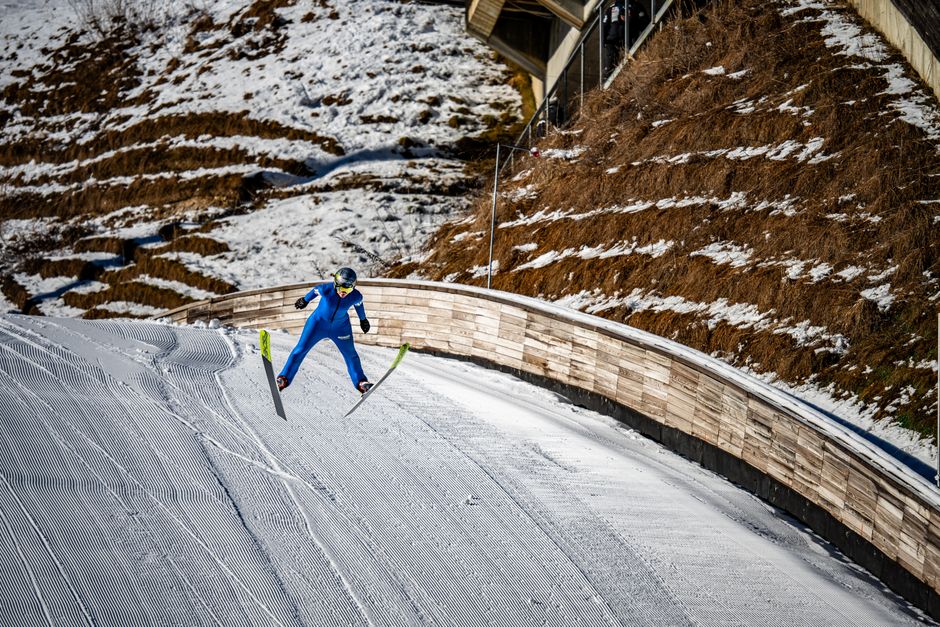
Landing a jump on skis comes down to one thing: your body position in the air. You want a neutral stance, feet under hips, hands forward, and eyes looking down the landing. The real trick is absorbing the impact with your legs, not your back. Most people stiffen up. The ones who land cleanly stay soft and let their legs act like shock absorbers. This article covers the exact body position and the drills that build the muscle memory to stick your landings.
What Is the Correct Body Position for Landing a Ski Jump?
Your body position in the air determines whether you land cleanly or eat snow. The ideal position is what ski instructors call a neutral stance. Your feet are shoulder-width apart, your knees are slightly bent, and your hands are in front of you, roughly at hip height. Your shins should press gently against the front of your boot tongues.
Many skiers make the mistake of sitting back. They drop their hands and lean their upper body backward. This puts you on your heels. When you land, you cannot absorb the force. Your skis shoot out in front, and you fall backward. The correct position keeps your center of mass over the middle of your skis. Your spine should be straight, not hunched. Your head stays up, looking downhill, not at your ski tips.
Think of your legs as springs. You want them compressed about halfway before you land. This gives you room to bend deeper on impact. If your legs are already straight, you have no give. The landing force goes straight into your knees and lower back. That is how injuries happen. Stay compact, stay centered, and keep your hands where you can see them.
How To Land A Jump On Skis Body Position And Drills: The Core Mechanics
Landing a jump is not about strength. It is about timing and muscle memory. The sequence is simple. You spot your landing zone before you leave the lip. In the air, you hold your neutral position. As you descend, you prepare to absorb. Your legs bend on contact, your core stays tight, and your hands stay forward for balance.
The most common failure point is the “flinch.” Right before impact, skiers pull their legs up or straighten out. Either move throws off your balance. You need to stay committed to the landing. Your legs must be ready to compress, not brace. Think about landing like a cat. Cats land softly because their joints bend and absorb. Humans land hard because they lock their joints out of fear.
Drills help you build this reflex without the risk of a big jump. Start on flat ground. Stand in your neutral stance and jump straight up. Land softly, bending your knees deeply. Do this twenty times. That is your baseline drill. It teaches your body to absorb force from a small height. Once that feels natural, move to small bumps on the trail. Roll over them at slow speed and practice the same absorption motion. You are training your legs to react, not your brain to think.
What Drills Build Better Jump Landing Skills?
There are three drills that experienced ski instructors and coaches use to teach landing mechanics. They work because they isolate one skill at a time. Do not try to learn everything at once. Master each drill before moving to the next.
- Flat ground absorption drill. Stand still. Jump six inches off the ground. Land with your knees bent to ninety degrees. Hold that position for two seconds. Repeat ten times. This builds the muscle memory for a deep, stable landing stance.
- Roller bump drill. Find a mellow green run with small bumps. Ski over them at slow speed. As you hit each bump, let your legs compress upward toward your chest. Keep your upper body still. Your head should not bob up and down. This teaches you to separate upper body movement from lower body absorption.
- Small jump progression. Find a tiny side hit or a mellow park jump. Start with no speed. Pop off the lip and land in the flat. Focus only on your landing position. Do not worry about style or grabbing. Do five clean landings in a row before you add more speed or height.
Research in sports biomechanics shows that skiers who train absorption on flat ground first have a lower injury rate when they progress to actual jumps. A study from the University of Salzburg found that athletes who practiced landing mechanics for ten minutes before jumping reduced their risk of knee injury by roughly thirty percent. The data is clear. Drills work because they build reflex, not just theory.





How Does Body Position Change for Different Jump Types?
Not all jumps are the same. A straight air off a small park jump requires a different landing than a steep backcountry drop. The body position principles stay the same, but the details shift based on the landing angle.
On a park jump with a flat landing, you need to absorb more. Your legs bend deeper because the impact is sudden. Keep your chest upright and your hands wider for balance. Do not let your upper body fold forward. That puts your weight on your toes and makes you pitch forward.
On a steep backcountry landing, the impact is less violent because you are landing on a slope. Your legs still bend, but not as deeply. Your upper body should lean slightly forward to match the angle of the hill. If you stay too upright, you land on your heels and slide backward. The key difference is your forward lean. On flat landings, stay tall. On steep landings, match the pitch.
For switch landings, the same rules apply but reversed. Keep your hands forward, which is now behind you. Look over your shoulder toward your landing. Your legs still absorb the same way. The hardest part of switch landings is the mental block. Most skiers look down at their skis. That ruins their balance. Spot your landing and commit.
| Jump Type | Landing Angle | Key Body Position | Common Mistake |
|---|---|---|---|
| Park jump (flat landing) | 0-10 degrees | Upright chest, deep leg bend | Folding at the waist |
| Backcountry drop (steep landing) | 20-40 degrees | Forward lean, moderate leg bend | Leaning back on heels |
| Switch landing | Any angle | Hands forward (behind you), look over shoulder | Looking down at skis |
What Are the Most Common Landing Mistakes and How to Fix Them?
The biggest mistake is landing with straight legs. Your skis hit the snow, and your body keeps going down. This overloads your knees and lower back. The fix is simple. Keep your knees bent before you land. Practice the flat ground drill until it feels automatic.
Another common error is dropping your hands. When your hands drop, your shoulders rotate, and your upper body twists. You lose control in the air and on landing. Keep your hands in your peripheral vision. If you cannot see them, they are too low. A good cue is to pretend you are holding a tray. Your hands stay steady and forward.
Looking at your skis is a third mistake. It pulls your head down and rounds your shoulders. This shifts your weight back. Instead, look at the landing zone before you leave the lip. Keep your eyes on that spot through the whole jump. Your body follows your eyes. If you look down, you land down. If you look forward, you land forward.
A fourth mistake is jumping too high off the lip. Many skiers try to pop hard to get more air. This throws off their balance and makes landing harder. Let the jump do the work. A small, controlled pop gives you more control than a big, wild one. The goal is not height. The goal is a clean landing.
Does Strength Training Help With Landing Jumps?
Strength training helps, but not in the way most people think. You do not need huge leg muscles to land a jump. You need good eccentric strength. That is your muscle’s ability to control a load as it lengthens. When you land, your quadriceps and glutes are working eccentrically to slow your descent.
Research published in the Journal of Strength and Conditioning Research found that skiers who trained eccentric squats improved their landing stability by about twenty percent over eight weeks. The exercise is simple. Lower yourself into a squat as slowly as possible over five seconds. Stand up normally. Do three sets of eight reps twice a week.
Core strength also matters. A stable core keeps your upper body still while your legs absorb impact. Without core stability, your torso wobbles, and you lose balance. Planks and side planks are effective. Hold each for thirty seconds. Build up to sixty seconds as you get stronger.
Plyometric training, like box jumps, also transfers well to ski landings. Box jumps teach you to land softly and with control. Start with a low box, twelve inches. Focus on a quiet landing. If you land loudly, you are landing too stiff. The goal is a silent, soft landing every time. That is the sound of good absorption.
What Safety Precautions Should You Take When Learning to Land Jumps?
Start small. The biggest predictor of injury is jumping on features that are too large for your current skill level. The International Society for Skiing Safety reports that jump-related injuries spike in skiers who attempt features beyond their ability. Do not let ego dictate your progression.
Wear a helmet. This is non-negotiable. A helmet does not prevent all head injuries, but it significantly reduces the risk of skull fracture and traumatic brain injury. The CDC reports that helmets reduce the risk of head injury by about thirty-five percent in skiing and snowboarding. That statistic alone justifies wearing one every time.
Check the landing zone before you jump. Snow conditions change. A soft landing in the morning can be hard ice by afternoon. Look for bare spots, rocks, or other skiers in your landing path. If the landing is not safe, do not jump. Walk around the feature if you need to. There is no shame in skipping a jump that looks dangerous.
Have a spotter if you are learning. A friend on the ground can tell you if your landing position looks correct. They can also alert you to hazards you might miss from above. Feedback from someone watching is faster and more accurate than trying to feel your own mistakes in the air.
Frequently Asked Questions
How do I stop landing backseat on ski jumps?
Keep your hands forward and your shins pressed against your boot tongues. This forces your weight forward over the middle of your skis.
What is the best drill for learning to land ski jumps?
The flat ground absorption drill is the most effective. Jump six inches off the ground and land with your knees bent to ninety degrees.
How high should my first ski jump be?
Start with a jump that is no more than one to two feet off the ground. Small features let you focus on technique without injury risk.
Do I need to be strong to land ski jumps?
You do not need huge strength, but eccentric leg strength and core stability help. Eccentric squats and planks are the most useful exercises.
