
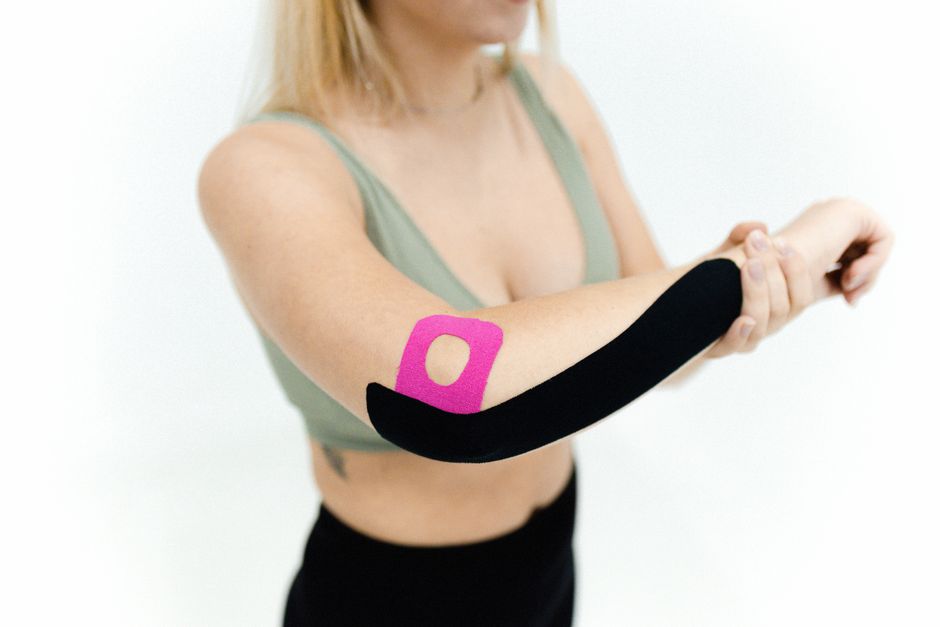
Golfer’s elbow is a stubborn overuse injury, and KT tape is one of the most searched-at-home remedies for it. To tape golfer’s elbow, you apply elastic tape along the forearm muscles that attach to the inner elbow, using either a strip that runs down the muscle belly or a small “fan” or diamond shape over the most tender point. The tape is not a treatment for the tendon damage itself. It is a support tool that some people use to reduce strain and increase awareness of the arm during activity.
What Is Golfer’s Elbow?
Golfer’s elbow is the common name for medial epicondylitis. It is an overload injury of the tendons that attach the forearm flexor muscles to the bony bump on the inside of the elbow, called the medial epicondyle.
Despite the name, most people who get it do not play golf. Repetitive gripping, lifting, and wrist flexion are the usual drivers. Think of a carpenter turning a screwdriver all day, a cook lifting heavy pans, or anyone doing a lot of pull-ups and gripping.
The problem is not inflammation in the way a sprained ankle is inflamed. Research over the past two decades has pointed toward a degenerative process in the tendon, with disorganized collagen and microtears rather than classic acute inflammation. This matters because it changes what helps. Rest and ice may calm symptoms, but the tendon itself usually needs graded loading to recover.
Pain typically builds gradually. It sits on the inner elbow and can travel a few inches down the forearm. Gripping a coffee cup, shaking hands, or turning a doorknob often brings it on.
How Do You Apply KT Tape for Golfer’s Elbow?
There is no single official taping method for medial epicondylitis. Several approaches are used in clinics and described in sports medicine resources. What follows is a common technique, not a validated protocol.
What you need
- Elastic kinesiology tape, roughly 2 inches wide
- Clean, dry, hair-free skin around the inner elbow and forearm
- Scissors
Basic steps
- Bend the elbow to about 90 degrees and turn the palm up.
- Measure a strip from just below the inner elbow crease down the length of the forearm toward the wrist. Cut it.
- Round the corners of the tape. Square corners peel faster.
- Peel the backing and apply the strip with light to moderate stretch — not maximum stretch — running from the inner elbow down the forearm along the flexor muscle group.
- Rub the tape firmly for 10 to 20 seconds. Friction activates the adhesive.
- For a second strip, cut a shorter piece and lay it across the tender point at a slight angle, again with light stretch.
Avoid stretching the last inch or two at each end. Those anchor points should sit on the skin with no tension, or the tape will lift within a day.
Some clinicians also use a small diamond or “Y” strip directly over the medial epicondyle. Others prefer a broader fan pattern across the forearm. If you are working with a physical therapist, follow their method rather than a video.
What Is KT Tape Actually Doing?
The honest answer is that the mechanism is not fully established. Several theories exist, and the evidence behind them is mixed.
One idea is that the tape lifts the skin slightly, which may change how sensory nerves in the area fire. Another is that it provides a light mechanical cue that reminds you to move your arm differently. A third is simple proprioceptive feedback — you feel the tape, so you notice when you grip too hard.
What KT tape is not doing is healing the tendon. It does not repair collagen, reverse degeneration, or strengthen the muscle. Those changes come from loading the tissue over weeks, not from a strip of adhesive fabric.
Some studies suggest kinesiology tape can reduce pain perception in the short term for various musculoskeletal complaints. Results vary, and effects are often small. A placebo response is possible and hard to rule out in taping studies, because participants usually know whether tape is on their skin.





Does KT Tape Help Golfer’s Elbow Pain?
The evidence is limited. No large, high-quality trial has confirmed that KT tape reduces pain or improves function specifically in medial epicondylitis.
Some smaller studies and clinical reports suggest short-term pain relief and improved grip comfort during activity. Other studies find no meaningful difference compared with sham taping. The overall picture is mixed, and most of the research has looked at lateral epicondylitis (tennis elbow) rather than the medial side.
That does not mean taping is useless. It means the case for it rests more on clinical experience and patient report than on strong trial data. If it helps you get through a workday or a round of golf with less discomfort, that is a reasonable outcome. If it does nothing, there is no reason to keep using it.
What KT tape is not is a substitute for the things with better evidence behind them — load management, strengthening, and time.
How Does KT Tape Compare to a Counterforce Brace?
A counterforce brace is the strap-style band worn around the upper forearm, just below the elbow. It is the more traditional option for both medial and lateral epicondylitis, and it has a longer track record.
| Feature | KT Tape | Counterforce Brace |
|---|---|---|
| How it works | Elastic tape along the muscle; proposed sensory and proprioceptive effects | Rigid strap that may reduce force transmitted to the tendon |
| Wear time | Typically 2 to 5 days per application | Worn during activity, removed for rest |
| Evidence in medial epicondylitis | Limited; mixed results | Limited; some clinicians recommend it |
| Skin irritation risk | Higher, especially with repeated use | Lower, but possible |
| Cost | Ongoing; rolls run out | One-time purchase |
Neither option has strong trial support for curing the condition. Both are typically used as adjuncts while the tendon is being rehabbed, not as standalone fixes.
What Else Actually Helps Golfer’s Elbow?
The interventions with the most consistent evidence are not tape. They are exercise and load management.
Eccentric and isometric loading of the forearm flexors — controlled, slow contractions against resistance — has the strongest support for tendinopathy in general. A physical therapist can set the right starting load, because doing too much too soon tends to flare the tendon.
Relative rest means reducing the aggravating activity, not eliminating all use of the arm. Complete rest tends to make tendons weaker, not better.
Other options that are sometimes used include:
- Activity modification, such as changing grip size or technique
- Ice for short-term symptom relief
- Topical or oral anti-inflammatory medication for short-term pain, though this does not address the tendon
- Corticosteroid injection, which can reduce pain in the short term but is associated with worse outcomes over months compared with exercise
- Extracorporeal shockwave therapy, which has some supporting evidence in chronic cases
Surgery is reserved for cases that do not improve after a substantial course of conservative care. It is uncommon.
If pain is severe, waking you at night, or accompanied by numbness or tingling in the hand, that points away from simple tendinopathy and toward nerve involvement such as ulnar neuropathy. That needs a clinician’s evaluation, not tape.
How Long Should You Wear It?
Most KT tape applications are designed to stay on for a few days. Two to five days is a common range, depending on the brand and how much you sweat.
Remove it sooner if the skin itches, burns, or develops a rash. Adhesive reactions are the most common problem with KT tape. People with sensitive skin or a history of reactions to medical adhesives should test a small strip first.
Do not tape over broken skin, infections, or rashes. Do not leave tape on for more than about a week without giving the skin a break.
If taping does not change your pain within a couple of weeks of consistent use, it is reasonable to stop and focus on loading exercises instead.
When Should You See a Doctor?
See a clinician if pain is not improving after several weeks of self-care, if it is getting worse, or if it interferes with basic daily tasks like lifting a cup or turning a key.
Also seek care if you notice numbness, tingling, weakness in the hand, or pain that shoots down the arm. Those symptoms suggest a nerve issue rather than a tendon problem, and taping will not address them.
Golfer’s elbow is usually a slow-healing condition. Many people improve over weeks to months with appropriate loading. Some take considerably longer. A physical therapist can guide the process and tell you whether taping is worth adding at all.
Frequently Asked Questions
Can KT tape cure golfer’s elbow?
No. KT tape does not heal the tendon and no strong evidence shows it resolves medial epicondylitis. It may help with short-term comfort during activity, but recovery depends mainly on progressive loading and load management.
How long do you leave KT tape on for elbow pain?
Most applications are designed to stay on for two to five days. Remove it sooner if you notice itching, burning, or a rash, and give the skin a break before reapplying.
Where exactly do you place KT tape for golfer’s elbow?
The tape usually runs from just below the inner elbow down the forearm along the flexor muscles, with an optional shorter strip over the tender point. The ends should sit on the skin with no stretch so they stay anchored.
Is a brace better than KT tape for golfer’s elbow?
Neither has strong trial evidence for curing the condition, so it comes down to comfort. A counterforce brace is reusable and less likely to irritate skin, while KT tape is more flexible and can be worn for several days at a time.
