
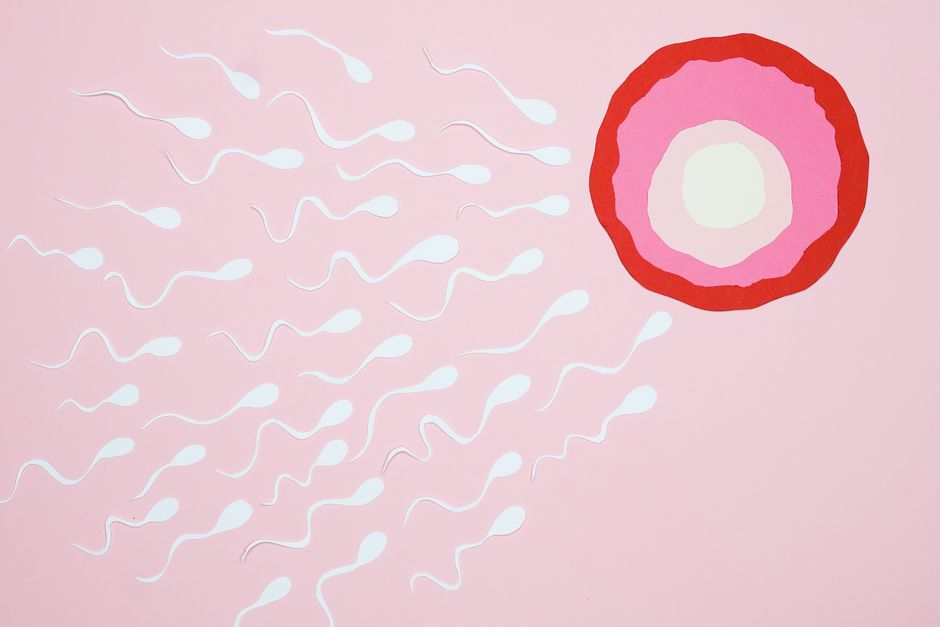
Ovulation happens once per cycle, usually about midway through, and it leaves behind several physical clues. The most reliable body signs are a rise in basal body temperature that stays up for days, a change in cervical mucus from thick to clear and slippery, and a shift in the position and feel of the cervix. No single sign proves ovulation on its own. Tracking two or three together gives you a much clearer picture than watching for one.
What Actually Happens During Ovulation?
Ovulation is the release of a mature egg from one of the ovaries. It is triggered by a sharp surge in luteinizing hormone (LH), which typically happens in the middle of the menstrual cycle. The egg then travels into the fallopian tube, where it can be fertilized for roughly 12 to 24 hours after release.
The follicle that held the egg does not disappear. It turns into a structure called the corpus luteum, which produces progesterone. That hormone does two things: it raises body temperature slightly and it changes the consistency of cervical mucus. Both of these are the basis for most of the physical signs people track.
One detail that surprises many people: sperm can survive in the reproductive tract for up to five days. That means the days before ovulation matter just as much as ovulation day itself. The fertile window is generally considered to be the five days before ovulation plus the day of ovulation.
How To Know When You Ovulated Key Body Signs?
The clearest sign is a sustained rise in basal body temperature. Basal body temperature (BBT) is your resting temperature, taken right after waking and before getting out of bed. After ovulation, progesterone pushes it up slightly — often by a few tenths of a degree Fahrenheit. The key word is sustained. A single high reading means little. Three or more consecutive higher readings confirm that ovulation has likely occurred.
Here is the catch that trips people up: BBT tells you ovulation already happened, not that it is about to happen. By the time your temperature rises, the fertile window is closing. That is why temperature tracking is better for confirming ovulation than for timing intercourse.
Other body signs that tend to appear around the same time include:
- Cervical mucus that becomes clear, slippery, and stretchy — often compared to raw egg white
- A softer, higher, more open cervix that you can feel with clean fingers
- Mild one-sided pelvic pain, sometimes called mittelschmerz
- Breast tenderness or bloating in the days after ovulation
- A positive result on an ovulation predictor kit, which detects the LH surge
Each sign has limits. Mucus can be affected by antihistamines, douching, or infection. Cervical position is hard to assess accurately without practice. Pain is not felt by everyone. Used together, though, these signs paint a reasonably reliable picture.
How Do You Track Basal Body Temperature Correctly?
Accuracy depends on consistency. Take your temperature at the same time every morning, immediately after waking, before you sit up, drink, or speak. Use a basal thermometer, which reads to a finer degree than a standard fever thermometer. Record the number every day, including during your period.
Several things can throw off a reading: poor sleep, illness, alcohol the night before, travel across time zones, or taking your temperature at a different hour. A single outlier is not meaningful. What matters is the pattern across a full cycle.
After a few months of tracking, most people can see their own baseline and recognize the shift. If your temperature stays elevated for more than about 18 days after ovulation, that can be an early sign of pregnancy — but a test is the reliable way to know.
What Does Cervical Mucus Tell You?
Cervical mucus changes in response to estrogen and progesterone, and those changes are one of the more useful signs to watch. In the days before ovulation, rising estrogen makes mucus thin, clear, and stretchy. This type of mucus helps sperm survive and travel. After ovulation, progesterone makes it thicker, cloudier, and less abundant.
To check, wash your hands and observe mucus on your fingers or on toilet paper. Note the color, feel, and whether it stretches between your fingers. You do not need to check internally — external observation is usually enough.
The stretchy, egg-white quality is the most fertile pattern. When it appears, ovulation is likely approaching within a few days. When it dries up, ovulation has probably passed. This is a general pattern, not a precise clock, and it varies widely between people and between cycles.
Can Ovulation Predictor Kits Confirm Ovulation?
Ovulation predictor kits detect the LH surge in urine. A positive result usually means ovulation will happen within roughly 24 to 36 hours. That makes them more useful than temperature for timing, because they give you advance warning.
What they cannot do is confirm that ovulation actually occurred. Some people have an LH surge without releasing an egg, a condition called an anovulatory cycle with a false surge. That is uncommon but real. A temperature rise after a positive kit is stronger evidence that ovulation truly happened.
Kits also vary in sensitivity, and testing at the wrong time of day can miss the surge. For people with irregular cycles, tracking with kits alone can be frustrating. Combining methods tends to work better.
Which Signs Are Less Reliable Than People Think?
Some popular signs are weaker than they appear. Mittelschmerz — the twinge of pain on one side — is real for some people but absent for many, so its absence means nothing. Breast tenderness and bloating are caused by progesterone and show up after ovulation, but they overlap heavily with premenstrual symptoms, so they cannot pinpoint timing.
Apps that predict ovulation based on cycle length are estimates, not measurements. They work reasonably well for people with very regular cycles and poorly for everyone else. A calendar prediction is not the same as a confirmed ovulation.
Saliva ferning — the idea that dried saliva forms a fern-like pattern around ovulation — is sometimes marketed as a reliable test. The evidence for it as a dependable standalone method is limited. Some studies suggest it correlates with fertile days, but it is not accurate enough to rely on alone.
When Should You Talk to a Doctor?
If you have been tracking for several months and see no temperature shift, no change in mucus, or no positive ovulation tests, that is worth discussing with a clinician. The same applies if your cycles are consistently shorter than 21 days or longer than 35 days, or if they vary widely from month to month.
These patterns can have many causes, and identifying them usually requires testing rather than guesswork. A doctor can check hormone levels and look for conditions that affect ovulation. Tracking data from your own records is genuinely useful to bring to that appointment.
One clarification worth making: ovulation tracking is a tool for understanding your cycle, not a diagnosis. It can support conversations with a clinician, but it does not replace one.
Frequently Asked Questions
How many days after ovulation does basal body temperature rise?
Temperature typically rises within one to two days after ovulation, driven by progesterone. The rise is small, often just a few tenths of a degree, so consistent measurement matters.
Can you ovulate without noticing any signs?
Yes. Many people ovulate with no noticeable symptoms at all, and silent ovulation is common. Absence of symptoms does not mean ovulation did not happen.
Is egg white cervical mucus a sure sign of ovulation?
No. It signals rising estrogen and a likely approach to ovulation, but it does not confirm that an egg was released. It is one clue among several.
How long does the fertile window last?
The fertile window is generally about six days: the five days before ovulation plus the day of ovulation. Sperm survival of up to five days is why the days before matter.
