
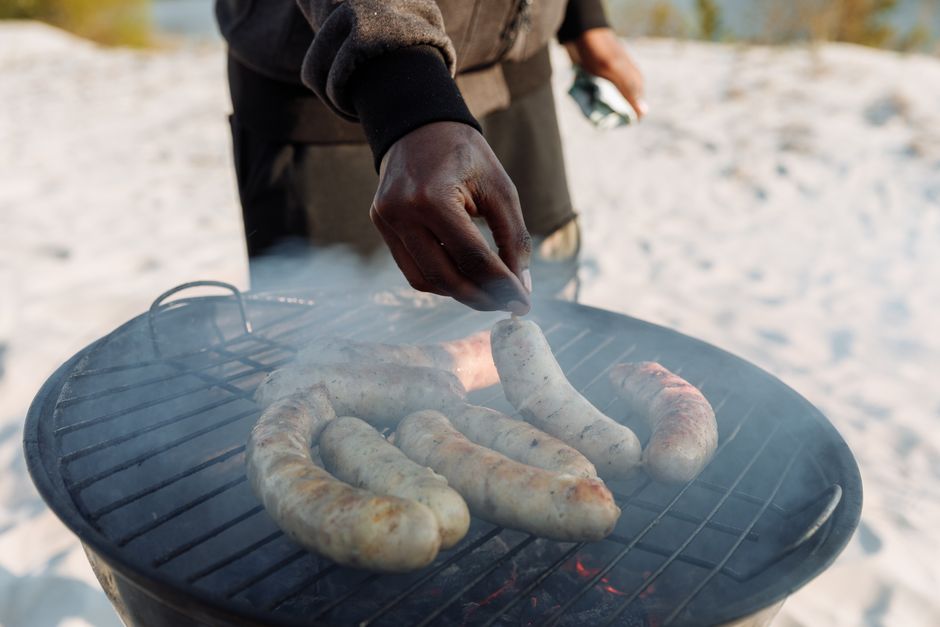
You cannot tell whether sausage is done by color alone. The only reliable way to know is to check the internal temperature with a food thermometer. Ground meat must reach a safe minimum internal temperature of 160°F (71°C), and poultry sausage must reach 165°F (74°C).
That single number matters more than any visual cue. Sausage can look brown and firm on the outside while still undercooked in the center. Pink inside does not automatically mean raw, and gray inside does not automatically mean safe either. The thermometer settles it.
Why Is a Food Thermometer the Only Reliable Method?
Heat moves through meat unevenly. The surface of a sausage link can brown and firm up long before the center reaches a safe temperature. This is especially true for thick links, sausages packed tightly in a pan, or links cooked from frozen.
Color is an unreliable guide for a specific reason. Meat can stay pink even after it is fully cooked, and it can turn gray-brown before it is safely done. The pink color in cooked meat comes from a protein called myoglobin. Myoglobin can remain pink even when the meat has reached a safe internal temperature. This is why a fully cooked sausage sometimes still looks pink inside.
The reverse also happens. Sausage can look done on the outside and still be undercooked at the center. There is no way to see the middle of a link without cutting it open, and even then, color will not tell you the temperature.
A food thermometer removes the guesswork. Insert the probe into the center of the thickest part of the sausage. Avoid touching the casing, the pan, or a bone if one is present, since those surfaces can give a false high reading.
How To Know When Sausage Is Done: The Temperature You Need
The target temperature depends on what kind of sausage you are cooking. The U.S. Department of Agriculture sets minimum safe internal temperatures for meat and poultry, and these are the numbers to follow.
- Ground meat sausage (pork, beef, or a mix): 160°F (71°C)
- Poultry sausage (chicken or turkey): 165°F (74°C)
- Pre-cooked or cured sausage that is reheated: 165°F (74°C) for safety when reheating
The reason ground meat has a higher target than whole cuts like steak is about how bacteria are distributed. On a whole cut, bacteria mostly sit on the surface, which is why a steak can be safely served pink in the middle. When meat is ground, those surface bacteria get mixed throughout the entire batch. Every part of the sausage now needs to reach a safe temperature, not just the outside.
This is the part many people miss. A pork chop and a pork sausage are not the same food from a food-safety standpoint, even though they come from the same animal.
What About Appearance, Texture, and Juices?
Visual and texture cues can support your judgment, but they should never replace the thermometer. Think of them as backup signals, not proof.
Some things people commonly look for:
- The casing looks browned and slightly crisp
- The sausage feels firm rather than squishy when pressed
- Juices run clear instead of pink
- The meat no longer looks shiny or raw in the center
Each of these can be misleading. A sausage can feel firm while still undercooked, and juices can run clear before the center is safe. Firmness depends on fat content, casing type, and cooking method, not just doneness. A high-fat sausage can feel soft even when fully cooked, and a lean one can feel firm while still underdone.
Use these cues to decide when to start checking with the thermometer. Do not use them to decide the sausage is done.





Does Cooking Method Change the Target Temperature?
The safe internal temperature does not change based on how you cook the sausage. Whether you pan-fry, grill, bake, boil, or cook it in a slow cooker, the center still needs to reach the same target.
What changes is how evenly and how quickly the sausage heats through.
- Pan-frying: Good browning, but the ends can cook faster than the center. Check the middle of the thickest link.
- Grilling: High heat can char the outside before the inside is done. Move links to a cooler part of the grill if the outside is browning too fast.
- Baking: More even heat, but links touching each other cook more slowly where they meet. Space them out.
- Boiling or simmering: Heats evenly, but browning does not happen. You still need to confirm the center temperature.
- Slow cooker: Low, slow heat can leave cold spots. Check several links, not just one.
A common mistake is assuming that a long cooking time guarantees safety. Time alone does not. A sausage can sit in a warm pan for a long time and still have a cool center.
How Do You Check the Temperature Correctly?
How you use the thermometer matters as much as having one. A few habits make the reading accurate.
- Insert the probe into the center of the thickest part, from the end of the link toward the middle.
- Push deep enough to reach the core, not just under the casing.
- Avoid touching the pan, a bone, or a large fat pocket, which can read higher than the meat.
- Wait for the reading to stop moving before you read it.
- Check more than one sausage, especially in a large batch. Temperatures vary from link to link.
If you are cooking several sausages, check two or three in different spots in the pan. The one nearest the heat source is often done first, while the ones in the middle of a crowded pan can lag behind.
Clean the probe with hot soapy water between uses, especially if you check raw meat and then cooked meat.
Why Undercooked Sausage Is a Real Risk
Undercooked ground meat and poultry can carry harmful bacteria. The two most commonly linked to sausage are Salmonella and Escherichia coli (E. coli), along with other pathogens like Campylobacter in poultry. These bacteria can cause foodborne illness, which may lead to stomach cramps, diarrhea, vomiting, and fever.
For most healthy adults, foodborne illness is unpleasant but usually short-lived. For some people, it can be serious. Those at higher risk include older adults, young children, pregnant women, and people with weakened immune systems.
Reaching the correct internal temperature is what kills these bacteria. This is why the temperature target is not a suggestion. It is the point at which the meat is considered safe to eat.
One clarification worth making: cured and fermented sausages sold as ready-to-eat are a different category. They are produced to be safe without cooking. But once you reheat them, or if the label says they need cooking, treat them like raw sausage and check the temperature.
Can You Tell Doneness by Cutting the Sausage Open?
Cutting a sausage open shows you the inside, but it still does not tell you the temperature. You can see color and texture, but not the number that matters.
Cutting also has a downside during cooking. Piercing the casing lets juices escape, which can dry out the sausage. If you want to check, use a thermometer instead of a knife.
If you do cut one open to look, use it as a rough check only, then confirm with the thermometer. Do not rely on the cut test alone to decide the sausage is safe.
Practical Tips for Getting It Right Every Time
A few simple habits make it easy to cook sausage safely without overcooking it.
- Keep a digital instant-read thermometer within reach. It gives a fast, clear reading.
- Start checking a few degrees before your target so you do not overshoot.
- Remember that the temperature will keep rising slightly after you remove the sausage from the heat. This is called carryover cooking.
- Let thick links rest a minute or two before serving. This helps the juices settle.
- If you are unsure, put the sausage back on the heat and check again.
Overcooking is a quality issue, not a safety one. A sausage cooked well past its target will still be safe, just drier and tougher. Undercooking is the safety concern. When in doubt, cook a little longer and check again.
The bottom line is simple. Color, firmness, and juices are clues, not proof. The thermometer is the only tool that tells you what you actually need to know.
Frequently Asked Questions
What temperature should sausage be cooked to?
Ground meat sausage should reach 160°F (71°C), and poultry sausage should reach 165°F (74°C). These are the USDA minimum safe internal temperatures.
Can sausage be fully cooked and still be pink inside?
Yes. A protein called myoglobin can keep meat looking pink even after it reaches a safe internal temperature. Color alone cannot confirm doneness.
Is it safe to eat sausage that is a little pink in the middle?
Only if a food thermometer confirms the center reached 160°F (71°C) for ground meat or 165°F (74°C) for poultry. Pink color by itself does not mean it is safe or unsafe.
Do I need a thermometer, or can I just eyeball it?
A food thermometer is the only reliable way to confirm sausage is done. Visual cues like browning and firmness can be misleading.
