
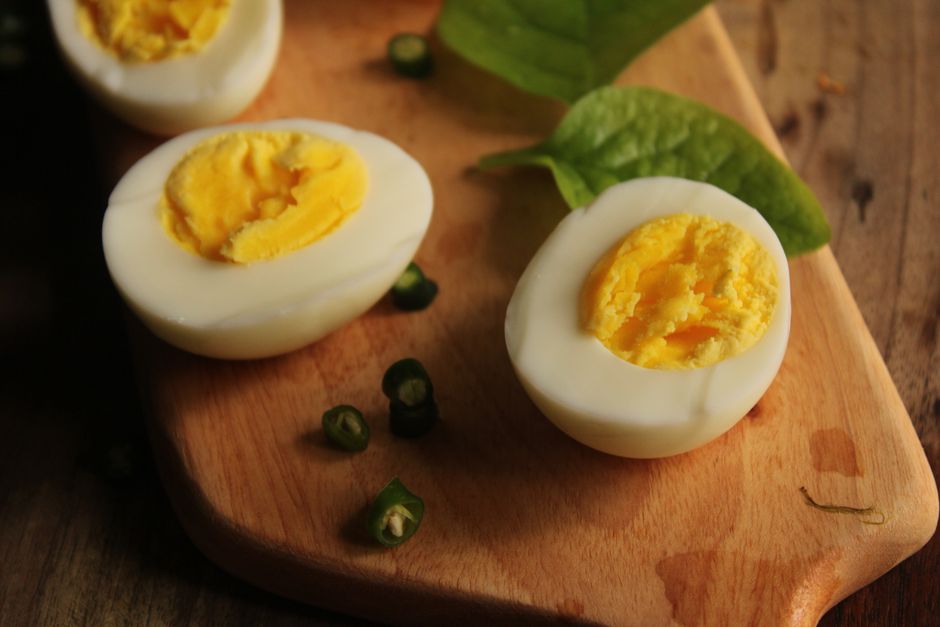
A hard boiled egg is done when the white is fully set and the yolk has reached the texture you want. The most reliable way to know is to control the time and the starting temperature of the water, not to guess by look or feel. Here is the step by step method, plus the signs that tell you an egg is undercooked or overcooked.
Timing depends on two things most people overlook: whether the eggs start in cold water or go into already boiling water, and how large they are. Get those two straight and the rest is repetition.
How To Know When Hard Boiled Egg Is Done
You know a hard boiled egg is done when the white is firm from edge to center and the yolk is cooked through, which takes about 10 to 12 minutes of simmering for a large egg that started in boiling water. The white sets first because it coagulates at a lower temperature than the yolk. Egg white proteins firm up around 63°C (about 145°F), while yolk proteins need closer to 70°C (about 158°F) to set.
That gap is the whole reason timing matters. Pull the egg too early and the white may look done while the center of the yolk is still runny. Leave it too long and the yolk turns pale and dry, and a greenish ring can form around it.
Two dependable methods exist:
- Timed method: Lower eggs into boiling water, simmer for a set time, then chill. Predictable and repeatable.
- Spin test: Spin a cooked egg on a counter. A fully hard boiled egg spins fast and wobbles very little. An uncooked or soft egg wobbles and stops quickly because the liquid inside sloshes.
The spin test tells you whether an egg is cooked at all. It does not tell you how done the yolk is. For that, time and temperature are the only reliable guides.
Step by Step: Cooking Times for a Perfect Hard Boiled Egg
Start with eggs that are not cracked and, ideally, a few days old rather than brand new. Fresh eggs are harder to peel because the inner membrane clings tightly to the shell. This is one of the few kitchen situations where an older egg works better than a fresh one.
Follow these steps:
- Place eggs in a single layer in a saucepan. Do not stack them.
- Add cold water to cover the eggs by about one inch.
- Bring to a rolling boil over high heat, uncovered.
- Once boiling, cover the pan and remove it from the heat. Let it stand.
- For a large egg: about 9 to 12 minutes for a firm yolk, less for a softer center. Extra large eggs need slightly longer; medium eggs slightly less.
- Move the eggs immediately into a bowl of ice water and let them cool for at least a few minutes.
The ice bath does two things. It stops the cooking so the yolk does not overcook, and it makes peeling easier by cooling the egg quickly and shrinking the contents slightly away from the shell.
If you prefer the boiling-water start, lower eggs gently into already boiling water with a spoon, simmer for about 10 to 12 minutes for a large egg, then chill. This method can crack shells more easily, so lower them slowly.
What Do the Different Yolk Colors and Textures Mean?
Yolk color tells you how long the egg cooked, not whether it is safe. A bright yellow yolk is fully set but still moist. A pale, chalky yolk has been cooked past the point where it tastes good. A greenish-gray ring around the yolk is a sign of overcooking.
That green ring is not dangerous, and it does not mean the egg has gone bad. It forms when sulfur from the egg white reacts with iron from the yolk, producing iron sulfide. The reaction speeds up with longer cooking times and higher heat. Cooking more gently and chilling promptly limits it.
Texture is the better guide to doneness:
- Jammy yolk: firm white, soft and slightly runny center. Around 6 to 7 minutes.
- Medium: set white, fudgy yolk with a soft middle. Around 8 to 9 minutes.
- Hard boiled: fully set white and firm, dry-ish yolk. Around 10 to 12 minutes.
These times assume a large egg starting in boiling water. Your stove, pan, and altitude all shift the numbers a little, so the first batch is a test run.





How Can You Tell If a Hard Boiled Egg Is Undercooked?
An undercooked hard boiled egg has a white that is still soft, translucent, or jiggly, and a yolk that runs when you cut into it. If the white is not fully opaque and firm, the egg is not done. The center of the yolk is the last part to set, so a firm white with a runny yolk means you pulled it a little early.
Undercooked eggs carry a real food safety concern. Eggs can contain Salmonella bacteria, and thorough cooking is what kills it. The FDA advises cooking eggs until both the yolk and white are firm. Dishes made with raw or lightly cooked eggs pose a risk, particularly for young children, older adults, pregnant women, and anyone with a weakened immune system.
If you cut into an egg and the yolk is runny but you wanted it firm, you cannot really fix it by reheating without overcooking the white. The cleaner move is to cook the next batch a minute or two longer and note the time.
How Long Do Hard Boiled Eggs Last and How Should You Store Them?
Hard boiled eggs keep in the refrigerator for about one week, whether peeled or unpeeled. The USDA lists hard cooked eggs among foods that should be refrigerated within two hours of cooking and used within about seven days. This is a well established food safety guideline, not a rough estimate.
Storage details that matter:
- Keep them in a covered container in the refrigerator, not at room temperature.
- Unpeeled eggs last longer than peeled ones because the shell and membrane protect the white.
- Peeled eggs should sit in a covered container and are best eaten within a few days.
- Do not leave hard boiled eggs out at room temperature for more than two hours.
A hard boiled egg looks the same as a raw one on the outside, which makes for an unpleasant surprise if you mix them up. Mark the cooked ones, or keep them on a separate shelf. The spin test can rescue you here: a hard boiled egg spins smoothly, while a raw one wobbles.
Why Do Some Hard Boiled Eggs Peel Badly?
Peeling problems come down to the membrane just under the shell, not the cooking time alone. When that thin membrane sticks to the white, the white tears away with the shell. Very fresh eggs are the main culprit because their membrane binds more tightly.
A few things help:
- Use eggs that are at least a few days old.
- Chill the eggs in ice water right after cooking.
- Crack the shell all over, then start peeling from the wide end, where the air pocket sits.
- Peel under running water or in a bowl of water to help the shell slip off.
Some people add salt or baking soda to the cooking water. The evidence that these reliably improve peeling is limited, and baking soda can affect flavor. Chilling and using slightly older eggs are the more dependable steps.
Does Altitude Change Hard Boiled Egg Timing?
Yes. Water boils at a lower temperature at higher altitudes, so eggs need more time to reach the same doneness. At sea level water boils at 212°F (100°C). As elevation rises, the boiling point drops, and the egg cooks more slowly even though the water is boiling vigorously.
If you live at high altitude, add a few minutes to your usual time and check the first egg before cooking a whole batch. The exact adjustment depends on your elevation, so testing is more reliable than a single rule. This is one of those cases where a small experiment beats a fixed number.
Frequently Asked Questions
How long do you boil eggs to make them hard boiled?
For a large egg starting in boiling water, about 10 to 12 minutes gives a fully set white and firm yolk. Reduce the time to around 6 to 9 minutes if you want a softer center.
How can you tell if a hard boiled egg is done without cutting it?
Spin it on a flat surface. A fully hard boiled egg spins fast and steadily, while a raw or soft egg wobbles and stops quickly because the liquid inside moves around.
Is the green ring around a hard boiled yolk safe to eat?
Yes, it is safe. The greenish-gray ring is iron sulfide, which forms when an egg is overcooked, and it does not make the egg unsafe or spoiled.
How long can you keep hard boiled eggs in the fridge?
About one week, according to USDA food safety guidance. Keep them refrigerated within two hours of cooking and store them in a covered container.
