
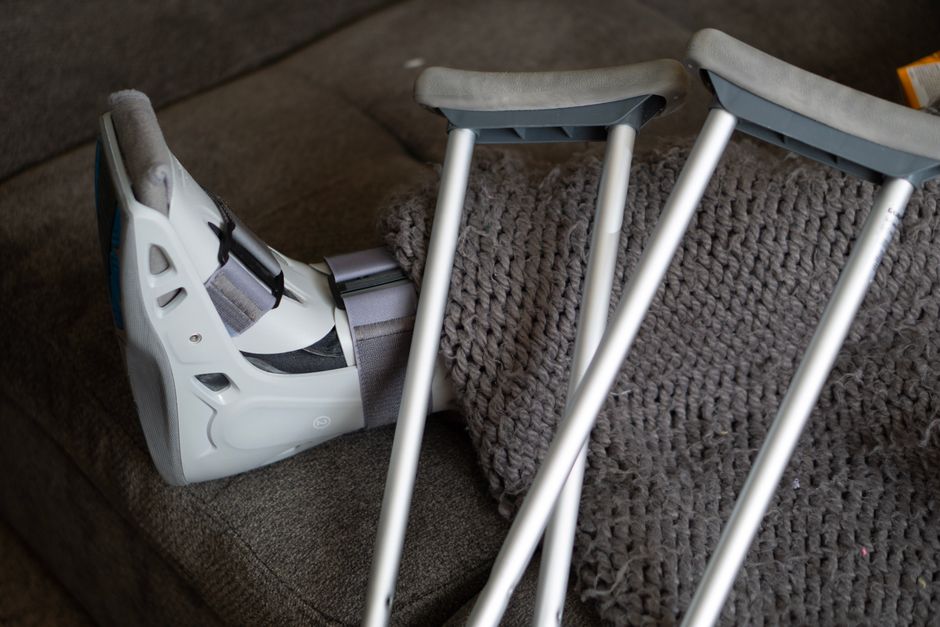
An ankle fracture means one or more of the bones that make up your ankle joint have cracked or broken. The most reliable sign is tenderness directly over the bone — especially along the bony bumps on either side — combined with swelling and an inability to bear weight. If you cannot take four steps on the injured ankle, or if the bone is tender when pressed, you need medical imaging. X-rays are the only way to confirm a fracture.
What Does a Fractured Ankle Actually Feel Like?
A broken ankle hurts in a specific way. The pain is sharp and localized over the bone itself, not just in the soft tissue around it. When you press along the bony edges of your ankle — the knobs on the outside (lateral malleolus) and inside (medial malleolus) — a fracture typically produces intense tenderness right at that spot.
Swelling usually develops quickly, often within minutes to hours. Bruising may appear soon after or take a day or two to show up. Many people describe a deep, aching pain that gets worse when they try to put weight on the foot.
Here is where it gets tricky. A severe ankle sprain can cause swelling, bruising, and pain that feels almost identical to a fracture. The soft tissues around the ankle can bleed and swell just as dramatically as a broken bone. You cannot reliably tell the difference by how it looks or how much it hurts. That is why imaging matters.
Some fractures are surprisingly tolerable. A small avulsion fracture — where a ligament pulls off a tiny piece of bone — may cause only moderate pain. Someone might walk on it for days before seeing a doctor. A stress fracture from overuse can cause a dull ache that worsens with activity and improves with rest, without any single moment of injury.
The opposite is also true. A severe sprain can hurt more than a minor fracture. Pain intensity alone is not a dependable guide.
How To Know If U Fractured Your Ankle vs. Sprained It
Doctors use a set of clinical rules to decide whether an ankle injury needs an X-ray. These are called the Ottawa Ankle Rules, and they are widely used in emergency departments and urgent care clinics.
An X-ray is recommended if any of the following apply:
- Bone tenderness along the back edge of the outer ankle bone (posterior edge of the lateral malleolus), from the tip up about 6 cm
- Bone tenderness along the back edge of the inner ankle bone (posterior edge of the medial malleolus)
- Bone tenderness at the base of the fifth metatarsal — the bump on the outer edge of your foot about halfway to your little toe
- Bone tenderness along the back of the navicular bone — on the top inner side of your midfoot
- Inability to bear weight and take four steps both immediately after the injury and in the clinic
These rules were developed to reduce unnecessary X-rays without missing fractures. Research has consistently shown they are highly sensitive — meaning if you do not meet any of these criteria, the likelihood of a clinically significant fracture is very low.
But here is the limitation. These rules were designed for adults with acute injuries. They do not apply the same way to children, pregnant women, people with numbness in their feet from nerve damage, or those with multiple injuries. They also do not cover stress fractures or injuries that develop gradually.
If you are unsure, get it checked. The cost of an unnecessary X-ray is far lower than the cost of a missed fracture that heals wrong.
What Types of Ankle Fractures Exist?
Ankle fractures are classified by which bone is broken and how stable the joint remains.
The ankle is made of three bones: the tibia (shinbone), the fibula (the thinner bone beside it), and the talus (a small bone in the foot that fits between them). The tibia and fibula form a socket that holds the talus. Ligaments on both sides hold this structure together.
Lateral malleolus fracture — the most common type. The outer bump of the fibula breaks. This can range from a small chip to a complete break.
Medial malleolus fracture — the inner bump of the tibia breaks. This often happens alongside a lateral fracture.
Bimalleolar fracture — both the inner and outer bumps are broken. This is generally less stable and more likely to need surgery.
Trimalleolar fracture — all three ankle prominences are involved, including the back edge of the tibia. These are typically unstable and almost always require surgical repair.
Maisonneuve fracture — a fracture of the upper fibula near the knee, combined with ankle ligament damage. This is less common but important because the pain may be at the ankle while the break is near the knee.
Stability is the key question. A stable fracture means the bones are aligned and the joint can bear weight without shifting. An unstable fracture means the bones may move out of place, which can damage the cartilage surface of the joint over time.





When Should You Go to the Emergency Room?
Some ankle injuries need immediate attention. Go to an emergency department if:
- The ankle is visibly deformed or bent at an unnatural angle
- Bone has broken through the skin (open fracture) — this carries a high risk of infection
- You feel numbness, tingling, or coldness in your foot or toes
- The foot turns pale, blue, or gray
- You cannot put any weight on the foot at all
- The pain is severe and worsening despite elevation and over-the-counter pain relief
An open fracture is a surgical emergency. The bone is exposed to bacteria, and infection in bone (osteomyelitis) is difficult to treat. Antibiotics and surgical cleaning are typically needed within hours.
Numbness or poor circulation suggests nerves or blood vessels may be compressed. This can happen from severe swelling or from bone fragments pressing on soft tissue. It needs urgent evaluation.
If none of these apply but you meet the Ottawa criteria for tenderness or cannot bear weight, urgent care or a same-day appointment with a doctor is reasonable. Do not wait a week to see if it gets better.
What Happens During Diagnosis and Treatment?
Diagnosis starts with a physical exam. The doctor will press along the bones, check for tenderness at specific landmarks, and assess your ability to bear weight. They will also check circulation and nerve function in your foot.
X-rays are the standard first imaging test. They show most fractures clearly. If the X-ray is negative but the doctor still suspects a fracture — or if they need more detail about ligament damage — they may order a CT scan or MRI. Stress fractures often do not show up on initial X-rays and may need a follow-up scan or MRI.
Treatment depends on stability:
- Stable fractures — often treated with a cast, walking boot, or splint. You may need to avoid weight-bearing for several weeks. Healing typically takes six to twelve weeks, though timelines vary by age, health, and fracture type.
- Unstable fractures — usually require surgery to realign and fix the bones with plates, screws, or pins. Recovery after surgery is longer, and physical therapy is almost always part of the plan.
- Stress fractures — rest and activity modification are the mainstays. Some may need a walking boot or cast to allow healing.
Rehabilitation matters. Even after the bone heals, the ankle may be stiff and weak. Physical therapy helps restore range of motion, strength, and balance. Skipping this step increases the risk of long-term problems.
One non-obvious point: the bone healing you feel on the outside does not always match what is happening inside. X-rays at follow-up visits tell the real story. Do not assume you are fully healed just because the pain is gone.
What Should You Do Right After the Injury?
First, stop using the ankle. Do not try to walk it off or test it repeatedly. If you suspect a fracture, avoid putting weight on the foot until a doctor evaluates it.
Elevate the ankle above heart level if possible. This helps reduce swelling. Apply ice wrapped in a cloth for short periods — usually 15 to 20 minutes at a time — to help with pain and swelling. Do not put ice directly on the skin.
Over-the-counter pain relievers like acetaminophen or ibuprofen can help with pain. If you have any chance of needing surgery, ask a doctor before taking ibuprofen or other anti-inflammatory drugs, as some surgeons prefer patients avoid them before procedures.
Do not try to push the bone back into place yourself. Do not wrap the ankle so tightly that your toes turn numb or cold. If you have an open wound or bone is visible, cover it with a clean cloth and go to the emergency room.
If you are not sure whether it is broken, treat it as if it is. That means immobilize, elevate, and get it checked. The risk of waiting is a fracture that heals in the wrong position, which can lead to arthritis, chronic pain, and difficulty walking.
Frequently Asked Questions
Can you walk on a fractured ankle?
Sometimes yes. Some small or stable fractures allow weight-bearing with only moderate pain, while severe sprains can make walking impossible. The ability to walk does not rule out a fracture.
How can I tell if my ankle is broken or sprained at home?
You cannot tell reliably at home. The only dependable way to distinguish a fracture from a sprain is with an X-ray, especially if you have tenderness directly over the bone or cannot take four steps.
What happens if a broken ankle goes untreated?
An untreated fracture can heal in the wrong position, leading to chronic pain, stiffness, and post-traumatic arthritis. In some cases, surgery becomes more complex the longer treatment is delayed.
How long does a fractured ankle take to heal?
Most ankle fractures take about six to twelve weeks to heal, though this varies by fracture type, age, and overall health. Full recovery, including strength and balance, often takes longer and may require physical therapy.
