
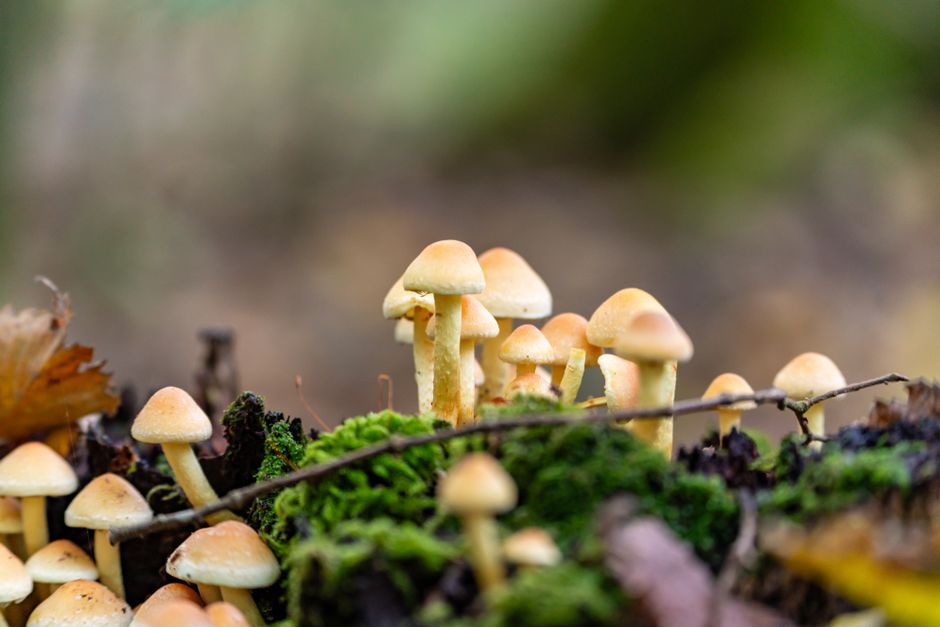
Mushroom spores are built to survive. They resist drying, tolerate wide temperature swings, and can stay viable for years in the right conditions. That durability is exactly why killing them is harder than most people expect. The method that actually works depends on what you are trying to treat — a contaminated grow room, a bathroom wall, a petri dish, or a batch of food. Heat above 250°F (121°C) under pressure, certain chemical disinfectants, and high-concentration hydrogen peroxide are the approaches with real evidence behind them. Many popular home remedies do not work at all.
What Are Mushroom Spores and Why Are They So Hard To Kill?
Mushroom spores are reproductive cells, not seeds. They contain no stored food and no embryo. Their job is to travel, land somewhere suitable, and grow into a new fungal network. That minimal design is part of why they are so persistent.
A spore is essentially a tiny package of genetic material wrapped in a tough outer wall. That wall contains chitin and other compounds that resist heat, radiation, and many chemicals. When conditions turn bad, the spore shuts down its metabolism almost completely. It can sit in that dormant state for months or years and then revive when moisture and nutrients return.
Some fungal spores also carry a protective coating that helps them survive stomach acid, ultraviolet light, and common household cleaners. This is why wiping a surface with a damp cloth does nothing meaningful. You may remove visible spores, but you are not killing them.
The distinction matters: removing spores and killing spores are different goals. For most health and contamination concerns, killing them is what you actually need.
Does Heat Kill Mushroom Spores?
Heat is one of the most reliable ways to kill fungal spores, but the temperature and time required are higher than most people assume. Boiling at 212°F (100°C) does not reliably kill all fungal spores. Many can survive boiling for extended periods.
Moist heat under pressure is a different story. Autoclaving at 250°F (121°C) for 15 to 20 minutes at 15 psi is the standard used in laboratories and medical settings to sterilize equipment. This combination of high temperature, pressure, and steam destroys fungal spores, including those of Aspergillus and other common environmental molds. This is an established sterilization standard, not a home remedy.
Dry heat requires even higher temperatures and longer times. Dry heat sterilization typically uses 320°F to 340°F (160°C to 170°C) for two hours or more. A standard kitchen oven set to 300°F will not reliably kill spores in a reasonable time.
What about freezing? Freezing does not kill most fungal spores. It pauses their activity. When they thaw, many remain viable. This is why frozen food can still develop mold after thawing.
Do Disinfectants and Cleaners Actually Kill Spores?
Most household cleaners do not kill fungal spores. They clean surfaces, remove organic material, and reduce bacterial counts. Spores are a different target entirely.
The chemicals with documented sporicidal activity include:
- Hydrogen peroxide at concentrations of 6% or higher, with sufficient contact time
- Peracetic acid, used in industrial and laboratory disinfection
- Chlorine bleach at higher concentrations than typical household use, with extended contact time
- Glutaraldehyde and ortho-phthalaldehyde, used in medical sterilization
Even these require correct concentration and contact time. A quick spray-and-wipe does not kill spores. The surface needs to stay wet with the product for the full contact time listed on the label, which is often 10 minutes or longer for sporicidal claims.
Regular household bleach at typical dilution is not reliably sporicidal. It works well against many bacteria and some viruses, but fungal spores are more resistant. If a product label does not specifically claim sporicidal activity, assume it does not kill spores.
Alcohol, including 70% isopropyl alcohol, is not sporicidal. It is a good general disinfectant but does not kill fungal spores. Vinegar, tea tree oil, and most “natural” cleaners have no documented sporicidal activity.



What About UV Light and Radiation?
Ultraviolet light can damage spore DNA, but the dose required to reliably kill fungal spores is much higher than what a typical UV sanitizing wand delivers. UV light also only works on surfaces it directly hits. Spores in cracks, under edges, or in shadowed areas are not affected.
Some studies suggest that UV-C at specific wavelengths and sufficient intensity can reduce spore viability on surfaces. However, the practical limitations — shadowing, distance, and required exposure time — make it unreliable as a standalone method for killing spores in a room or on complex surfaces.
Ionizing radiation is used industrially to sterilize certain medical products and some foods. It is effective against spores but is not available or appropriate for home use.
How Do You Kill Spores in a Room or Building?
Killing spores in a room is more complicated than killing them on a clean surface. Spores settle into carpet, drywall, ventilation systems, and porous materials. No spray reaches all of them.
The approach that works in practice combines physical removal with chemical treatment:
- Fix the moisture source first. Spores do not grow into mold without water. If you do not address the leak or humidity problem, spores will return.
- Remove porous materials that cannot be cleaned, such as soaked drywall and carpet.
- Use a HEPA vacuum to capture spores from surfaces. HEPA filters trap particles at 0.3 microns with high efficiency. This removes spores rather than killing them, but removal is often the more practical goal.
- Apply an EPA-registered sporicidal disinfectant to hard surfaces, following the label contact time exactly.
- Improve ventilation and control indoor humidity to prevent regrowth.
For large or repeated contamination, professional remediation is often necessary. This is not a marketing claim — it reflects the difficulty of reaching all contaminated surfaces with any chemical.
Can You Kill Spores in Food or Medicine?
This is where the stakes are highest. You cannot reliably kill fungal spores in food using home methods. Heat-resistant spores can survive cooking temperatures that would kill most bacteria.
Commercial food sterilization uses retorting, which applies high heat under pressure for a calculated time. This is not something a home kitchen can replicate safely.
If food shows visible mold, the USDA advises discarding it. This is not overly cautious. Mold spores and their associated mycotoxins can spread beyond the visible surface, especially in soft foods like bread, jam, and soft cheese. Cutting off the moldy part does not make the rest safe.
For liquid medications and sterile products, spore contamination is a serious safety issue. These products are manufactured under strict sterilization standards for exactly this reason. There is no safe home method to re-sterilize a contaminated medication.
What Does Not Work To Kill Mushroom Spores?
Several methods are widely believed to work but do not reliably kill spores:
- Boiling water — many spores survive
- Freezing — spores go dormant but stay alive
- Rubbing alcohol — not sporicidal
- Vinegar — no documented sporicidal activity
- UV wands — insufficient dose and surface limitations
- Standard household bleach dilution — not reliably sporicidal at typical concentrations
- Essential oils — no clinical evidence of sporicidal activity
This matters because people rely on these methods and assume the problem is solved. In a grow environment, a bathroom with recurring mold, or a food safety situation, that assumption can lead to ongoing contamination.
What Is the Most Practical Approach?
Match the method to the situation. There is no single answer that works everywhere.
For hard, non-porous surfaces in a controlled setting, an EPA-registered sporicidal disinfectant with the correct contact time is the practical choice. For laboratory or medical equipment, autoclaving is the standard. For a contaminated room, removal of porous materials plus HEPA vacuuming plus chemical treatment plus moisture control is the combination that works.
The most important step is often the one people skip: controlling moisture. Spores are everywhere in the environment. They only become a problem when they land somewhere wet enough to grow. Killing the spores already present without fixing the moisture source means they will return.
If you are dealing with a health concern related to mold exposure — respiratory symptoms, allergic reactions, or ongoing sinus issues — talk to a healthcare provider. The evidence linking mold exposure to specific health outcomes varies by individual and by situation. A clinician can help assess your specific case.
Frequently Asked Questions
Does boiling water kill mushroom spores?
Boiling at 212°F (100°C) does not reliably kill all fungal spores, and many can survive extended boiling. Moist heat under pressure at 250°F (121°C) for 15 to 20 minutes is the established method that does kill them.
Does bleach kill mold spores?
Household bleach at typical dilution is not reliably sporicidal, though higher concentrations with extended contact time can be. If a product does not specifically claim sporicidal activity on its label, assume it does not kill spores.
Does vinegar kill mushroom spores?
There is no documented evidence that vinegar kills fungal spores. It may clean surfaces and inhibit some surface mold growth, but it does not kill spores.
How long do mushroom spores stay alive?
Many fungal spores can remain viable for months to years in dry, dormant conditions. Viability depends on the species and the environment, and some spores revive quickly once moisture returns.
