
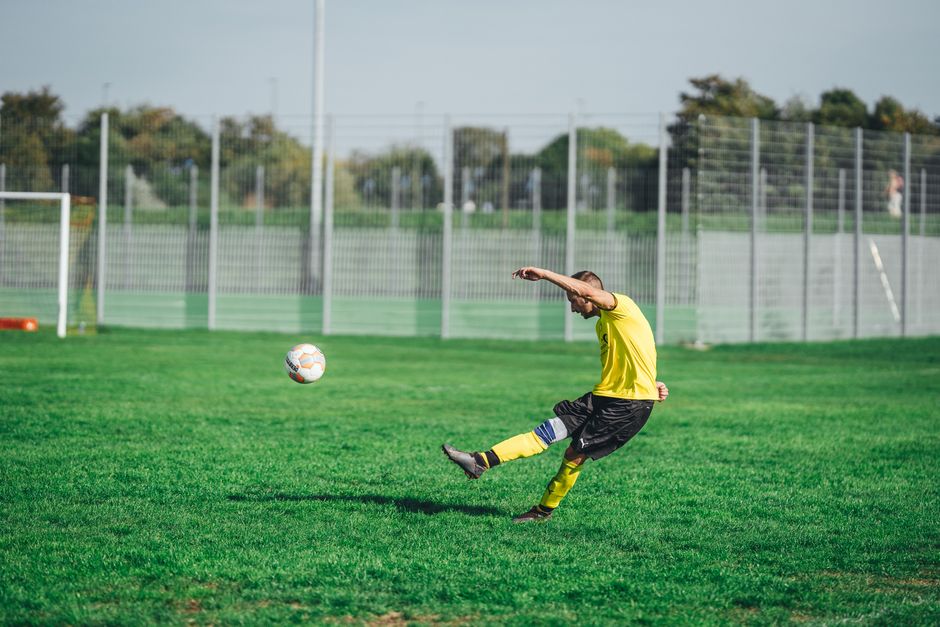
To kick a curve ball in soccer, you need to strike the ball off-center with the inside or outside of your foot while following through across your body. This off-center contact creates sidespin, and the spin makes the ball bend through the air due to the Magnus effect. The technique is not about raw power; it is about precise foot placement, ankle lock, and a controlled swing path.
What Makes a Soccer Ball Curve in Flight?
The curve on a soccer ball comes from physics, not magic. When you strike the ball off-center, you create sidespin. As the ball spins, one side moves with the airflow and the other side moves against it.
This difference in air pressure on either side of the ball pushes it in one direction. That force is called the Magnus effect. It is the same principle that makes a tennis ball dip or a baseball curve. The faster the spin, the more the ball bends.
Professional players like David Beckham and Roberto Carlos built careers on this effect. They did not hit the ball harder than everyone else. They hit it with more spin and better placement.
How To Kick A Curve Ball In Soccer Like A Pro
The pro technique comes down to three parts: your approach, your contact point, and your follow-through. Each part matters equally. Get one wrong and the ball will not bend the way you want.
Your approach should be at a slight angle, not straight behind the ball. Approaching from about a 30-degree angle gives your foot room to swing across the ball. This angle is essential because it lets your foot contact the side of the ball rather than the center.
Your plant foot should be placed beside the ball, not behind it or on top of it. Point your plant foot toward your target. The distance between your plant foot and the ball should be about one fist-width. Too close and you will toe-poke it. Too far and you will miss the sweet spot.
Your kicking foot must strike the ball with the inside of your foot for a classic inswinging curve. Aim for the lower half of the ball, slightly to the outside of center. This contact point gives you both lift and spin.
Your follow-through is where most beginners fail. Do not stop your kick at the ball. Swing your leg across your body, finishing with your kicking leg pointing toward the opposite side of your body. The follow-through direction controls the spin axis. If you follow straight through, you get a straight shot. If you follow across your body, you get a curve.
Keep your ankle locked and toes pointed slightly down. A loose ankle absorbs the energy and produces a weak, unpredictable shot. A locked ankle transfers all your power into the ball.
Using the Outside of Your Foot for an Outswinging Curve
The inside-of-the-foot technique is the most common way to curve a ball. But the outside of your foot produces a different bend that goes the opposite direction.
Strike the ball with the outside edge of your foot, contacting the lower inside of the ball. Your ankle must be locked and turned inward. Follow through across your body in the opposite direction from the inside-foot technique.
This shot is harder to master because the contact area is smaller and the margin for error is tighter. Professional players use it for free kicks when they want the ball to bend away from the wall and back toward the far post. It also produces a flatter trajectory that is harder for goalkeepers to read.
Most amateur players never practice this shot. That is a mistake. Adding the outside curve to your skill set makes you harder to defend because the goalkeeper cannot predict which way the ball will bend.
-
 Fermented Foods List For Gut Health. Best Ones Included!
 -
Connor Stanhope Weight Loss Journey. What Diet He Followed?
-
ProstaVive Reviews 2025. Analyzed Complaints & Scam Reports!
-
Gordon Ramsay Skin Cancer: Take Sun Protection Seriously!
-
SleepLean Reviews. Does It Help Weight Loss & Sleep (2025 Verdict)





Common Mistakes That Kill Your Curve
Several errors prevent players from getting the bend they want. The most common is striking the ball too centrally. If you hit the center of the ball, you get power but no spin. You need that off-center contact.
Another mistake is leaning back too far. Leaning back lifts the ball too high, and the curve becomes unpredictable. Keep your chest over the ball and your head down at the moment of contact.
Many players also swing too hard. Maximum power reduces your control over the contact point. A controlled swing at about 70 to 80 percent effort produces better spin and a more predictable curve. As your technique improves, you can increase power without losing accuracy.
Finally, do not chase the ball after you kick it. Your plant foot and body position determine the shot. If you are off balance, the ball will reflect that. Stay balanced through the entire motion.
How to Practice Curving a Soccer Ball
Practice is the only way to build the muscle memory for this shot. Start without a goal. Place the ball about 20 yards from a wall or a partner and focus on the spin.
Begin with the inside-foot curve. Take 20 shots, focusing only on the contact point and follow-through. Do not worry about accuracy yet. Watch how the ball spins in the air. If it is not spinning, you are hitting too centrally.
Once you can consistently produce spin, add a target. Place a cone or marker and aim for it. Then move to free kicks with a wall of defenders. The wall forces you to curve the ball around an obstacle, which is the real game situation.
Practice with both feet if you can. Being able to curve the ball with your weaker foot makes you a more complete player. It takes longer to develop, but the payoff is significant.
Some players use a tennis ball or a smaller ball to practice. The smaller ball exaggerates the spin and teaches your foot to find the correct contact point. This drill is not a replacement for real-ball practice, but it can accelerate your learning.
Does the Ball Type or Weather Affect the Curve?
Yes, the ball matters. A new, properly inflated ball curves more predictably than an old, worn ball. The surface texture and panel design affect how the air moves over the ball.
Modern match balls with textured surfaces are designed to have predictable flight. Older smooth leather balls behave differently. If you are practicing with a worn ball, the curve will be less consistent.
Weather also plays a role. Wind can add to or cancel out your curve. A strong headwind can make the ball dip more. A tailwind can flatten your shot. Rain makes the ball heavier and reduces the spin effect. Professional players adjust their technique based on these conditions, but for practice, aim for calm days to build consistent technique.
Altitude matters too. At higher altitudes, the air is thinner, and the ball curves less. This is why free kicks at high-altitude stadiums like Mexico City behave differently than at sea level.
How Long Does It Take to Master the Curve?
There is no fixed timeline. Some players develop a reliable curve in weeks. Others need months. The difference comes down to practice quality, not just practice time.
Focused practice with immediate feedback produces faster results. Record yourself on video. Compare your technique to professional players. Look at your approach angle, plant foot position, and follow-through.
Most players see noticeable improvement within 10 to 15 focused practice sessions. That means 20 to 30 minutes per session, several times a week. Consistency beats marathon sessions.
The curve ball is not a trick shot. It is a fundamental skill used in crosses, corners, free kicks, and shooting. Mastering it changes how you play the game because it gives you options that straight kicks do not offer.
Frequently Asked Questions
What part of the foot do you use to curve a soccer ball?
Use the inside of your foot for an inswinging curve or the outside of your foot for an outswinging curve. The contact point is off-center, not through the middle of the ball.
Why does my soccer ball not curve when I kick it?
You are likely striking the ball too centrally, which produces power but no spin. Aim for the lower outside portion of the ball and follow through across your body.
Do you need to kick the ball hard to make it curve?
No, spin matters more than power. A controlled swing at 70 to 80 percent effort with proper technique produces a better curve than a full-power strike.
Can you curve a soccer ball with your weaker foot?
Yes, the technique is identical regardless of which foot you use. It takes more practice to build the same touch with your weaker foot, but it is achievable with consistent training.
