
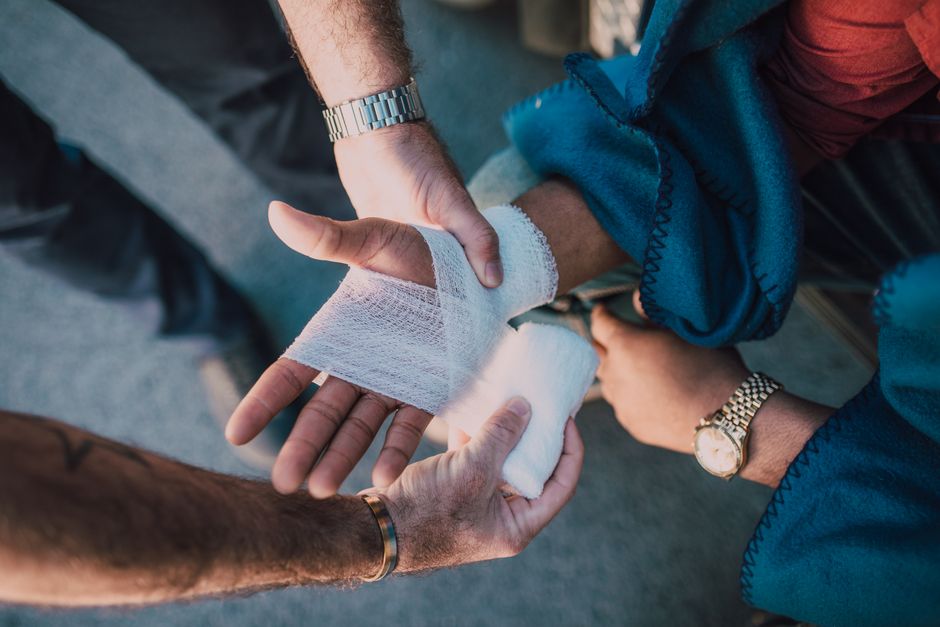
Bandages fail for predictable reasons: the skin moves, moisture builds up, and adhesive loses grip. The fix is equally predictable. Keep the skin dry and clean before you apply anything, choose a bandage that matches the wound and the body part, and anchor the edges so tension spreads instead of pulling at one corner. Do those three things and most bandages will stay put until you take them off.
Most people blame the bandage. In reality, the surface it sticks to decides the outcome. Skin is not a clean, dry, flat surface. It bends, sweats, and sheds tiny flakes of dead cells that lift adhesive from underneath. Once you understand that, keeping a bandage on stops being a matter of luck.
Why Do Bandages Fall Off So Easily?
Adhesive sticks best to dry, clean, unbroken skin. Human skin rarely stays that way under a bandage.
Three forces work against you. First, moisture. Sweat and wound fluid soften the adhesive and the top layer of skin, and a soft adhesive releases its grip. Second, movement. Every time you bend a knee, elbow, or finger, the skin stretches. A bandage that does not stretch with it gets pulled at the edges. Third, oil and dead skin cells. Normal skin produces oil and constantly sheds microscopic flakes. Adhesive bonds to those flakes rather than to the skin itself, so the bandage lifts as the flakes come loose.
Body hair makes this worse by reducing how much surface area the adhesive actually touches. So does applying a bandage over a crease, a joint, or a spot where clothing rubs.
None of this means the bandage is defective. It means the conditions were never right for it to hold.
How Do You Prepare Skin So a Bandage Actually Sticks?
Preparation takes about thirty seconds and does more for adhesion than any brand of bandage.
Start by washing the area with mild soap and water, then dry it completely. Pat rather than rub, and let the skin air-dry for a moment. Any lingering dampness weakens the adhesive from the start.
If the skin is oily, a gentle wipe with an alcohol pad can remove surface oil. Let the alcohol evaporate fully before applying anything. Do not use alcohol on an open wound or on broken skin. It stings and can damage healing tissue.
For hairy areas, you have two options. You can trim the hair short with small scissors or clippers, which increases the contact area without irritating the skin. Shaving is a poor choice near a wound because it creates small nicks that can become infected.
If the skin is intact and not wounded, a skin-protectant wipe or a thin layer of skin barrier film can help adhesive hold while protecting the skin underneath. These products are designed for exactly this purpose. Do not apply barrier products directly into an open wound.
One detail people miss: body heat helps adhesive activate. After pressing the bandage down, hold it in place with your hand for 20 to 30 seconds. The warmth helps the adhesive flow into the skin surface and form a stronger bond.
How Should You Apply a Bandage for Maximum Hold?
Technique matters as much as preparation. A bandage applied carelessly will lift at the corners within hours.
Choose a size that covers the wound with a margin of at least half an inch of adhesive on every side. A bandage that barely covers the wound has almost no adhesive doing useful work.
Apply it to dry skin, then press down firmly across the whole pad and all four edges. Do not stretch the bandage tight across a joint. Stretching creates tension that pulls the edges loose the moment you move.
If the wound is on a joint or an area that bends, orient the bandage so the adhesive strips run across the bend rather than along it. This spreads the pull instead of concentrating it at one edge.
For extra security on edges that tend to lift, you can add a strip of medical tape over each end. Overlap the tape onto the bandage and onto clean, dry skin. This is a common approach in clinical settings and works well at home.
Do not wrap tape or a bandage so tightly that it restricts blood flow. Signs of a too-tight bandage include numbness, tingling, cool skin, or discoloration beyond the edges. If you see any of these, remove it and reapply more loosely.




Which Bandage Type Works Best for Which Situation?
Different wounds and body parts call for different products. Matching the bandage to the job prevents most failures.
| Bandage type | Best for | Main limitation |
|---|---|---|
| Adhesive strip (standard bandage) | Small cuts, scrapes, flat surfaces | Lifts at joints and on hairy skin |
| Flexible fabric bandage | Fingers, knuckles, areas that bend | Less waterproof than film types |
| Waterproof film bandage | Handwashing, brief water contact | Traps moisture if left on too long |
| Transparent film dressing | Intact skin, protecting a closed wound | Not for draining or infected wounds |
| Self-adherent wrap | Holding gauze in place, larger areas | Sticks to itself, not to skin |
| Medical tape over gauze | Custom coverage, odd shapes | Can irritate sensitive skin |
Flexible fabric bandages move with the skin, which is why they hold better on fingers and knuckles. Waterproof film bandages resist water but can trap sweat and wound moisture underneath, so they are not ideal for wounds that are still draining.
Self-adherent wraps stick to themselves rather than to skin. They are useful for holding gauze on larger areas or when adhesive irritates the skin, but they do not work as a standalone cover for a small wound.
What About Wounds on Fingers, Joints, and Awkward Spots?
Fingers and joints are the hardest places to keep a bandage on. They bend constantly and have a small, curved surface area.
For a fingertip wound, a standard strip often works if you angle it so the pad sits over the tip and the adhesive wraps partly around the sides. For a wound on the side of a finger or across a knuckle, a flexible fabric bandage oriented across the bend holds better than a stiff one.
For larger or oddly shaped areas, gauze plus medical tape gives you more control. Cut the tape into strips and place them so they cross the gauze at different angles. This distributes tension instead of concentrating it.
If a bandage keeps failing on a specific spot, a tubular net bandage or a self-adherent wrap may be a better fit. These are widely used in clinical settings for exactly this reason. They rely on compression and friction rather than adhesive alone.
When Should You Change a Bandage?
Adhesive weakens over time, and moisture builds up underneath. Changing the bandage regularly keeps the wound clean and the bandage functional.
For most minor wounds, changing the bandage once a day is reasonable, or sooner if it gets wet or dirty. If a bandage becomes loose, soiled, or wet, replace it rather than trying to press it back down. Reused adhesive rarely holds well and can introduce bacteria to the wound.
When you remove a bandage, pull it gently along the direction of hair growth rather than straight up. This reduces skin irritation. If adhesive resists, a little warm water or an adhesive remover wipe can help.
Some redness around the edges after removal is normal and fades within a short time. Spreading redness, warmth, swelling, pain, or pus are signs of possible infection. If you see these, seek medical care rather than covering it up again.
Why Do Some People React to Bandage Adhesive?
Adhesive irritation is common and often mistaken for infection. The skin under and around the adhesive becomes red, itchy, or bumpy, but the wound itself looks fine.
This reaction is usually a form of contact dermatitis. It can come from the adhesive itself, from the material of the bandage, or from residue left on the skin. Some people are sensitive to specific adhesives, particularly acrylate-based ones used in many medical tapes.
If you react to one type of bandage, try a different adhesive formulation or a hypoallergenic product. For people with known adhesive sensitivity, self-adherent wraps or gauze held with paper tape may be better options. If a reaction is severe, spreading, or does not improve after removing the bandage, see a clinician.
One clarification worth making: a red ring exactly the shape of the adhesive is more likely irritation than infection. Infection tends to spread beyond the bandage edges and is often accompanied by pain that worsens rather than improves.
Frequently Asked Questions
How do I keep a bandage from falling off in water?
Use a waterproof film bandage or cover a standard bandage with a waterproof dressing before showering. If the bandage gets wet underneath, remove it and apply a fresh one, because trapped moisture weakens adhesive and can promote infection.
Can I use tape to hold a bandage on better?
Yes. Medical tape applied over the edges of a bandage, overlapping onto clean dry skin, can improve hold. Avoid wrapping so tightly that it restricts circulation, and never tape completely around a finger or limb.
Why does my bandage keep coming off even when I press it hard?
Pressing harder does not fix a poor surface. Moisture, oil, hair, or movement at a joint are the usual causes. Clean and dry the skin, trim hair if needed, and choose a flexible bandage for areas that bend.
How long can I leave a bandage on?
For most minor wounds, changing the bandage once a day is reasonable, or sooner if it gets wet or dirty. Replace any bandage that becomes loose, soiled, or wet rather than trying to reattach it.
