
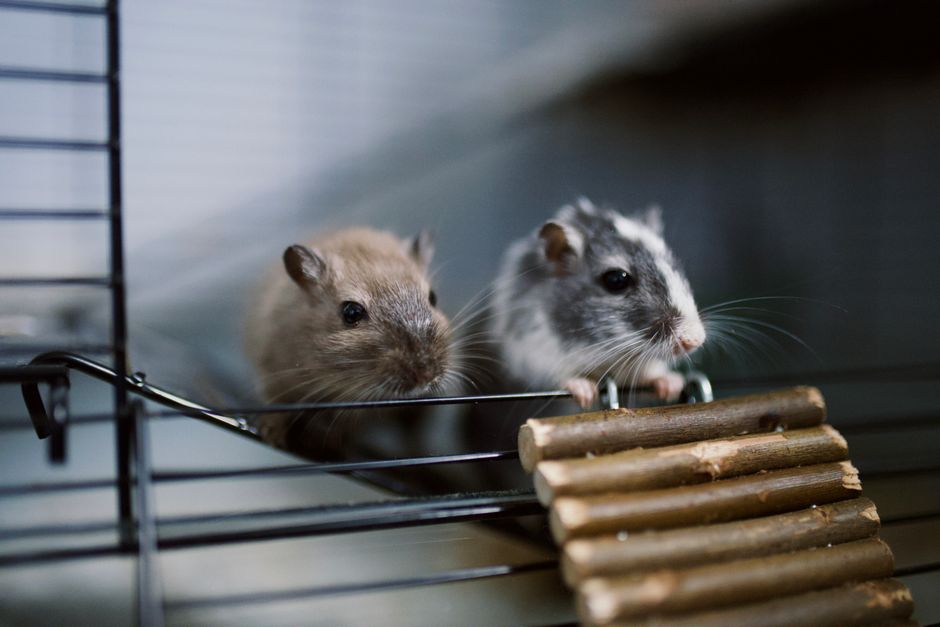
Gerbils are territorial, and adults that don’t know each other will often fight if you simply put them together. The split cage method solves this by housing two gerbils side by side in one divided enclosure so they can see, smell, and hear each other without being able to make contact. Over roughly one to two weeks, they get familiar enough that most pairs can be safely united. The method is widely used by gerbil keepers and is the standard approach for introducing unfamiliar gerbils, though it works best with young animals and same-sex pairs.
Why Can’t You Just Put Two Gerbils Together?
Gerbils are highly territorial, and an unfamiliar gerbil dropped into another’s space is usually treated as an intruder. In the wild, gerbils live in family groups and defend their burrow against outsiders. That instinct doesn’t disappear in captivity.
Gerbils are also fast and can do real damage to each other. Their incisors are sharp, and a serious fight can cause injury or death within minutes. Unlike some rodents that scuffle and then settle, gerbils that fight often keep fighting. This is why the “just put them together and watch” approach is risky.
There is a second reason the split cage method matters. Gerbils are social animals that generally do poorly when housed alone. A single gerbil can become stressed and withdrawn. But pairing them badly is worse than keeping them apart briefly. The split cage gives you a controlled way to build familiarity before any contact happens.
What Supplies Do You Need Before You Start?
You need a suitable divided enclosure before the gerbils arrive. A glass tank with a mesh or wire divider fitted securely in the middle is the usual setup. The divider must be fixed in place, not loose, because a determined gerbil can push a weak divider aside.
Here is what to gather:
- A tank large enough that each half gives the gerbil real floor space, not a cramped strip
- A sturdy divider with small mesh openings that allows smell and sight but no contact
- Two of everything: water bottles, food dishes, hideouts, and bedding
- A solid lid, since gerbils can jump and climb
- Deep bedding on both sides for burrowing
Keep the setup simple during the introduction. Elaborate toys and tunnels aren’t necessary yet and can complicate the swap process described below.
How To Introduce Gerbils Using The Split Cage Method
The core of the method is a daily swap. Each day you move the two gerbils to opposite sides of the divider, so each one spends time in the other’s space and bedding. This is what builds the shared scent that tells both animals they belong to the same group.
Here is the process step by step:
- Set up the divided tank and place one gerbil on each side. Give them a day or two to settle in before you start swapping.
- Swap them once a day. Move gerbil A to side B and gerbil B to side A. Do this gently, using a cup or your hands, and keep the swap quick.
- Don’t clean the bedding during this period. The whole point is to let each gerbil’s scent build up on both sides. Cleaning wipes out the progress.
- Watch their behavior at the divider. Gerbils that are becoming comfortable will groom near each other, sleep close to the divider, and show little aggression. Gerbils that aren’t ready may chatter their teeth, thump, or lunge at the mesh.
- Keep swapping daily until the behavior at the divider is calm and consistent.
How long this takes varies. Many keepers report progress within one to two weeks, but some pairs take longer. There is no fixed timeline that applies to every pair, and rushing it is the main cause of failed introductions.
How Do You Know They’re Ready To Live Together?
You’re looking for calm, not just the absence of fighting. Ready gerbils will often sleep pressed against the divider on both sides. They may groom themselves while the other is close by. There is little or no teeth chattering, thumping, or lunging when they meet at the mesh.
When you see this consistently for several days, you can attempt a meeting. Do it in a neutral, empty space — a dry bathtub or a large empty box works well. Put both gerbils in at the same time, not one after the other. Have a thick towel or a small dustpan ready to separate them if needed.
Watch closely. Normal behavior includes sniffing, grooming each other, and settling down together. Warning signs include:
- Locked-together fighting or rolling balls of fur
- Biting that draws blood
- One gerbil pinned and unable to escape
- Persistent chasing with no letup
If you see any of these, separate them and return them to the split cage. Some pairs need more time. A few simply don’t get along, and forcing it risks injury.
What Happens After They’re United?
Once the pair is living together peacefully, move them into a single, freshly cleaned enclosure — ideally one that neither gerbil considers its own territory. A neutral tank reduces the chance that one gerbil defends “its” space against the other.
Keep the setup simple for the first few days. Provide deep bedding, a water source, and a hideout, but skip the elaborate tunnels until things are clearly settled. Watch for renewed scuffling, especially in the first week.
One point that catches people out: gerbils form strong pair bonds, and separating a bonded pair can cause real distress. Once two gerbils are living together well, they should generally stay together. This is also why the introduction matters so much — a good pairing is a long-term commitment, not a temporary arrangement.
What Are the Common Mistakes With the Split Cage Method?
The most common mistake is moving too fast. People see calm behavior at the divider and assume the gerbils are ready, then unite them before the bond has formed. The result is often a fight that sets the process back.
Other frequent errors include cleaning the bedding during the swap period, which erases the scent progress, and using a divider that isn’t secure. A loose divider lets one gerbil get through, and the introduction becomes a surprise encounter.
Another mistake is attempting the method with gerbils that are already adults with strong territorial instincts and expecting quick results. The method can work with adults, but young gerbils — often introduced when they’re still juveniles — tend to accept each other more readily. Age and temperament both affect how smoothly it goes, and no method guarantees a successful pairing.
Does the Split Cage Method Always Work?
No. The split cage method improves the odds considerably and is the most reliable approach keepers use, but it is not a guarantee. Some pairs simply don’t bond, and a minority of introductions fail even when done carefully.
If a pairing doesn’t work after a reasonable period, the honest options are to keep trying with more time or to house the gerbils separately. Keeping a single gerbil alone is not ideal for the animal, but a failed pairing that ends in injury is worse. There is no clinical or veterinary guideline that dictates a fixed number of days for this process, so judgment and careful observation matter more than a strict schedule.
If either gerbil is injured during an introduction attempt, or if you’re unsure whether a wound needs veterinary care, contact a veterinarian who treats small animals. Gerbil bites can become infected, and a professional assessment is the safe choice.
Frequently Asked Questions
How long does the split cage method take?
Most keepers see progress within one to two weeks, but the timeline varies by pair and there is no fixed rule. Judge readiness by calm behavior at the divider rather than by the calendar.
Can I introduce two adult gerbils using the split cage method?
Yes, it can work with adults, though adult gerbils tend to be more territorial and may take longer. Young gerbils usually accept each other more readily.
Should I clean the cage during the split cage introduction?
No. Avoid cleaning the bedding during the swap period because the shared scent is what builds familiarity between the two gerbils.
What should I do if the gerbils fight when I put them together?
Separate them immediately and return them to the split cage for more time. If a fight draws blood or leaves one gerbil injured, have a veterinarian examine it.
