
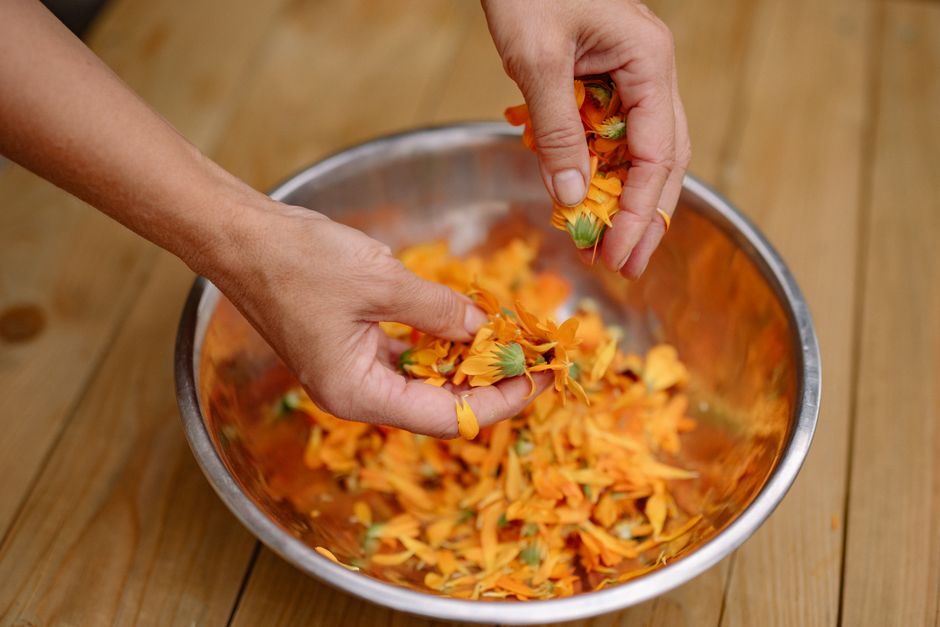
Infusing calendula in oil means covering dried calendula flowers with a carrier oil and letting the plant’s oil-soluble compounds move into the oil over time. The cold method soaks the flowers at room temperature for several weeks. The heat method uses gentle warmth to speed the same process into a few hours. Both work. The difference is time, convenience, and how much heat-sensitive color and aroma the finished oil keeps.
Calendula is one of the most common herbs in homemade skin oils and salves. It has a long history of topical use, and it is generally regarded as gentle. What it does not have is a large body of rigorous human trial evidence behind most of the specific claims made for it. That distinction matters, and it runs through everything below.
What Is Calendula And Why Infuse It In Oil?
Calendula is the common name for Calendula officinalis, a flowering plant in the daisy family. The petals are bright yellow to orange and slightly sticky. The part used for oil infusion is almost always the dried flower head, sometimes just the petals.
The plant’s useful compounds are not water-soluble in the same way tea herbs are. The resins, waxes, and fat-soluble pigments in the petals dissolve in oil. That is the whole reason oil infusion exists. You are not making a tea. You are pulling out the oil-loving fraction of the plant.
The compounds most often discussed in calendula research are triterpenoids, flavonoids, and carotenoids. These are the same families of molecules found across many plants. Laboratory studies have looked at calendula extracts for antioxidant and anti-inflammatory activity. Those are test-tube and animal findings. They do not automatically translate into a proven effect on human skin.
What is fair to say: calendula oil is a traditional topical preparation with a long history of use, a good safety record for most people when applied to intact skin, and limited high-quality human trial evidence for specific outcomes. It is not a medicine. It is a carrier oil that has been given some of the plant’s fat-soluble content.
How To Infuse Calendula In Oil: Cold And Heat Methods Compared
Both methods produce a usable infused oil. They differ in how much time and heat they involve, and heat is the variable that matters most.
The cold method is slower and gentler. You fill a clean jar with dried flowers, cover them with oil, seal it, and leave it in a warm, dark spot for several weeks, shaking it every day or two. Heat never enters the equation, so heat-sensitive pigments and aromatics stay intact. The tradeoff is time and the small risk of spoilage if moisture gets in.
The heat method uses a controlled, low temperature to accelerate extraction. You warm the flowers and oil together, usually in a double boiler or a jar set in a pot of water, for a few hours. The oil should be warm to the touch, not hot and never simmering or frying. Higher heat extracts faster but can degrade some compounds and can push the oil toward rancidity.
Neither method is “better” in an absolute sense. The cold method preserves more of the delicate fraction. The heat method gets you a finished oil the same day. Many people use the heat method for everyday salves and the cold method when they want the most intact color and scent.
| Factor | Cold infusion | Heat infusion |
|---|---|---|
| Time | Several weeks | A few hours |
| Temperature | Room temperature | Warm, low heat only |
| Heat-sensitive compounds | Best preserved | Partly degraded |
| Spoilage risk | Higher if moisture is present | Lower, since heat drives off some water |
| Best for | Maximum quality, small batches | Same-day results, larger batches |
What You Need To Get Started
The quality of the finished oil depends more on your starting materials than on your technique. Garbage in, garbage out applies here.
- Dried calendula flowers. Fully dry, crumbly, and free of visible mold. Fresh flowers carry water, and water in oil is the main cause of spoiled infusions.
- A carrier oil. Olive, sunflower, safflower, jojoba, sweet almond, or fractionated coconut oil all work. Choose one with a shelf life long enough for your plans.
- A clean glass jar with a tight lid. Glass does not react with the oil. Metal can over time.
- A double boiler or a jar in a pot of water if you are using heat. Never put oil directly over a flame at high heat.
- Cheesecloth or a fine strainer for separating the flowers from the oil.
One point that trips people up: dried flowers absorb a surprising amount of oil. If you want a cup of finished oil, start with more oil than you think you need. A common working ratio is roughly one part dried flowers to two or three parts oil by volume, but this is a practical convention rather than a measured standard.




Step-By-Step: The Cold Infusion Method
The cold method is simple, but it rewards patience and cleanliness. Work with dry tools and dry hands.
- Fill a clean, dry glass jar loosely with dried calendula flowers. Do not pack them down.
- Pour carrier oil over the flowers until they are fully covered, with an inch or so of oil standing above the plant material. Flowers poking above the surface can grow mold.
- Seal the jar and set it in a warm spot out of direct sunlight. A cupboard works well.
- Shake gently once a day for the first week, then every few days after that.
- Let it sit for several weeks. Color and scent will deepen over time.
- Strain through cheesecloth into a clean jar. Squeeze the cloth to recover the oil the flowers are holding.
- Label with the date and the oil you used. Store in a cool, dark place.
If you see any water droplets at the bottom of the jar, or smell anything sour or off, discard the batch. Do not try to salvage it.
Step-By-Step: The Heat Infusion Method
The heat method is faster but less forgiving. The single most common mistake is using too much heat.
- Combine dried calendula flowers and carrier oil in a clean glass jar or the top of a double boiler. Use the same loose-fill approach as the cold method.
- Set the jar in a pot with a few inches of water, or use a double boiler. The water should not touch the oil container directly.
- Warm over low heat. Keep the oil warm to the touch, roughly the temperature of a warm bath. It should never bubble, smoke, or fry.
- Hold that temperature for a few hours, stirring occasionally. Two to four hours is a common range, though this is a practical convention rather than an established standard.
- Remove from heat and let it cool slightly.
- Strain through cheesecloth into a clean jar, squeezing to recover absorbed oil.
- Label and store in a cool, dark place.
If the oil starts to smell cooked, acrid, or “off” during heating, you have pushed it too far. Turn the heat down or start over.
Which Oil Should You Use?
The carrier oil does two jobs. It extracts the plant compounds, and it becomes the base of whatever you make next. Its own shelf life matters as much as its extraction ability.
Olive oil is traditional, widely available, and has a long shelf life, but it has a strong scent that can mask the calendula. Sunflower and safflower are lighter and nearly odorless, which makes them popular for salves and facial oils. Jojoba is technically a liquid wax, very stable, and absorbs quickly, though it costs more. Sweet almond is light and pleasant but goes rancid faster than olive or jojoba. Fractionated coconut oil is stable and light, though it lacks some of the heavier fatty acids that help pull out waxy plant compounds.
There is no single best choice. Pick based on what you plan to do with the oil and how quickly you will use it.
How Long Does Calendula Oil Last?
Infused calendula oil lasts about as long as the carrier oil you started with, and usually a bit less. The plant material introduces trace moisture and compounds that can speed up oxidation.
Store it in a cool, dark place in a tightly sealed glass jar. Light and heat are the two biggest enemies. A cupboard away from the stove is better than a sunny windowsill.
Signs the oil has gone bad include a rancid or crayon-like smell, a sticky or tacky feel, and a darker or cloudy appearance that was not there before. Rancid oil should be discarded. It will not perform the way fresh oil does, and it can irritate skin.
Adding a small amount of vitamin E oil is a common practice among home herbalists. Whether it meaningfully extends shelf life in a homemade infusion is not well established. Some evidence suggests it can slow oxidation in certain oils, but results vary. Treat it as a reasonable precaution, not a guarantee.
What Is Calendula Oil Actually Good For?
This is where honesty matters most. Calendula oil is widely used topically, and it has a long history in traditional herbal practice. It is generally well tolerated on intact skin.
What the evidence actually shows is more modest. Some small studies and traditional use suggest calendula preparations may soothe minor skin irritation, and some research has looked at calendula in wound care settings. The human trial evidence is limited, often small, and rarely of the quality needed to make firm claims. There is no strong evidence that calendula oil treats any specific skin condition better than a plain carrier oil.
It is reasonable to use calendula oil as a gentle, pleasant base for salves, balms, and massage oils. It is not reasonable to expect it to cure eczema, heal infections, or replace prescribed treatment. If you have a skin condition that is persistent, painful, spreading, or infected, see a clinician. Do not self-treat with infused oil.
One non-obvious point: the carrier oil is doing a lot of the work in most “calendula oil” products. Olive and sunflower oils are themselves emollients that soften and protect skin. Some of the benefit people attribute to calendula may simply be the oil base. That does not make the infusion useless. It just means the plant is not the only active ingredient in the jar.
Safety And Cautions
Calendula is in the daisy family, which includes ragweed, chrysanthemums, and marigolds. People with allergies to those plants may react to calendula too. If you have known plant allergies, patch test on a small area of skin first and wait a day before wider use.
Do not apply infused oils to open wounds, burns, or broken skin without medical guidance. A homemade oil is not sterile, and introducing it to a wound can cause problems.
If you are pregnant, breastfeeding, or making this for an infant or child, note that no clinical guidelines exist for calendula oil use in these groups. Topical use is generally considered low risk, but the evidence is limited, and it is worth asking a clinician before applying anything new to a baby’s skin. Calendula is also sometimes taken internally, but that is a different question entirely and carries different risks. Do not assume that because it is used on skin it is safe to swallow.
Keep all infused oils out of reach of children, and never use a batch that smells or looks wrong.
Frequently Asked Questions
Can I use fresh calendula flowers instead of dried?
Fresh flowers contain water, and water in oil causes spoilage and mold. Use fully dried flowers for any oil infusion.
How long do I need to infuse calendula oil using the cold method?
Several weeks is typical, with daily shaking for the first week. There is no fixed standard, and longer infusion generally deepens color and scent.
What temperature should the oil be for the heat method?
Keep it warm to the touch, roughly like a warm bath, and never let it bubble or smoke. High heat degrades the plant compounds and can turn the oil rancid.
Is calendula oil safe for babies?
No clinical guidelines exist for calendula oil use in infants, so ask a clinician before applying it to a baby’s skin. Patch test on a small area first if you do use it.
