
Dunking a basketball is a clear goal for many players, but it is not just about being tall. Increasing your vertical jump requires a specific mix of strength training, explosive power work, and proper technique. Research shows that focused training programs can add 4 to 8 inches to your vertical jump over 8 to 12 weeks. The most effective approach combines heavy strength exercises like squats with explosive movements like plyometrics, all while giving your body enough time to recover.
What Is the Single Most Important Factor for Jumping Higher?
The biggest factor in how high you jump is your rate of force development (RFD). This is a fancy way of saying how quickly you can produce force. Jumping is not just about raw strength. It is about applying that strength in a split second. A person who can squat 400 pounds slowly will not jump as high as someone who can squat 300 pounds very fast.
Studies published in the Journal of Strength and Conditioning Research have found that RFD is a stronger predictor of vertical jump height than maximum strength alone. This means your training must focus on speed just as much as weight. Lifting a heavy barbell slowly builds muscle, but it does not teach your nervous system to explode upward. You need exercises that force your muscles to contract as fast as possible.
The second factor is your stretch-shortening cycle. When you dip down before jumping, you stretch the muscles in your legs and store elastic energy. Releasing that energy quickly adds inches to your jump. Plyometric training specifically targets this cycle.
How To Increase Your Vertical Jump To Dunk In Basketball With Strength Training
Strength training builds the raw power your legs need to push off the ground. The best exercises for vertical jump are compound movements that work multiple joints at once. Squats, deadlifts, and lunges are the foundation. The back squat is the most studied exercise for improving vertical jump. Research from the National Strength and Conditioning Association shows that squatting at 80 to 90 percent of your one-rep max for sets of 3 to 5 reps increases lower body power significantly.
But you cannot just squat heavy all the time. You need to combine heavy days with explosive days. On explosive days, use a weight that is about 50 to 60 percent of your max and move it as fast as you can. Jump squats with a light barbell or dumbbells are a good option. The goal is to leave the ground at the top of the movement. This trains your body to produce force quickly.
Do not forget your calves and glutes. Strong calves help with the final push off the ground. Strong glutes drive your hips upward. Exercises like Romanian deadlifts and calf raises should be in your program twice per week.
What Plyometric Exercises Actually Add Inches?
Plyometrics are explosive bodyweight exercises that train the stretch-shortening cycle. They are the closest thing to jumping itself. The most effective plyometric for vertical jump is the depth jump. You step off a box, land on the ground, and immediately jump as high as possible. The landing stores energy, and the jump releases it. A study in the Scandinavian Journal of Medicine and Science in Sports found that depth jumps improved vertical jump height by an average of 4.7 percent over 6 weeks.
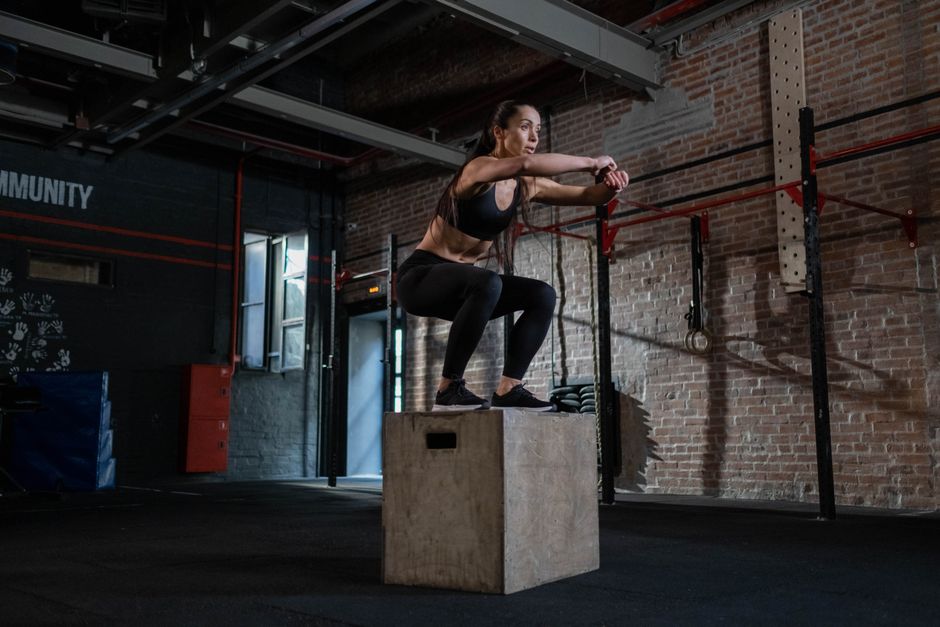
Box jumps are also excellent but often done incorrectly. Many people step up onto the box instead of jumping. To get the benefit, you need to jump from a standing start and land softly on the box. Start with a box height of 12 to 18 inches and increase slowly. Pogo jumps — small, rapid jumps staying in place — build ankle stiffness and reactive strength. They are a good warm-up exercise.
Here is a simple plyometric progression:
- Week 1-2: Box jumps (low box), pogo jumps, and standing broad jumps
- Week 3-4: Depth jumps (low box, 12 inches), tuck jumps, and lateral bounds
- Week 5-6: Depth jumps (medium box, 18-24 inches), single-leg box jumps, and 180-degree jumps
- Week 7-8: Depth jumps (higher box, 24 inches), weighted vest jumps, and hurdle hops
Do plyometrics no more than two to three times per week. Your nervous system needs 48 hours to recover from high-intensity explosive work. Doing them every day increases injury risk and reduces gains.





How Much Rest and Recovery Do You Need?
Rest is not optional. It is where your muscles repair and get stronger. The vertical jump is a high-force, high-speed movement. Without enough recovery, your performance drops and your risk of injury rises. The American College of Sports Medicine recommends at least 48 hours between intense leg training sessions. This means you should never do heavy squats and plyometrics on consecutive days.
Sleep is the most underrated factor. A study from Stanford University found that basketball players who slept 10 hours per night improved their sprint times and shooting accuracy. Vertical jump likely follows the same pattern. Aim for 7 to 9 hours of quality sleep per night. Your central nervous system recovers during deep sleep. If you are tired, your reaction time slows and your jump height drops.
Active recovery can help. Light jogging, cycling, or swimming on rest days keeps blood flowing without stressing your legs. Stretching is useful for mobility but does not directly increase jump height. Foam rolling may reduce soreness but does not improve performance. Do not confuse feeling loose with being recovered.
What Diet and Body Composition Changes Help?
Your body weight directly affects how high you jump. You are essentially launching your body mass into the air. Less body fat means less weight to lift. More muscle mass in your legs means more force to lift it. The ideal situation is to be lean with strong, powerful legs.
Protein intake matters for muscle repair. Aim for 1.6 to 2.2 grams of protein per kilogram of body weight per day. This is the range supported by research from the International Society of Sports Nutrition. Good sources are chicken, fish, eggs, dairy, and plant options like beans and tofu. Carbohydrates are also important because they fuel explosive movements. Eat complex carbs like oats, rice, and potatoes around your workouts.
One common mistake is trying to lose weight too fast while training for vertical jump. Rapid weight loss reduces energy and muscle mass. If you need to lose body fat, do it slowly, at a rate of 0.5 to 1 pound per week. Your performance should not drop during the process.
Comparison of Vertical Jump Training Methods
Different training methods produce different results. Here is a comparison based on research and practical experience:
| Training Method | Primary Benefit | Frequency Per Week | Expected Gain (8 Weeks) | Risk Level |
|---|---|---|---|---|
| Heavy strength training (squats, deadlifts) | Raw leg power | 2-3 times | 2-4 inches | Low to moderate |
| Plyometrics (depth jumps, box jumps) | Explosive speed and reactive strength | 2-3 times | 3-6 inches | Moderate |
| Olympic lifting (power cleans, snatches) | Full-body explosive power | 1-2 times | 2-4 inches | Moderate to high |
| Plyometric + strength combined | Both power and speed | 3-4 times | 4-8 inches | Moderate |
| Flexibility and stretching alone | Range of motion | Daily | Negligible | Low |
Notice that flexibility alone does not increase jump height. Stretching helps prevent injury but does not make you jump higher. The combination of strength and plyometrics consistently produces the best results.
What Common Mistakes Stop People From Dunking?
Many people train hard but never see big gains because of a few key errors. The first mistake is overtraining. Doing intense leg work every day breaks down muscle faster than it can rebuild. You need rest days. If your jump height is going down week after week, you are not recovering enough.
The second mistake is poor technique. A proper jump starts with a quick dip, a forceful arm swing, and a full hip extension. Many people jump with their knees caving inward or their back rounding. This wastes energy and reduces height. Record yourself jumping from the side. Look for your arms driving upward and your hips opening fully at the peak of the jump.
The third mistake is neglecting the core. Your core connects your upper body and lower body. A weak core means energy leaks out during the jump. Planks, Russian twists, and hanging leg raises build the stability you need. Do core work two to three times per week.
The fourth mistake is expecting quick results. Adding 4 inches in 8 weeks is realistic. Adding 12 inches in 4 weeks is not. Programs that promise huge gains in a month are usually selling a myth. Real progress takes consistent effort over months.
Frequently Asked Questions
How long does it take to increase vertical jump for dunking?
Most people see noticeable gains in 8 to 12 weeks with consistent training. Adding 4 to 8 inches is a realistic goal if you follow a proper program.
Can you increase vertical jump without weights?
Yes, plyometric exercises like box jumps and depth jumps can improve your jump without weights. Gains will be slower than with strength training, but progress is still possible.
Is it possible to dunk if you are short?
Yes, many shorter players have learned to dunk through training. A 5-foot-9 person with a 38-inch vertical can reach the rim. It requires dedication and proper technique.
How many days per week should I train for vertical jump?
Train leg strength and plyometrics two to three times per week each. Do not train legs on consecutive days. Rest and recovery are essential for results.
