
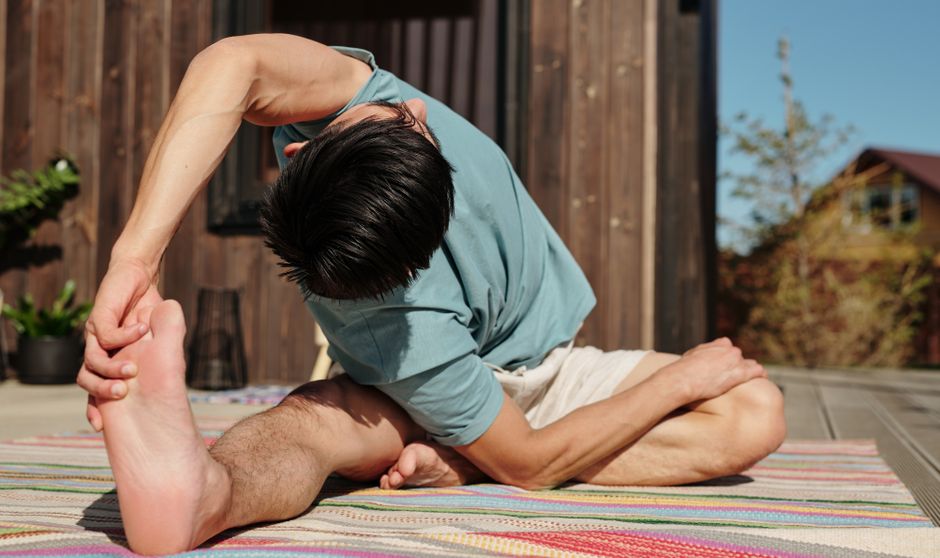
Improving your sit and reach comes down to two things: lengthening the muscles that limit the movement and controlling your nervous system’s response to the stretch. The sit and reach test measures hamstring and lower back flexibility, and most people can improve their score with consistent stretching over several weeks. The key is knowing which muscles to target and how to stretch them without triggering a protective tension response that works against you.
What Does The Sit And Reach Test Actually Measure?
The sit and reach test measures the flexibility of your hamstrings and lower back. You sit on the floor with legs extended and reach forward as far as possible. The distance you reach is your score.
But here is what many people miss: the test does not measure just one thing. Your score depends on hamstring length, lower back flexibility, hip joint structure, and even the ratio of your limb lengths. Someone with naturally long arms and a short torso may score well without particularly flexible hamstrings. Someone with a long torso and short arms may struggle even with good flexibility.
Research has questioned how well the sit and reach test predicts overall flexibility or injury risk. Some studies suggest it has limited value as a general fitness measure because it only assesses one movement pattern. It remains widely used in schools and fitness settings because it is simple and requires no equipment.
Understanding this matters because chasing a better score without understanding your limiting factor can lead to frustration. If your hamstrings are already flexible but your hip structure limits forward bending, more stretching will not help much.
Why Do Some People Struggle With The Sit And Reach?
Hamstring tightness is the most common limiter. The hamstrings run along the back of your thigh from your sit bones to below your knee. When they are short or tense, they resist the forward bend needed to reach your toes.
The nervous system also plays a role. Stretching triggers sensors in your muscles and tendons that signal the spinal cord to resist the movement. This is a protective reflex, not a sign of permanent tightness. With repeated gentle stretching, this reflex becomes less active, allowing greater range of motion.
Other factors that affect your reach include:
- Lower back mobility — the spine contributes significantly to forward bending
- Hip joint anatomy — the shape of your hip socket can limit how far you bend
- Body proportions — arm length relative to torso and leg length
- Previous injuries — scar tissue or joint changes can restrict movement
- Age and activity level — flexibility tends to decrease without regular movement
One clarification worth making: feeling tight does not always mean your muscles are physically short. Sometimes the sensation of tightness comes from the nervous system guarding a range of motion it perceives as risky. This is why slow, relaxed stretching often works better than forcing.
How To Improve Sit And Reach Stretches That Work
Effective stretching for the sit and reach follows a few principles. The goal is to gradually increase tolerance to the stretch, not to push through pain.
Hold stretches long enough. Research on static stretching generally supports holding a stretch for 15 to 60 seconds. Shorter holds may not produce lasting changes. Longer is not necessarily better — holding beyond your comfort level can trigger the protective reflex you are trying to calm.
Stretch consistently. Most research suggests stretching at least two to three times per week to see improvement. Daily stretching is generally safe for most people and may produce faster results. Flexibility gains fade if you stop stretching, so consistency matters more than intensity.
Relax into the stretch. Tensing against the stretch activates the muscle you are trying to lengthen. Breathe slowly and let the tension drop before going deeper.
Warm up first. Stretching cold muscles is less effective and potentially uncomfortable. A few minutes of light activity before stretching can help.
What about the evidence for stretching improving sit and reach scores specifically? Studies have generally found that regular hamstring stretching does improve sit and reach performance in most people. The improvements are typically modest but measurable over several weeks.





Which Stretches Actually Help?
Several stretches target the hamstrings and lower back. The most effective ones allow you to control the intensity and relax into the position.
Seated hamstring stretch. Sit with one leg extended and the other bent. Hinge forward from your hips over the extended leg. Keep your back straight rather than rounding. Hold for 30 seconds and switch sides.
Standing forward fold. Stand with feet hip-width apart. Bend forward from your hips, letting your upper body hang. Bend your knees slightly if needed. This stretches the hamstrings and lower back together.
Supine hamstring stretch. Lie on your back. Loop a strap or towel around one foot and lift that leg toward the ceiling. Keep the other leg flat on the floor. This position lets you control the stretch without loading your back.
Dynamic leg swings. Before static stretching, controlled leg swings can warm up the hamstrings and prepare them for longer holds. Swing one leg forward and back in a controlled arc, then switch.
For the lower back, gentle spinal flexion movements like cat-cow can help. But be cautious — if you have back pain, some forward bending can aggravate it. A healthcare provider can advise on what is appropriate for your situation.
Does Stretching Alone Improve Your Score?
Stretching helps, but it is not the only factor. Your sit and reach score also depends on how your nervous system allows you to move.
Some approaches combine stretching with other techniques. Proprioceptive neuromuscular facilitation, or PNF, alternates between contracting and relaxing the muscle being stretched. Some studies suggest PNF may produce greater flexibility gains than static stretching alone, though results vary and the evidence is not conclusive.
Strength training for the opposing muscles may also help. Strengthening your quadriceps and hip flexors can create better balance around the hip and knee, potentially allowing greater range of motion.
What does not appear to help: forcing the stretch, bouncing, or trying to push through pain. These approaches can trigger the protective reflex and may increase injury risk without improving flexibility.
How Long Until You See Improvement?
Most people notice some improvement within two to four weeks of consistent stretching. The changes are usually gradual. Significant gains typically take several weeks to a few months.
Early improvements often come from the nervous system relaxing its guard on the movement rather than actual muscle lengthening. This is still real progress — your range of motion has increased. True changes in muscle length take longer and are generally modest.
If you have been stretching consistently for several weeks with no change, consider whether something else is limiting you. Hip structure, back mobility, or body proportions may be the real barrier. A physical therapist can assess what is actually restricting your movement.
It is also worth noting that flexibility is not the same as health. Being able to reach your toes does not predict lower injury risk or better athletic performance. Some very flexible people have no advantage over less flexible ones. The sit and reach is one measure of one aspect of fitness, not a verdict on your overall health.
Frequently Asked Questions
How often should I stretch to improve my sit and reach?
Stretching at least two to three times per week is generally recommended for flexibility gains. Daily stretching is safe for most people and may produce faster results.
Can I improve my sit and reach in one week?
Some people see small improvements within a week, mostly from the nervous system relaxing its protective response. Meaningful changes in muscle length typically take several weeks of consistent stretching.
Is it bad if I can’t reach my toes?
Not being able to reach your toes is common and not necessarily a problem. Your score depends on many factors including body proportions and hip structure, not just hamstring flexibility.
Should I stretch before or after exercise?
Static stretching is generally more effective after exercise when muscles are warm. Before activity, dynamic movements that take your joints through their range of motion may be more appropriate.
