
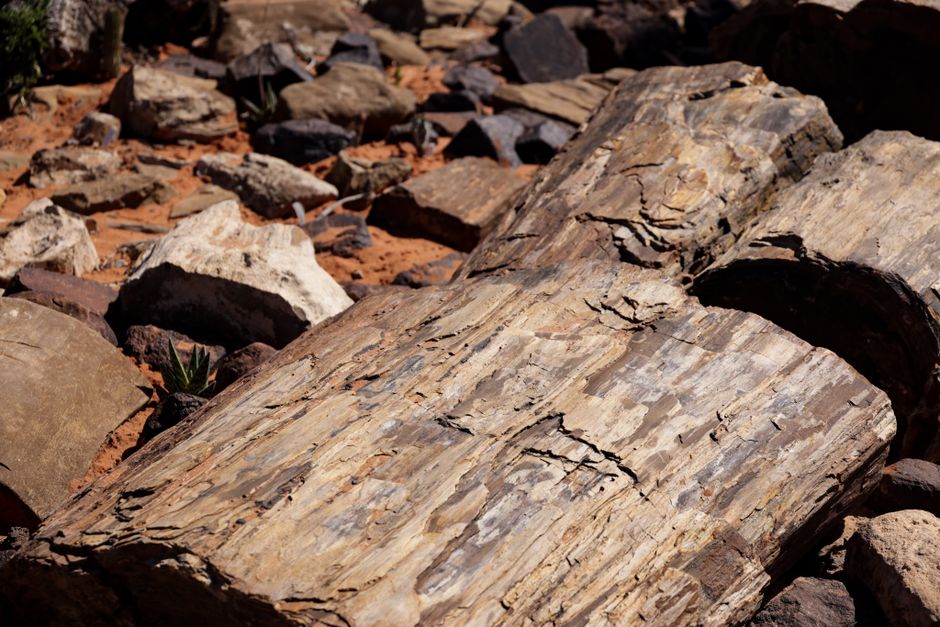
Petrified wood is fossilized wood. Over long periods, minerals slowly replace the original plant material, turning it to stone while often preserving the grain, rings, and bark patterns. You identify it by looking for wood structure that has been preserved in stone: visible growth rings, straight grain lines, bark texture, and a hard, rock-like weight. Simple tests — checking hardness, weight, and how it breaks — help confirm what your eyes suggest.
This is a case where the visual evidence is strong but not always obvious. Many rocks mimic wood, and some real petrified wood looks nothing like a log. The sections below explain what to look for, which tests actually mean something, and where people commonly get fooled.
What Does Petrified Wood Look Like?
Petrified wood looks like wood that has turned to stone. The shape of a branch or log is often intact, but the surface has the texture and hardness of rock.
The most reliable visual feature is preserved wood anatomy. Look for parallel lines running along the length of the piece — these are grain lines. On a cross-section, you may see concentric rings where growth rings once were. Bark texture can also survive, showing the rough or scaly pattern of the original tree.
Color varies enormously and is not a reliable identifier on its own. Petrified wood can be brown, gray, black, red, yellow, or nearly white depending on which minerals replaced the wood. Silica is common, but iron, manganese, and other elements create the colors. A piece that is bright red is not “more real” than a plain gray one.
One detail people miss: petrified wood often breaks like stone, not like wood. A broken edge shows a smooth, glassy, or grainy rock surface rather than splintered fibers.
How To Identify Petrified Wood Visual Cues Tests
Start with your eyes, then confirm with simple physical tests. No single test proves petrified wood on its own — the strongest identification comes from several clues agreeing.
Visual cues to check first
- Grain lines: Straight, parallel lines running the length of the piece, like the grain in a wooden board.
- Growth rings: Concentric circles or arcs on a cut or broken end.
- Bark patterns: Rough, textured outer surfaces that match tree bark.
- Knots and branch stubs: Round bumps or junctions where branches once grew.
- Color banding: Mineral colors that follow the wood structure rather than cutting across it randomly.
Physical tests to confirm
Hardness. Petrified wood is essentially stone. Most pieces are harder than a steel nail and will scratch glass. Real wood is soft and will not. If a nail easily digs in, you likely have modern wood, not fossilized wood.
Weight. Pick it up. Petrified wood is dense and heavy for its size — noticeably heavier than a same-sized piece of ordinary wood or light rock. This is one of the quickest reality checks.
The break test. Look at any broken surface. Stone breaks with sharp, clean, or grainy edges. Wood breaks with splinters and fibrous strands. This difference is usually obvious once you know to look.
The tongue test. Dry petrified wood can feel slightly sticky to the tongue because its porous structure draws moisture. This is a weak clue, not proof, and it works poorly on polished or wet surfaces. Treat it as a minor hint only.
Why Do People Mistake Other Rocks For Petrified Wood?
Several common rocks and minerals mimic wood closely enough to fool most people. Knowing the lookalikes saves a lot of confusion.
Concretions and nodules are rounded rock masses that can develop banding and cracks resembling grain. Their patterns usually do not run in straight, parallel lines the way real grain does.
Limonite and ironstone can form in woody shapes and take on brown, rusty colors. They often lack true growth rings and may feel lighter or softer than petrified wood.
Fossilized bone can resemble wood at a glance, but bone has a different internal texture and often shows a spongy interior rather than grain.
Slag and industrial byproducts sometimes form in log-like shapes with flow lines. These are not natural and usually lack organized wood structure.
The key difference: real petrified wood shows organized, repeating wood anatomy — grain, rings, bark. Lookalikes tend to show random patterns, cracks, or banding that does not follow a wood-like structure.
Can You Test Petrified Wood At Home?
You can run several useful checks at home without special equipment. None is definitive, but together they narrow things down considerably.
A simple scratch test tells you a lot. Try scratching the surface with a steel nail or a piece of glass. Petrified wood is hard enough that a nail will struggle to leave a mark, and it can scratch glass. Ordinary wood and softer rocks fail this test.
Weigh it in your hand against a similar-sized rock or piece of wood. The density difference is often clear.
Examine a fresh break or chip under bright light, ideally with a magnifying glass. This is where grain and ring structure become easiest to see. A cheap jeweler’s loupe works well.
What home testing cannot do is confirm the exact mineral composition or the age of the specimen. For that, you need laboratory analysis. If a piece matters to you — for value or collection — a museum, university geology department, or professional appraiser is the reliable route.
When Should You Get A Professional Opinion?
Get expert help when money, legal ownership, or significant collection value is involved. Home tests are good for curiosity, not for appraisal.
Geologists and paleontologists can identify petrified wood with high confidence using microscopy and mineral analysis. Many university geology departments will look at a sample, sometimes for free. Local rock and mineral clubs are another practical resource, and their members often have decades of field experience.
Be cautious with sellers who claim a piece is rare, valuable, or from a famous location without documentation. Provenance — where a specimen came from — matters for value and is hard to verify after the fact. A beautiful piece of petrified wood is common and often inexpensive. Genuine rarity is the exception, not the rule.
What Petrified Wood Is Not
Petrified wood is not the same as all fossil wood, and it is not a living material. The term specifically refers to wood that has been replaced by minerals.
Some fossil wood is preserved differently — for example, compressed or carbonized rather than fully mineralized. These are still fossils but not what most people mean by petrified wood.
It also has no established health or healing properties. Claims that petrified wood balances energy or treats illness are not supported by clinical evidence. It is a fascinating geological specimen, not a medical product.
If you are handling rough specimens, basic care applies. Freshly broken edges can be sharp, and dusty material from cutting or grinding stone should not be inhaled. Use common sense and eye protection when working with any rock.
Frequently Asked Questions
How can you tell if wood is petrified?
Look for preserved wood structure — grain lines, growth rings, and bark texture — combined with the hardness and weight of stone. A piece that scratches glass and feels heavy for its size is very likely petrified wood.
Does petrified wood feel like rock or wood?
It feels like rock. Petrified wood is dense and hard, and it breaks with the sharp, clean edges of stone rather than splintering like wood.
Can petrified wood scratch glass?
Most petrified wood is hard enough to scratch glass because the original wood has been replaced by hard minerals such as silica. If a piece cannot scratch glass and a nail digs in easily, it is probably not petrified wood.
Is petrified wood worth money?
Most petrified wood is common and inexpensive, though large, colorful, or unusually well-preserved specimens can be worth more. Get a professional appraisal before paying a premium or assuming a piece is valuable.
