
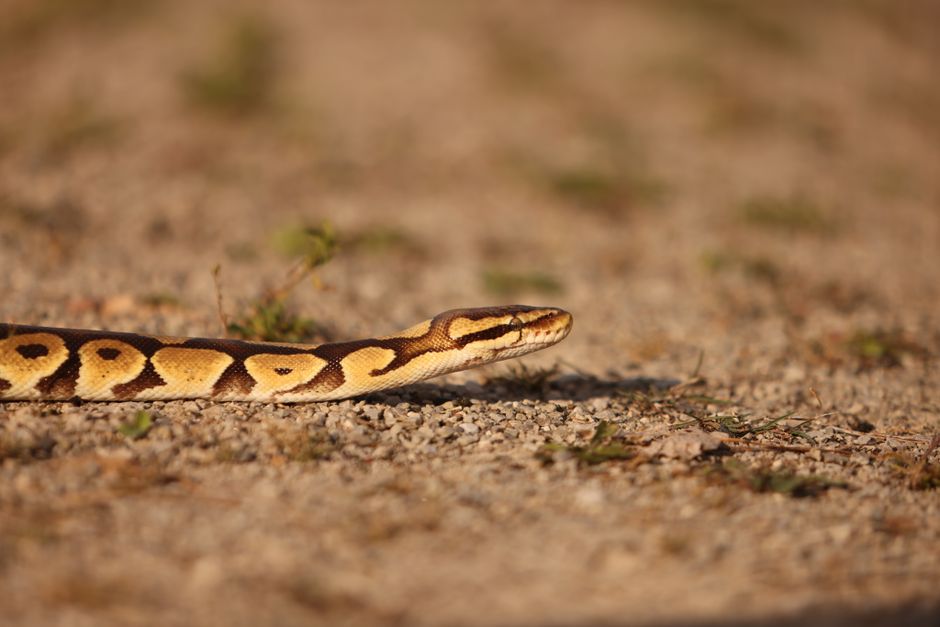
Ball python morphs are identified by comparing a snake’s pattern, color, and eye appearance against the known traits of established genetic lines. Most morphs change one or more of four things: the base color, the darkness of the pattern, the shape of the markings, or the amount of white. Because hundreds of morphs now exist and many look similar, identification usually means ruling out lookalikes rather than spotting one defining feature.
How To Identify Ball Python Morphs By Pattern And Color
Start with the base color. A normal ball python has a tan to brown body with dark brown or black blotches called saddles, and a pale belly. Any snake that deviates clearly from that baseline is carrying at least one morph gene.
Then look at pattern shape. Some morphs change color but leave the pattern intact. Others reshape the markings entirely. A few do both. Separating color changes from pattern changes is the single most useful habit in morph identification.
Finally, check the eyes. Eye color is one of the most reliable indicators in several well-known morphs, and it is often the fastest way to separate two snakes that otherwise look alike.
One clarification worth knowing: a morph is a genetic variant, not a breed or a species. Every ball python morph is the same species, Python regius. What differs is which genes are switched on and how they interact.
What Do the Main Ball Python Morphs Actually Look Like?
These are among the most widely kept and most consistently recognizable morphs. Descriptions below reflect how each typically appears, though individual snakes vary.
- Albino — no black pigment at all. The body is yellow to orange with white or pale lavender pattern markings, and the eyes are red or pink. This is a recessive trait.
- Piebald — large patches of pure white with no pattern, mixed with normal-colored areas. The amount of white varies widely from snake to snake. Also recessive.
- Pastel — a lighter, brighter yellow overall, with faded or washed-out dark pattern edges. Often described as having a “clean” look.
- Spider — a reduced, thin, web-like pattern with a lighter body. Frequently associated with a head wobble, a neurological trait discussed further below.
- Lesser — a faded, pale brown to gray-brown body with softened pattern edges and often a light or blue-gray eye.
- Mojave — similar to Lesser but generally darker, with a distinctive pattern that often forms a keyhole or “M” shape along the spine.
- Clown — a highly reduced pattern with a distinctive head marking and a pale, often orange-tinted body. Recessive.
- Banana — a pale yellow to cream body with faint pattern, and often small dark spots scattered along the sides.
Notice how many of these are described in relative terms — lighter, faded, reduced. That is not laziness. Morph appearance genuinely varies between individual snakes, and it shifts as a snake grows from juvenile to adult. A hatchling’s colors are not a reliable preview of its adult colors in many lines.
Why Color Alone Is Not Enough to Identify a Morph
Color is the least reliable single trait. Two reasons explain why.
First, ball pythons change color as they age. Many morphs start out brighter or more contrasty as juveniles and settle into duller tones as adults. A snake that looks like one morph at six months may look like a different one at three years.
Second, color is heavily influenced by lighting and photography. A photo taken under warm indoor light can make a Pastel look like a different line entirely. Two photos of the same snake under different lighting can look like two different snakes.
Pattern is more stable than color across a snake’s life. The shape and arrangement of markings tends to hold, even as the colors fade or deepen. If you are trying to identify a morph from a photo, pattern is the better starting point.





How Do Genetics Determine Which Morph You Get?
Morphs follow the same basic inheritance rules as other simple genetic traits. The two categories that matter most are recessive and dominant or co-dominant.
Recessive morphs require two copies of the gene — one from each parent — for the snake to visibly show the trait. Albino, Piebald, and Clown are classic examples. A snake with only one copy looks normal but can pass the gene to offspring. These are called “hets,” short for heterozygous.
Dominant and co-dominant morphs show visibly with just one copy of the gene. Pastel, Spider, and Mojave fall into this group. Co-dominant specifically means the heterozygous form looks different from the homozygous form — for example, a snake with two Pastel genes looks noticeably different from one with a single Pastel gene.
This matters for identification because some of the most visually striking snakes are combinations. A “super” form has two copies of a co-dominant gene. A “combo” or “double gene” snake carries two different morph genes at once. These animals can display patterns and colors that match no single morph, which is the main reason visual identification becomes genuinely difficult at the higher end of the hobby.
Why Some Morphs Are Hard to Tell Apart
Several morphs overlap heavily in appearance. Lesser and Mojave are a well-known example — both produce a faded, pale body, and inexperienced keepers mix them up regularly. The Mojave typically shows a darker overall tone and a more defined pattern, but the difference is subtle and not always clear in photos.
Pastel and several lighter lines also overlap. So do many of the “yellow belly” type morphs, where the distinguishing feature is a subtle change along the lower sides and belly rather than anything obvious on the back.
Breeders who work with these lines often rely on knowing the parents, not just looking at the snake. When lineage is unknown, even experienced keepers sometimes cannot give a confident answer. That is an honest limit of visual identification, not a failure of skill.
There is also a practical issue: some traits only reveal themselves in certain lighting, at certain ages, or when the snake is compared side by side with a known example. A single photo is often not enough to work from.
What About the Spider Wobble and Other Health Concerns?
Some morphs are linked to neurological or physical issues, and this is worth stating plainly rather than glossing over.
The Spider morph is associated with a neurological condition commonly called “wobble” or “wobble syndrome.” Affected snakes may show head tremors, poor coordination, and difficulty righting themselves. The severity varies widely — some snakes are barely affected, others are significantly impaired. The trait appears to be linked to the same gene that produces the Spider pattern, which is why it cannot simply be bred out while keeping the morph.
Other morphs have documented issues as well. Some lines are associated with eye abnormalities, and some with reduced fertility or other problems. The evidence base here is largely from breeder observation and veterinary case reporting rather than controlled studies, so the precise prevalence and severity are not well established.
The responsible position is straightforward: if you are considering acquiring a snake from a line with known associated health issues, ask about it directly and be aware that the trait may not be fully separable from the appearance you want. This is not a reason to panic about all morphs. Many morphs have no known associated health problems.
Can You Identify a Morph From a Photo Alone?
Sometimes, but not reliably. Clear photos in natural light showing the full body, the head, and the eyes give the best chance. Photos taken under colored or dim lighting are much less useful.
For common, visually distinct morphs like Albino or Piebald, a good photo is usually enough. For subtle lines, combination animals, or anything involving multiple genes, a photo often is not sufficient. In those cases, the only reliable answer comes from knowing the snake’s lineage.
If you are trying to identify a snake you already own and the answer matters — for breeding plans, for example — the practical route is to consult a breeder who works with that specific line. They can often narrow it down faster than any visual guide.
Frequently Asked Questions
What is the easiest ball python morph to identify?
Albino is generally the easiest, because the complete absence of black pigment and the red or pink eyes are unmistakable. Piebald is also straightforward, given the large white patches with no pattern.
Can two normal-looking ball pythons produce a morph?
Yes, if both parents carry a hidden recessive gene. Two snakes that look normal but are both “het” for Albino can produce Albino offspring. This is why lineage matters more than appearance when predicting offspring.
Is the Spider morph unhealthy?
The Spider morph is associated with a neurological condition called wobble, which affects coordination and can range from mild to severe. The trait appears linked to the gene that produces the pattern, so it is not fully separable.
Why does my ball python’s color look different than photos of the same morph?
Color varies with age, individual genetics, and lighting. Many morphs look brighter as juveniles and duller as adults, and photos taken under different light sources can make the same snake look like two different animals.
