
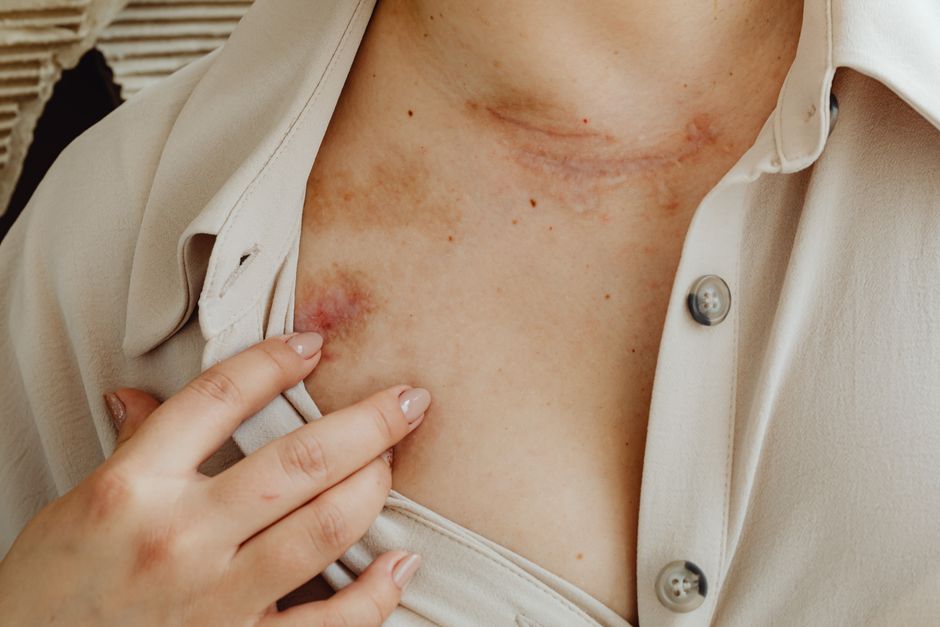
Arm lift scars can be hidden with makeup once the skin has fully closed and healed, usually a matter of weeks after surgery. Before that point, makeup should not be applied to an open wound. For the long term, options range from silicone gels and pressure garments to steroid injections, laser therapy, and scar revision surgery. Each works differently, and none erases a scar completely. The realistic goal is to make scars flatter, softer, and closer in color to the surrounding skin.
An arm lift (brachioplasty) leaves a scar because the procedure removes skin. The length and position depend on how much skin was removed and which technique the surgeon used. A full brachioplasty typically leaves a scar running along the inner arm, often from the elbow area up into the armpit and sometimes extending toward the back. A limited or mini brachioplasty leaves a shorter scar, usually confined to the underarm region.
That matters for concealment, because where the scar sits changes what will actually cover it.
Why Do Arm Lift Scars Look So Prominent At First?
A fresh surgical scar is not a finished scar. It is an active healing wound, and it changes considerably over the first year.
In the early weeks, the scar typically appears red, raised, and firm. This happens because the body is laying down collagen to close the wound and building a new blood supply to the area. The inner arm also moves constantly — reaching, lifting, dressing — and that movement puts tension on the healing tissue. Tension is one of the factors clinicians associate with wider or more noticeable scars.
Over several months, the redness usually fades and the scar softens and flattens. This maturation process generally continues for up to a year or longer. Some scars stay raised and thickened, a pattern known as hypertrophic scarring. Others spread beyond the original wound line, which is called a keloid scar. Keloids are more common in people with darker skin tones, though they can occur in anyone.
Understanding this timeline matters because it shapes what you can do and when. A scar that looks alarming at eight weeks may look very different at twelve months. And no concealer applied at week three will help — the priority then is protecting the healing wound, not covering it.
When Can You Start Using Makeup On Arm Lift Scars?
Makeup should not go on the scar until the incision is fully closed and your surgeon has cleared it. That is the single most important rule here.
Applying cosmetics to an open or partially healed wound raises the risk of infection and can irritate the tissue. Once the skin surface is intact and any scabbing has resolved, concealing products become an option. The exact timing varies from person to person, so the surgeon’s assessment — not a general timeline — should guide the decision.
Even after clearance, the scar and the skin around it may be more sensitive than usual for a while. Patch testing a small area first is sensible. Fragrance-free, non-comedogenic products are generally a gentler choice for healing skin.
How Do You Hide Arm Lift Scars With Makeup?
Concealing a scar is a layering process, not a single product. The goal is to even out color first, then match texture and tone to the surrounding skin.
Scars often differ from nearby skin in two ways at once — they may be redder, paler, or darker, and they may be shinier or smoother because scar tissue lacks normal pores and hair follicles. A product that only fixes color can leave the scar looking odd in different lighting. That is why color correction comes before concealment.
- Color correct first. A green-toned corrector can neutralize redness on a healing scar. A peach or orange tone can help with darker or brownish discoloration. Apply a thin layer only over the scar.
- Use high-coverage, long-wear concealer. A full-coverage formula matched to your skin tone goes over the corrector. Build in thin layers rather than one thick application.
- Set with powder. A light setting powder reduces shine and helps the product stay put on an area that moves.
- Consider transfer-resistant formulas. The inner arm rubs against clothing and the body, so products labeled transfer-resistant or waterproof tend to last longer.
- Blend the edges. Feather the product outward past the scar line so there is no visible border.
One practical limitation: makeup is temporary. It rubs off on sleeves, washes away with sweat, and needs reapplying. It is best suited to specific occasions — a sleeveless event, a photo, a day when you want the scar less visible — rather than as a permanent daily solution.
What Non-Makeup Options Actually Reduce Scar Appearance?
Several approaches have reasonable evidence behind them, though none removes a scar. The strongest support is for silicone and for treatments a clinician applies.
Silicone gel or sheeting is widely used and is among the better-supported at-home options for improving the appearance of scars. It is typically started once the wound has closed and is used over weeks to months. Evidence indicates it can help soften and flatten scars, though results vary and it does not erase them.
Pressure garments are sometimes recommended after brachioplasty to support healing and reduce swelling, and some surgeons use them with scar management in mind. The evidence for pressure therapy specifically improving scar appearance on the arm is limited, and practice varies among surgeons.
Corticosteroid injections are used by clinicians for raised, thickened scars. They can flatten a hypertrophic or keloid scar, but this is a medical treatment given in a clinical setting, not something to attempt at home.
Laser therapy is used to improve scar color and texture. Different lasers target different features — some address redness from blood vessels, others address texture and pigmentation. Laser treatment is performed by a clinician, usually requires multiple sessions, and results vary. It can improve appearance but does not make a scar disappear.
Scar revision surgery is an option when a scar is unusually wide, raised, or poorly positioned. It replaces the old scar with a new one that may heal better, but it is still a scar and carries its own healing and recovery considerations.
How Do Makeup, Silicone, Injections, And Laser Compare?
These approaches do different jobs. Makeup changes appearance for hours. The others aim to change the scar itself over time.
| Approach | What It Does | Who Applies It | Duration |
|---|---|---|---|
| Makeup / concealer | Temporarily hides color and texture | You | Hours; needs reapplication |
| Silicone gel or sheet | May soften and flatten over time | You | Weeks to months of regular use |
| Pressure garment | Supports healing; scar evidence limited | You, per surgeon guidance | Weeks, per surgeon |
| Steroid injections | Can flatten raised scars | Clinician | Multiple visits |
| Laser therapy | Can improve color and texture | Clinician | Multiple sessions |
| Scar revision | Replaces scar with a new one | Surgeon | Permanent change, new healing |
No single option is best for everyone. The right combination depends on the scar’s age, its position and width, your skin type, and how it is healing. A clinician who can see the scar is in the best position to advise.
Can You Prevent Arm Lift Scars From Getting Worse?
You cannot prevent a scar from forming after an arm lift — the incision guarantees one. But some habits support better healing.
Protecting the scar from the sun matters. Fresh scar tissue is more vulnerable to ultraviolet exposure, and sun can darken a scar permanently. Covering the area or using sun protection once the wound is healed is a reasonable step, particularly during the first year.
Avoiding unnecessary tension on the healing incision in the early weeks — following your surgeon’s guidance on movement and lifting — is also sensible, since tension can affect how a scar forms. Keeping the wound clean and following post-operative instructions reduces the risk of infection, which can worsen scarring.
Beyond that, much of scar healing is individual. Genetics, skin tone, age, and how your body responds to injury all play a role, and these are not things you control. If a scar becomes raised, spreading, painful, or itchy, that is worth raising with your surgeon rather than treating at home.
When Should You See A Professional About A Scar?
See your surgeon or a dermatologist if a scar is raised and growing, extends beyond the original incision, is painful or persistently itchy, or if you are unhappy with how it is healing. These can be signs of hypertrophic or keloid scarring, which respond better to early clinical treatment.
Also seek care if the wound shows signs of infection during healing — increasing redness, warmth, swelling, pus, or fever. Those are medical concerns, not cosmetic ones, and they should be addressed promptly.
Frequently Asked Questions
Can I put makeup over an arm lift scar?
Yes, but only after the incision is fully closed and your surgeon has cleared it. Makeup on an open or healing wound can raise infection risk and irritate the tissue.
What is the best makeup to cover arm lift scars?
A color corrector to neutralize redness or discoloration, followed by a full-coverage, long-wear concealer matched to your skin tone. Setting powder helps it last on an area that moves.
Do arm lift scars ever go away completely?
No. An arm lift requires an incision, and the resulting scar is permanent. Treatments can make it flatter, softer, and closer in color to surrounding skin, but they do not remove it.
Does laser remove arm lift scars?
No. Laser therapy can improve a scar’s color and texture, but it does not remove the scar. It is typically done by a clinician over multiple sessions, and results vary.
