
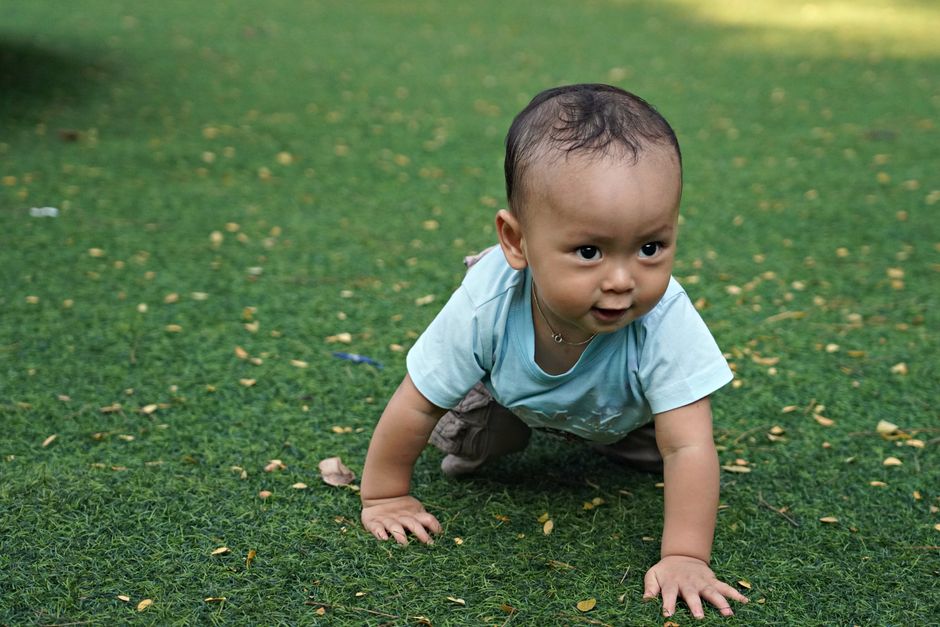
Most babies start crawling between 6 and 10 months. At 8 months, your baby may be ready to move, but every child develops at their own pace. You can help by giving them plenty of supervised tummy time, creating a safe space to explore, and placing toys just out of reach to encourage forward movement. Avoid forcing your baby into crawling positions. Instead, let them build strength and coordination naturally through play.
Why Is Crawling Important for Development?
Crawling builds strength in the shoulders, arms, core, and legs. It also helps with coordination between the left and right sides of the body. This cross-lateral movement is good for brain development and spatial awareness. Babies who crawl learn to shift weight and balance, skills they will use when they start walking.
That said, not every baby crawls. Some skip crawling entirely and go straight to standing and walking. Others use different methods like bottom-shuffling, rolling, or belly crawling. Research consistently shows that these babies develop normally as long as they meet other motor milestones within typical windows.
What Are the Typical Stages of Crawling?
Before crawling, babies usually go through several stages. Around 4 to 6 months, many start pushing up on their arms during tummy time. Next, they may rock back and forth on their hands and knees. This rocking motion helps them learn to shift weight. Some babies first crawl on their belly, dragging themselves with their arms. This is sometimes called commando crawling.
After that, they get onto all fours and begin moving one arm and the opposite leg forward. This reciprocal crawling is the classic hands-and-knees pattern. Not all babies follow every stage, and many move through them quickly. At 8 months, your baby may be somewhere in this sequence. That is normal.
How Can Tummy Time Help My Baby Learn to Crawl?
Tummy time is one of the most important activities for building the strength needed to crawl. When babies spend time on their stomachs, they push up with their arms, lift their heads, and eventually rock on all fours. These movements strengthen the neck, back, and shoulder muscles.
If your baby is 8 months old and you have not done much tummy time, it is not too late. Start with short sessions of 2 to 3 minutes several times a day. Place a favorite toy or mirror in front of them to encourage reaching. As they get stronger, they will naturally start to move. Avoid propping them on their hands and knees if they resist. Let them find their own way.
Pediatricians generally recommend at least 15 to 30 minutes of tummy time total per day by 3 to 4 months of age. For an 8-month-old who is already sitting, tummy time still matters. It is the only position that reliably builds the upper body strength needed for crawling.





What Specific Activities Can I Do to Encourage Crawling?
You can set up simple play situations that motivate your baby to move. The key is to make movement interesting and rewarding, not forced. Try these activities:
- Place a toy or object just out of reach while your baby is on their tummy. Let them stretch and shift weight to get it.
- Get down on the floor with them. Crawl alongside or in front of them. Babies often imitate what they see.
- Create a small tunnel using a cardboard box or a play tunnel. Encourage your baby to crawl through to reach you or a toy.
- Use a mirror propped safely on the floor. Babies are often drawn to their own reflection and will move toward it.
- Place pillows or cushions on the floor to create gentle obstacles. Let your baby practice climbing over them.
Only use toys and items that are safe for your baby’s age. Always supervise. Never leave your baby unattended on an elevated surface or with small objects that could be choking hazards.
When Should I Be Concerned About My Baby Not Crawling?
Most babies crawl between 6 and 10 months. Some start as early as 5 months, others as late as 12 months. If your baby is not crawling at 8 months, that alone is not cause for concern. Many perfectly healthy babies do not crawl until 10 or 11 months.
However, you should talk to your pediatrician if your baby shows no signs of wanting to move by 12 months. Other red flags include not sitting independently by 9 months, not bearing weight on legs by 12 months, or using only one side of the body consistently. These signs could indicate a motor delay or a muscle weakness that needs evaluation.
Remember that some babies skip crawling altogether. If your baby is pulling up to stand and cruising furniture by 10 or 11 months, they may never crawl. That is considered a normal variation. The important thing is that they are progressing in their motor skills over time.
Is It Normal for My Baby to Skip Crawling?
Yes. Some babies never crawl on hands and knees. They may scoot on their bottom, roll across the room, or belly crawl. Others go straight from sitting to standing to walking. Research and pediatric guidelines consider this a normal developmental path.
Skipping crawling does not cause learning problems or coordination issues later in life. The key is that the baby is learning to move independently by some method. If your baby is 8 months old and shows no interest in any form of mobility besides being held, that is different. Talk to your pediatrician if you are concerned about overall motor progress.
Frequently Asked Questions
What age do babies start crawling?
Most babies start crawling between 6 and 10 months. Some begin earlier, and some later, and that is usually normal.
Can I help my baby crawl by putting them on all fours?
You can gently place your baby on their hands and knees for a few seconds during play, but never force the position. Let them get there naturally through tummy time and reaching.
Is it bad if my baby doesn’t crawl?
No. Many healthy babies skip crawling and go straight to walking. As long as your baby is meeting other motor milestones, skipping crawling is not a problem.
How much tummy time does an 8-month-old need?
At 8 months, aim for at least 15 to 30 minutes of total tummy time spread throughout the day. This can include play on the floor and reaching for toys.
