
Insertional Achilles tendonitis is an overuse injury where the tendon breaks down right where it attaches to the heel bone. Healing it fast means calming the acute pain first, then loading the tendon gradually so it rebuilds. There is no shortcut that skips the loading phase — the tissue has to be challenged to repair.
Most people improve with a structured program of relative rest, calf strengthening, and load management over weeks, not days. The word “fast” needs an honest definition here. Tendon tissue heals on its own timeline, and pushing harder than the tendon can tolerate usually sets recovery back.
What Is Insertional Achilles Tendonitis and Why Does It Hurt?
The Achilles tendon attaches to the back of the heel bone. That attachment point is called the insertion. When it becomes irritated and starts to break down, the condition is called insertional Achilles tendonitis.
The pain comes from two places. The tendon fibers at the insertion develop small tears and inflammation. The bursa — a small fluid-filled sac that sits between the tendon and the bone — can also become inflamed. In many cases both are involved at once, which is part of why this injury can be stubborn.
This is different from mid-portion Achilles tendonitis, which happens about 2 to 6 centimeters above the heel. The distinction matters because the two respond to different loading strategies. Insertional cases are more sensitive to stretching and to exercises that compress the tendon against the bone.
It develops from repeated strain rather than one event. Sudden increases in running mileage, a switch to more uphill running, or a jump in training intensity are common triggers. Tight calf muscles, weak calf muscles, and a prominent heel bone can all add stress to the insertion.
One non-obvious point: the tendon at the insertion has a poorer blood supply than the middle of the tendon. That reduced circulation is one reason insertional cases can heal more slowly than other tendon problems.
How To Heal Insertional Achilles Tendonitis Fast
Fast recovery starts with reducing the load that is aggravating the tendon, then rebuilding its capacity. You cannot strengthen your way out of a tendon that is still being overloaded every day.
The first step is relative rest. This does not mean total immobilization. It means cutting back on the activities that provoke pain while keeping the tendon moving in ways it tolerates. Complete rest weakens the tendon further and is generally not recommended for this condition.
Pain is the guide. A common clinical approach is to keep activity at a level where pain stays mild and settles within a day. Some clinicians use a rough rule of keeping discomfort at or below 3 out of 10 during activity. That threshold is a practical guideline, not a strict rule, and it varies between people.
Ice can help in the early, painful stage. Apply it for short periods to the heel. It reduces pain but does not speed tissue repair, so think of it as comfort, not treatment.
Heel lifts or a small insert in your shoe can reduce strain on the insertion by taking the tendon through a smaller range of motion. This is a common short-term measure. It is a bridge, not a permanent fix, because the tendon still needs to be loaded to heal.
What genuinely drives recovery is progressive loading. The tendon adapts to demand. When you load it gradually and consistently, the tissue remodels and gets stronger. Skip this and the pain tends to return as soon as you resume normal activity.
Which Exercises Actually Help?
Loading exercises are the core of recovery. The right ones strengthen the tendon and calf without jamming the tendon into the heel bone.
Isometric holds are often used first because they can reduce pain while building tension in the muscle. A typical version is a seated or standing calf hold where you push into the ball of your foot and hold the contraction. Because these are commonly used in clinical practice rather than proven in large trials, treat them as a reasonable starting point, not a guaranteed fix.
Heavy slow resistance training is well supported for tendon recovery. This means lifting relatively heavy loads through a controlled range of motion, slowly. For the calf, that usually means heel raises done with added weight and a slow tempo.
Here is the key difference for insertional cases: avoid deep stretching of the calf and avoid exercises that push the tendon hard against the heel bone. Going up on your toes fully can compress the insertion. Many clinicians recommend working in a partial range — staying below the point where the heel lifts all the way — to reduce that compression.
Eccentric heel drops, which are a mainstay for mid-portion Achilles problems, are used more cautiously for insertional cases for the same reason. Some people tolerate them; others find they aggravate the insertion. This is a genuine point of debate in clinical practice.
Progress slowly. Add load or repetitions only when the current level is comfortable. Tendons adapt to gradual increases, not sudden jumps.




How Long Does Recovery Take?
Recovery timelines vary widely, and anyone promising a fixed number of days is oversimplifying. Insertional Achilles tendonitis often takes longer to settle than mid-portion cases because of the limited blood supply at the insertion.
Many people notice meaningful improvement over several weeks with consistent loading and load management. Full recovery and return to demanding activity can take a few months. Some cases linger longer, especially when the tendon has been irritated for a long time before treatment starts.
Factors that affect the timeline include how long you have had it, how consistently you follow a loading program, your age, and whether you keep re-aggravating the tendon. The single biggest predictor of a slow recovery is continuing to overload the tendon while trying to heal it.
Be patient with the process but honest about setbacks. A flare-up after a good week does not mean starting over. It usually means the load was increased too quickly.
When Should You See a Doctor?
See a clinician if the pain is severe, if you cannot bear weight, or if it is not improving after several weeks of self-care. A sudden pop or snap with immediate weakness needs urgent evaluation — that can signal a tendon rupture, which is a different and more serious problem.
Other reasons to seek care include diabetes, poor circulation, or use of medications that affect tendon health. Some antibiotics in the fluoroquinolone class carry a known risk of tendon problems, and a doctor should be involved in managing tendon pain in that situation.
Imaging is not always needed. Many cases are diagnosed by history and physical exam. Ultrasound or MRI may be used when the diagnosis is unclear or when symptoms do not follow the expected course.
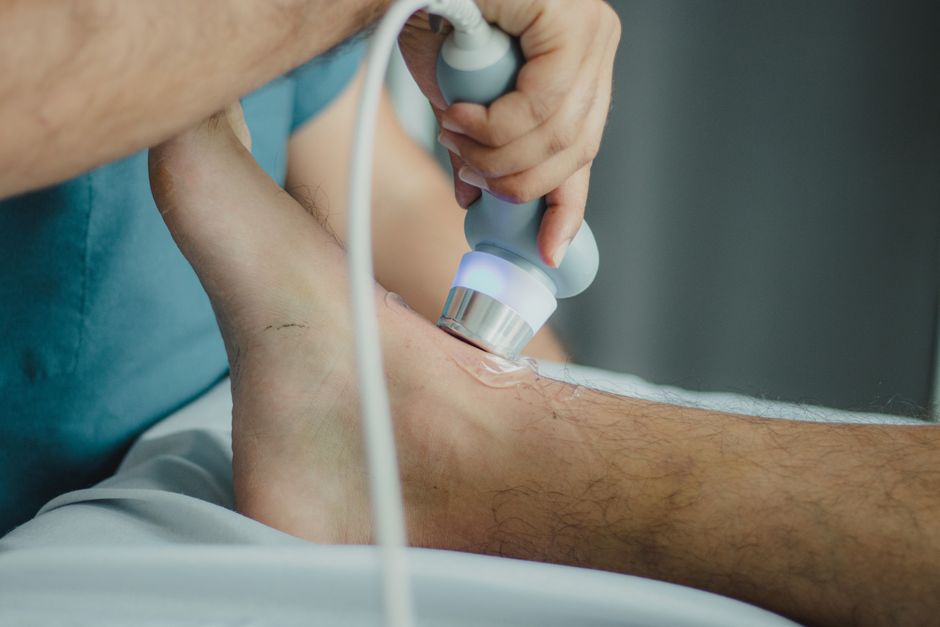
Treatment options a clinician might discuss include physical therapy, custom orthotics, and in persistent cases, other interventions. Extracorporeal shockwave therapy has some evidence for chronic Achilles tendon problems, though results vary. Surgery is generally reserved for cases that do not respond to months of conservative care.
What Makes Recovery Slower?
Certain habits and choices reliably work against healing.
- Continuing to train through pain instead of adjusting load
- Deep calf stretching that compresses the insertion
- Sudden jumps in activity after a period of rest
- Skipping the strengthening phase once pain fades
- Wearing flat, unsupportive shoes during flare-ups
The most common mistake is stopping treatment as soon as pain drops. Pain often fades before the tendon has regained strength. If you return to full activity at that point, the problem tends to come back.
Another factor is overall health. Conditions that affect blood flow and connective tissue, such as diabetes, can slow tendon healing. Smoking also impairs circulation and is linked to poorer tendon outcomes.
Frequently Asked Questions
Can insertional Achilles tendonitis heal on its own?
Mild cases can improve with rest and reduced activity, but the tendon usually needs progressive loading to rebuild strength. Without that, pain often returns when you resume normal activity.
Should I stretch my calf with insertional Achilles tendonitis?
Deep calf stretching is often discouraged for insertional cases because it can compress the tendon against the heel bone. Gentle range-of-motion work is usually better tolerated than aggressive stretching.
Is it OK to walk with insertional Achilles tendonitis?
Walking is often fine if pain stays mild and does not worsen afterward. If walking makes it significantly worse, you may need to reduce distance or use a heel lift while it calms down.
How long until I can run again?
Return to running depends on pain and strength, not a fixed date, and many people need several weeks to a few months. A gradual return guided by a clinician or physical therapist lowers the risk of re-injury.
