
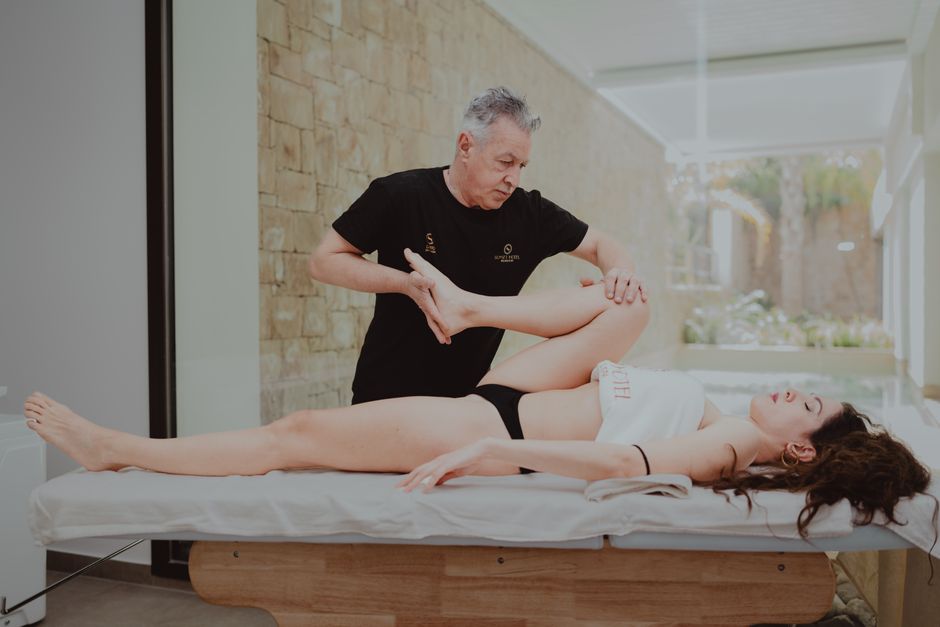
A groin injury hurts in a way that gets your attention fast. The muscles on the inside of your thigh — the adductors — attach from your pelvis to your thigh bone, and they do quiet work every time you walk, turn, or stand up. Healing comes down to three things: calming the acute strain, rebuilding strength and flexibility gradually, and returning to activity in stages instead of all at once. Most uncomplicated groin strains improve with rest, ice, and a graded rehabilitation program, but the timeline varies widely by severity and by how consistently you do the work.
What Actually Happens in a Groin Injury?
Most groin injuries are strains of the adductor muscles — a partial tear of muscle fibers where they meet tendon or bone.
The adductors are a group of muscles along the inner thigh. They pull your leg inward and help stabilize your pelvis during movement. When you push off hard, change direction suddenly, or stretch the leg outward under load, those fibers can be stretched beyond their capacity and tear. The tear can be small (a few fibers) or more substantial.
Doctors grade strains from mild to severe. A mild strain involves minor fiber damage with little loss of strength. A moderate strain involves more fiber disruption and noticeable weakness. A severe strain means a substantial or complete tear, often with significant pain and loss of function. The grade matters because it drives the timeline and the rehab plan.
Not all groin pain is a muscle strain, though. This is where people get into trouble. Pain in the groin area can also come from the hip joint itself, from the lower abdominal wall, from a hernia, or from the pubic joint where the two sides of the pelvis meet. In athletes, long-standing groin pain is often a mix of several problems rather than one clean diagnosis. That is why pain that does not settle with basic care deserves a proper assessment rather than a guess.
How Do You Treat a Groin Injury in the First Few Days?
The early goal is to limit swelling and protect the injured tissue without letting the area stiffen up.
Relative rest means avoiding the movements that provoke pain — sprinting, kicking, sharp turns, heavy lifting — while staying generally active in ways that do not hurt. Complete bed rest is not helpful and can slow recovery. Gentle walking is usually fine if it does not increase pain.
Ice can help take the edge off pain in the first day or two. Apply it for short periods with a cloth between the ice and your skin. Heat is generally more comfortable later, once the acute sharp pain has settled, but the evidence comparing ice and heat for muscle strains is not strong either way — use what gives you relief.
Over-the-counter pain relievers are commonly used. Acetaminophen and nonsteroidal anti-inflammatory drugs like ibuprofen both reduce pain. Whether anti-inflammatories help or hinder long-term muscle healing is genuinely debated in the research, so use the lowest effective amount for the shortest time, and check with a pharmacist or clinician if you have stomach, kidney, or heart concerns.
Compression and elevation are often suggested for swelling. For a groin strain, elevation is awkward and the evidence for either is limited. Do not treat them as essential.
How Long Does a Groin Injury Take To Heal?
Mild groin strains often improve noticeably within one to two weeks, while moderate strains commonly take several weeks and severe strains can take months.
Those ranges are general guidance, not a promise. Healing depends on the grade of the strain, your age, your baseline strength, and whether you keep re-injuring the area by returning to sport too soon. The single most common reason a groin injury drags on is premature return to full activity.
Pain is a useful guide but not a perfect one. Pain that is fading steadily with gentle activity is a good sign. Pain that spikes with a specific movement, or that never quite goes away, suggests the tissue is not ready for that load yet. Sharp pain during a movement means back off. A dull ache afterward that settles within a day is usually acceptable.
See a clinician if you cannot bear weight, if there is severe swelling or bruising, if you heard or felt a pop with sudden loss of function, or if pain persists beyond a couple of weeks without improvement. Those signs can point to a more significant tear or a different problem entirely.
What Does Groin Injury Rehabilitation Involve?
Rehabilitation is the part that actually determines whether the injury heals well or keeps coming back.
Rehab for a groin strain follows a progression. Early on, the focus is gentle range of motion and pain-free activation of the adductor muscles — small, controlled squeezes rather than strong contractions. As pain allows, you add resistance. The adductors respond well to strengthening, and a structured program of progressive adductor exercises is one of the better-supported approaches in the sports medicine literature for both treating and preventing groin strains.
Strengthening then builds toward sport-specific or daily-life movements: side-to-side steps, controlled lunges, and eventually faster change-of-direction work. Flexibility work for the inner thigh is often included, but do not force a stretch into pain — aggressive stretching of a healing muscle can set you back.
Core and hip stability work matters too. The adductors do not work alone; they share the load with the abdominal muscles and hip stabilizers. A program that only targets the inner thigh often leaves the surrounding system underprepared.
This is a general framework, not a prescription. A physical therapist can tailor the progression to your specific injury, and for moderate to severe strains that individualized guidance is worth having.
When Can You Return to Exercise or Sport?
Return happens in stages, and each stage should be pain-free before you move to the next.
- Stage one: Daily walking and light activity without increased pain.
- Stage two: Strength exercises through a full, pain-free range of motion.
- Stage three: Running in straight lines, then adding direction changes.
- Stage four: Sport-specific drills at increasing speed and intensity.
- Stage five: Full training and competition.
The key test is whether the injured side can match the healthy side in strength and tolerate the demands of your activity. A muscle that is still weak or that protests under load is not ready, even if it feels fine at rest. Many people feel normal walking around and then re-injure themselves the first time they sprint.
For athletes, some sports medicine clinicians use strength testing and sport-specific movement screens to guide return rather than relying on time alone. That approach is sensible, though the exact criteria used vary between clinicians.
Can You Prevent a Groin Injury From Coming Back?
Yes — and prevention is where the strongest evidence sits for groin injuries.
Groin strains have a meaningful recurrence rate, and a prior groin injury is one of the more consistent risk factors for a future one. The good news is that structured strengthening programs reduce the risk. Research in soccer players, in particular, has found that programs emphasizing adductor strengthening lower the rate of groin problems. The same principle — build the adductors stronger than the demands you place on them — applies more broadly.
Practical steps that make sense based on that evidence:
- Keep adductor strengthening in your routine even after you feel better.
- Build up training load gradually rather than jumping into high-intensity work.
- Warm up before explosive or change-of-direction activity.
- Address hip and core strength, not just the inner thigh.
- Do not ignore mild groin discomfort that keeps returning — it is often an early warning.
One clarification worth making: stretching alone is not a proven way to prevent groin strains. Strength and load management have better support than flexibility work for prevention.
What About Groin Pain That Does Not Heal?
Groin pain that lingers for weeks or months without a clear strain needs a proper diagnosis, not more rest.
Long-standing groin pain — sometimes called long-standing adductor-related groin pain or by the broader term “athletic groin pain” — often involves more than one structure. The hip joint, the pubic joint, the lower abdominal muscles, and the adductors can all contribute. Imaging and a careful exam help sort out what is actually driving the pain.
Some cases involve the hip joint itself, such as hip impingement or early joint changes. Some involve a hernia. Some involve the pubic symphysis. Treating all of these as if they were a simple muscle strain is a common reason people stay stuck. If basic rehab has not worked after several weeks, ask for a referral to a clinician experienced with hip and groin problems.
Frequently Asked Questions
How long does a groin strain take to heal?
Mild strains often improve within one to two weeks, while moderate strains commonly take several weeks and severe strains can take months. The grade of the strain and how consistently you rehabilitate are the biggest factors.
Should I stretch a pulled groin muscle?
Gentle range-of-motion movement is fine early on, but aggressive stretching of a healing muscle can make it worse. Save deeper flexibility work for later in recovery, once pain has settled.
When should I see a doctor for groin pain?
See a clinician if you cannot bear weight, have severe swelling or bruising, felt a pop with sudden loss of function, or have pain that is not improving after a couple of weeks. These signs can point to a more serious tear or a different problem.
Can I exercise with a groin injury?
Light activity that does not increase pain is usually fine and can help recovery. Avoid sprinting, kicking, sharp turns, and heavy lifting until the muscle has rebuilt strength and can handle those demands.
