
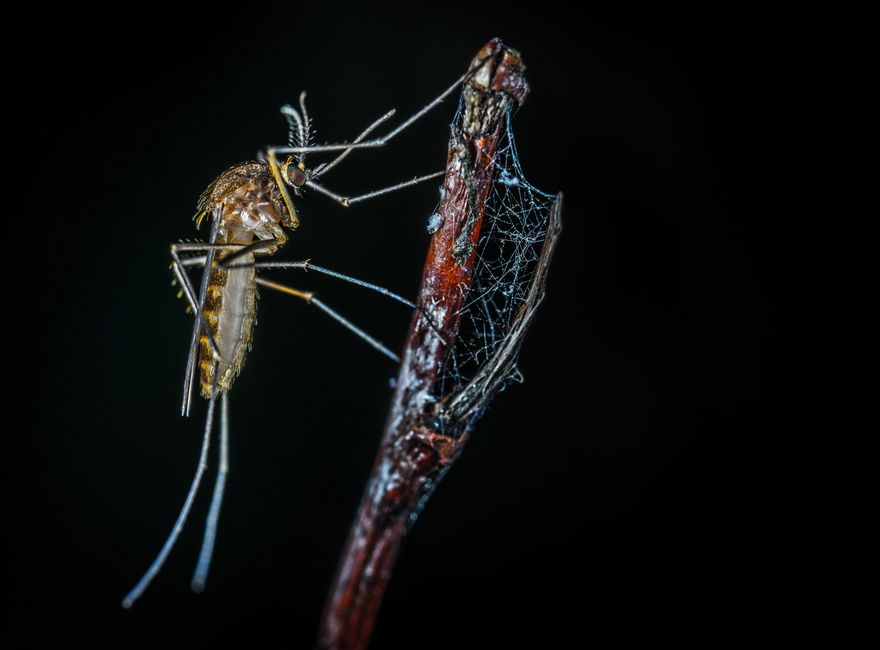
Getting rid of mosquitoes in your backyard comes down to one principle: remove the standing water where they breed and protect yourself from the adults that remain. Mosquitoes need stagnant water to complete their life cycle, and most backyard species can develop from egg to biting adult in about a week. Emptying, covering, or treating water sources every few days breaks that cycle. For the adults already flying, repellents, screens, and targeted yard treatments reduce bites — but no single method eliminates mosquitoes entirely.
Why Does Your Backyard Have So Many Mosquitoes?
Mosquitoes are not attracted to your yard because of its size or greenery. They are there because it offers water and shelter.
A female mosquito lays eggs in or near standing water. Depending on the species, the eggs hatch within a day or two, and the larvae that emerge live in the water and feed on organic matter. In warm weather, many common backyard species complete this entire cycle in roughly seven to ten days. That timeline matters: it means any container holding water for a week can produce a new generation of biting adults.
It does not take much water. A bottle cap, a clogged gutter, a plant saucer, or a folded tarp can hold enough. Some of the most aggressive daytime biters, including the Asian tiger mosquito, breed in small artificial containers rather than ponds or marshes. This is why a yard with no obvious swamp can still be swarming.
Shade and vegetation also matter. Adult mosquitoes rest in cool, damp, shaded spots during the heat of the day — under decks, in dense shrubs, in tall grass. Removing standing water reduces how many mosquitoes are born. Managing shade and vegetation reduces how many survive to bite you.
How To Get Rid Of Mosquitoes In Your Backyard By Removing Standing Water
Water removal is the single most effective thing a homeowner can do, and it costs nothing. Walk your yard after a rain and look for anything holding water.
Common sources people miss:
- Plant saucers under pots
- Clogged or sagging gutters
- Buckets, wheelbarrows, and kids’ toys left outside
- Tarps, pool covers, and grill covers that collect puddles
- Birdbaths and pet water bowls
- Old tires, which hold water and are notoriously hard to drain
- Drainage ditches and low spots that stay wet
- Tree holes and hollow stumps
For containers you cannot empty — birdbaths, for example — dump and refill the water at least twice a week. That interrupts the cycle before larvae can mature. For water you cannot remove, such as a rain barrel, seal the opening with fine mesh or a tight lid.
Ponds are usually not a major source of backyard mosquitoes if they contain fish, which eat larvae. A neglected, fishless pond is a different story. If you have one, that is worth addressing.
Do Mosquito Traps And Zappers Actually Work?
Bug zappers kill insects, but they kill far more harmless and beneficial insects than mosquitoes. Studies of zapper catches have found that mosquitoes make up a very small fraction of the insects killed. The devices also tend to attract insects to the area rather than reduce them.
Mosquito traps that use carbon dioxide or attractants to lure and capture females show more promise. Some studies indicate they can reduce local biting pressure, but the effect depends heavily on placement, the size of the surrounding mosquito population, and how consistently they run. A trap in a yard next to a large breeding area will not solve the problem.
Ultrasonic repellent devices that claim to drive mosquitoes away with sound have been tested, and the evidence does not support them. Multiple studies have found no meaningful reduction in bites. The evidence for these devices is weak at best.
If you want to try a trap, treat it as a supplement to water removal, not a replacement.





What Repellents And Treatments Keep Mosquitoes Off You?
Personal repellents are the most reliable way to prevent bites when you are outside. The two best-studied active ingredients are DEET and picaridin. Both are effective, and both are recommended by public health agencies for use on skin.
DEET has been studied for decades. Picaridin performs comparably in most comparisons and has the advantage of not damaging plastics or synthetic fabrics. Oil of lemon eucalyptus is a plant-based option with reasonable evidence behind it. Other botanical repellents vary widely in how long they last and how well they work.
For clothing and gear, permethrin-treated fabric is effective and long-lasting. Permethrin should be applied to clothing, not skin.
The CDC recommends repellents registered with the EPA, because registration means the product has been evaluated for both safety and effectiveness. Concentration affects how long protection lasts, not how well it works at the start. Higher concentrations generally last longer; they are not stronger.
For yard-wide treatment, professional or DIY barrier sprays can reduce adult mosquitoes for a period, but the effect fades and must be repeated. These sprays also kill pollinators and other insects, so use them selectively — around resting sites and entry points rather than broadcasting over flowering plants.
What About Mosquito Dunks And Larvicides?
Larvicides target the larval stage in water. The most common homeowner product is Bacillus thuringiensis israelensis, sold as “dunks” or “bits.” It is a bacterium that is toxic to mosquito and black fly larvae but has low toxicity to people, pets, fish, and most other wildlife. This is one of the better-supported tools for water you cannot drain.
The catch is that larvicides only work where larvae are present. If you have a rain barrel, a fishless ornamental pond, or a drainage area you cannot empty, treating it can help. If your mosquitoes are breeding in a neighbor’s yard or a nearby wetland, treating your own water will not touch them.
Use larvicides as a complement to water removal, not a substitute. A container you can simply dump does not need a dunk.
How Do You Protect Your Yard And Your Skin Long-Term?
Long-term control is a combination of habits and barriers, not a one-time fix.
On the property side:
- Keep gutters clear year-round, not just in summer
- Fix leaky outdoor faucets and irrigation that leaves puddles
- Mow regularly and trim dense shrubs to reduce resting habitat
- Store containers upside down or under cover
- Consider screening windows and doors, and repairing tears in existing screens
On the personal side, wear long sleeves and pants when mosquitoes are most active, use an EPA-registered repellent, and consider a screened porch or a fan. Mosquitoes are weak fliers; a fan moving air across a patio can meaningfully cut bites.
Community matters too. Mosquitoes fly. If a vacant lot or a neighbor’s abandoned pool is breeding them, your yard will keep getting visitors no matter how diligent you are. Some municipalities offer mosquito control programs, and reporting standing water on public or neglected property can help more than anything you do on your own lot.
When Should You Call A Professional?
Professional pest control makes sense when you have done the basics and still cannot get relief — or when you cannot find or reach the breeding source.
Signs it may be time:
- Mosquitoes remain dense despite consistent water removal
- You have a large, unmanageable water feature or a heavily shaded, overgrown property
- You have a health concern, such as a family member who is immunocompromised or a local disease outbreak
Professionals can identify breeding sites you missed, apply larvicides and adulticides, and time treatments to the local mosquito season. They cannot, however, overcome a breeding source on someone else’s property. Be skeptical of anyone promising total elimination.
Frequently Asked Questions
What is the fastest way to get rid of mosquitoes in my backyard?
The fastest reliable step is to dump or cover every source of standing water, since that removes the breeding ground. You can also use an EPA-registered repellent on your skin to stop bites immediately while you work on the water.
Does spraying my yard actually kill mosquitoes?
Barrier sprays can reduce adult mosquitoes for a period, but the effect fades and must be repeated. They also kill pollinators, so targeted use is better than broadcasting over the whole yard.
What plants keep mosquitoes away?
No plant has been shown to repel mosquitoes from a distance. Some plant oils, such as oil of lemon eucalyptus, work as repellents when applied to skin, but simply growing the plants does not keep mosquitoes off you.
Why do mosquitoes bite me more than other people?
Some people do get bitten more, and the reasons are not fully understood. Factors like body heat, carbon dioxide output, and skin chemistry appear to play a role, but the evidence is not conclusive.
