
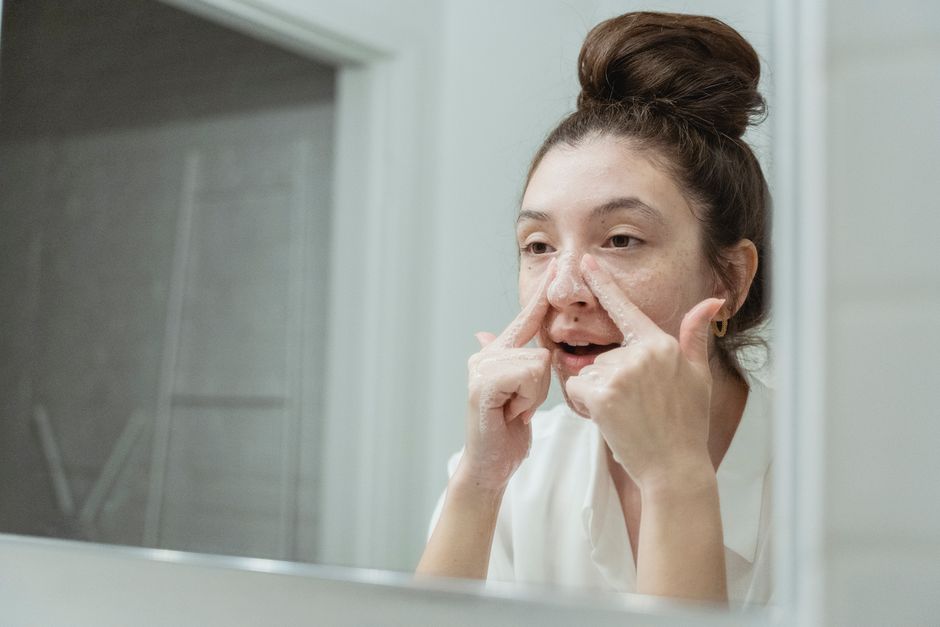
Hard whiteheads are closed pores blocked by oil and dead skin cells. You cannot scrub or pop them away — the plug sits beneath the skin surface, sealed off from the air. The reliable approach is a topical routine built around salicylic acid or a retinoid, consistent gentle cleansing, and a little patience. Those steps take weeks, not days, because you are changing how the pore behaves, not just clearing what is visible today.
What Exactly Is a Hard Whitehead?
A whitehead is a closed comedo — a hair follicle blocked by sebum and dead keratinocytes, with only a tiny opening to the surface. Because the pore stays closed, the trapped material does not oxidize and turn dark the way a blackhead does. It stays pale and raised.
The “hard” sensation many people describe comes from the plug itself. Sebum mixed with compacted skin cells forms a firm, waxy mass inside the follicle. When you press on it, it feels like a small bead under the surface rather than a soft, fluid-filled bump.
This is different from a pustule, which is inflamed and contains white blood cells. It is also different from milia — small, firm white bumps that look similar but form from trapped keratin near the surface, not from a blocked oil gland. The distinction matters because milia often do not respond to acne treatments the same way.
Whiteheads are most common where oil glands are dense: the forehead, nose, chin, and sometimes the upper cheeks. Hormonal shifts, genetics, and certain medications influence how much sebum your skin produces.
Why You Should Not Pop or Squeeze Them
Squeezing a closed whitehead pushes the plug downward and sideways, not up and out. The follicle wall can rupture beneath the skin, spilling sebum and bacteria into surrounding tissue.
That rupture is what turns a quiet closed pore into an inflamed red bump, or in worse cases a nodule. It also raises the risk of scarring and of post-inflammatory hyperpigmentation, which can last far longer than the original whitehead would have.
There is a second problem. Fingernails carry bacteria, and the pressure you apply is uneven. Even when a plug does come out, the follicle often refills. People who pick regularly tend to have more breakouts, not fewer.
Some clinicians perform extraction using sterile tools and controlled technique. That is a different situation from at-home squeezing, and it does not change the underlying plugging process.
How Do Salicylic Acid and Retinoids Work?
Two categories of topical treatment have the strongest track record for comedonal acne: salicylic acid and retinoids. They work in different ways, and many people use both.
Salicylic acid is a beta-hydroxy acid. It is oil-soluble, which lets it penetrate into the pore lining. There it helps loosen the bonds between dead skin cells so the plug is less likely to form. It is widely available over the counter in cleansers, toners, and leave-on treatments.
Retinoids — including adapalene, tretinoin, and tazarotene — change how follicular skin cells turn over and shed. Adapalene is available over the counter in some markets. Tretinoin and tazarotene require a prescription in the United States. These are the treatments with the most consistent evidence for comedonal acne.
Both approaches take time. Salicylic acid may show gradual improvement over several weeks. Retinoids typically take longer, and a period of irritation or purging in the first weeks is common and expected. Do not judge a retinoid by the first two weeks.
What About Benzoyl Peroxide?
Benzoyl peroxide kills Cutibacterium acnes and reduces inflammation. It is well established for inflammatory acne. For purely closed whiteheads with no redness, it is less directly targeted at the plugging process, though it can still help if inflammation is part of the picture.
Benzoyl peroxide can bleach fabric and towels. Keep that in mind if you use it on the back or chest.





Building a Routine That Actually Works
Consistency matters more than the number of products. A simple routine used daily outperforms a complicated one used sporadically.
- Cleanse gently twice a day with a mild, non-stripping cleanser. Harsh scrubs and abrasive brushes irritate the skin and can worsen plugging.
- Treat with one active at a time to start — either a salicylic acid leave-on product or a retinoid. Adding both at once makes it hard to tell what helps and what irritates.
- Moisturize with a non-comedogenic formula. Dry, irritated skin sheds poorly, which can make plugging worse, not better.
- Use sunscreen daily. Retinoids increase sun sensitivity, and sun exposure worsens post-inflammatory marks.
Introduce a retinoid slowly — a few nights a week at first, then build up as your skin tolerates it. Apply a pea-sized amount to the whole face rather than dabbing it only on visible whiteheads. Comedonal acne is a whole-follicle process, and treating only the spots you can see tends to miss developing ones.
Give any new routine at least eight to twelve weeks before deciding whether it works. That timeline reflects how long it takes for follicular cell turnover to change. It is not a marketing figure.
What to Look For in Products
Ingredients matter more than brand names. For a leave-on salicylic acid product, concentrations commonly range from 0.5% to 2%. The 2% level is the maximum allowed in over-the-counter acne products in the United States. Higher is not better; it is more irritating.
For adapalene, 0.1% is the standard over-the-counter strength. Prescription retinoids come in several strengths, and a clinician will match the strength to your skin and how well you tolerate it.
Watch for products labeled non-comedogenic. This means the formula has been assessed for its tendency to clog pores, though the testing methods are not perfectly standardized. It is a useful signal, not a guarantee.
Fragrance and alcohol-heavy toners do not help whiteheads. They can strip the skin and trigger irritation that mimics or worsens breakouts.
When to See a Dermatologist
If over-the-counter treatment has not helped after about three months of consistent use, a dermatologist can offer prescription options. These include stronger retinoids, topical antibiotics, azelaic acid, or in some cases oral medications.
For stubborn comedonal acne, a clinician may also perform professional extraction or recommend procedures such as chemical peels. These are done in a clinical setting with appropriate technique.
See a doctor sooner if you have deep, painful nodules, signs of infection, or scarring. Also seek care if acne is affecting your mood or daily life — that is a legitimate reason to ask for help, not a minor concern.
One clarification worth making: whiteheads and milia are often confused, and they respond to different treatments. If a bump has been unchanged for months and never becomes inflamed, it may be milia rather than a whitehead. A dermatologist can tell the difference quickly.
Common Mistakes That Keep Whiteheads Around
Over-washing is one of the most common. Cleansing more than twice a day strips the skin barrier and can increase oil production as the skin tries to compensate.
Layering too many actives is another. Using salicylic acid, benzoyl peroxide, and a retinoid all at once is a recipe for irritation, not faster results. Irritated skin plugs more, not less.
Switching products too soon is a third. Many people abandon a treatment at week three, right before it would have started working, and start something new. That resets the clock.
Finally, changing your diet or buying supplements without addressing the topical routine rarely resolves comedonal acne. Diet may play a role for some people, but the evidence is mixed and the effect is generally smaller than that of consistent topical treatment.
Frequently Asked Questions
How long does it take to get rid of hard whiteheads?
Most people see gradual improvement over eight to twelve weeks of consistent treatment. Whiteheads that have been present for a long time may take longer to clear.
Can I pop a hard whitehead safely?
No — squeezing a closed whitehead can rupture the follicle and cause inflammation, scarring, or dark marks. Professional extraction by a clinician is a safer option if removal is needed.
Is salicylic acid or a retinoid better for whiteheads?
Both are effective, and they work in different ways. Salicylic acid loosens the plug, while retinoids change how follicular cells shed. Some people use both, introduced gradually.
Do hard whiteheads go away on their own?
Some do resolve without treatment, but closed whiteheads often persist or develop into inflamed acne. Consistent topical treatment is more reliable than waiting.
