
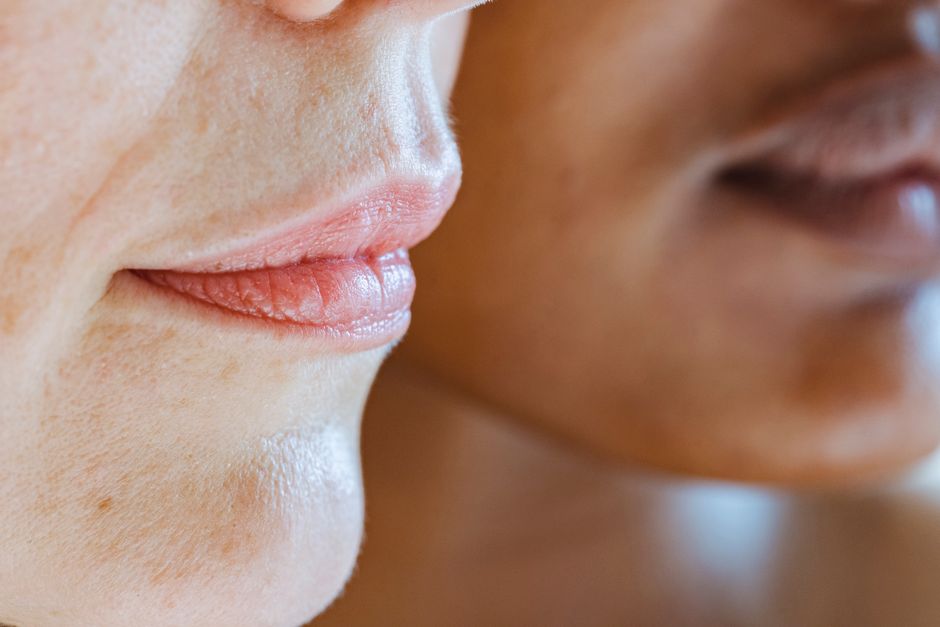
You cannot get rid of Fordyce spots on your lips at home, and no home remedy removes them permanently. Fordyce spots are enlarged oil glands that sit just under the skin, and they are harmless. Most people who want them gone are really looking for ways to make them less noticeable, not a medical fix. That distinction matters, because it changes what actually works.
Fordyce spots are not acne, not an infection, and not a sign of anything wrong. They are a normal variation in how skin is built. Because of that, treatments aimed at “clearing” them usually miss the point. What helps is understanding what they are and knowing which options have real evidence behind them.
What Are Fordyce Spots On The Lips?
Fordyce spots are visible sebaceous glands. Sebaceous glands produce sebum, the oil that keeps skin and hair lubricated. Most of these glands empty into hair follicles, so you never see them. Fordyce spots are glands that open directly onto the skin surface instead.
Without a hair follicle to hide inside, the gland and its duct show through the thin skin of the lips as small, pale, slightly raised bumps. They can also appear on the inner cheeks, the edges of the lips, and sometimes the genitals. On the lips they tend to be most noticeable because the skin there is thin and has little pigment.
They are named after John Addison Fordyce, the American dermatologist who described them in the late 1800s. They are sometimes called Fordyce granules or sebaceous hyperplasia of the lips.
Two features define them:
- They are typically 1 to 3 millimeters across, roughly the size of a pinhead.
- They are usually painless, not itchy, and do not bleed or crust.
They are not contagious. You cannot pass them to anyone, and you cannot catch them.
What Causes Fordyce Spots And Who Gets Them?
Fordyce spots are common in adults and appear in both men and women. They are not caused by poor hygiene, diet, stress, or a virus. No behavior creates them, and no behavior prevents them.
The main factor is hormones. Sebaceous glands are sensitive to androgens, the group of hormones that includes testosterone. This is why Fordyce spots often become more visible around puberty and why they can be more prominent in adults. They can also become more noticeable during pregnancy, when hormone levels shift.
Genetics likely play a role too. If a parent has visible Fordyce spots, you may be more likely to have them. Some people simply have more visible sebaceous glands than others, the same way some people have more visible pores.
Fordyce spots are not linked to any disease. Having them does not mean your skin is unhealthy or that something is wrong with your oil glands.
How To Tell Fordyce Spots From Other Lip Bumps
Most lip bumps that look like Fordyce spots are Fordyce spots. But a few other conditions can look similar, and a couple of them need medical attention.
Fordyce spots have a fairly consistent look. They are small, pale or yellowish, smooth, and arranged in clusters or scattered along the lip border. They do not change much over time. They stay the same size and color.
Here is how they compare with conditions that can be confused with them:
| Feature | Fordyce spots | Cold sores | Milia |
|---|---|---|---|
| Color | Pale or yellowish | Red, then fluid-filled | White, pearl-like |
| Texture | Smooth, slightly raised | Blister that crusts | Firm, tiny bump |
| Feel | Painless | Tingling, then painful | Painless |
| Changes over time | Stable | Heals in about 1 to 2 weeks | Often resolves on its own |
The key difference is behavior over time. Fordyce spots do not come and go. They do not blister, crust, or heal. If a bump on your lip is painful, bleeding, changing shape, or not healing, that is not a Fordyce spot and it should be checked by a clinician.
This is the one place where self-diagnosis can go wrong. Most lip bumps are harmless, but a sore that does not heal deserves a professional look, especially if you use tobacco or have a history of sun exposure.
Why Home Remedies For Fordyce Spots Do Not Work
No home remedy removes Fordyce spots, because the glands are a normal part of your skin. You cannot scrub, soak, or peel away a structure that is supposed to be there. This is the honest answer, even though it is not the one most people search for.
Several popular remedies circulate online. None of them are supported by clinical evidence for removing Fordyce spots.
- Exfoliating scrubs. These remove dead skin cells from the surface. Fordyce spots sit below the surface, so scrubbing does not reach them. Over-scrubbing can irritate the lips and make them look worse.
- Toothpaste. Some people apply toothpaste to dry out the spots. Toothpaste is not made for skin and can cause irritation or a rash on the lips.
- Apple cider vinegar. This is acidic and can burn or irritate the thin skin of the lips. There is no evidence it removes sebaceous glands.
- Coconut oil, honey, or lip balms. These can moisturize and may make the lips look smoother, but they do not remove the glands. Any improvement is temporary and cosmetic.
- Squeezing or picking. This does not empty a Fordyce spot the way it might empty a blackhead. It can cause bleeding, infection, or scarring.
The pattern here is worth noticing. Every one of these remedies either does nothing or risks harm. That is the opposite of what a real treatment should do.
There is one clarification that helps many people. Fordyce spots are often more visible when the lips are dry or when the surrounding skin is inflamed. Keeping lips moisturized with a plain lip balm can make them less noticeable without doing anything to the glands themselves. This is cosmetic, not curative, but it is a reasonable step.
What Actually Reduces The Appearance Of Fordyce Spots?
If your goal is to make the spots less noticeable, a few options exist. All of them are done in a clinic, not at home, and none of them are guaranteed to be permanent.
These procedures work by removing or damaging the visible gland tissue. Because sebaceous glands can regrow, results may not last, and repeat treatments are sometimes needed. The evidence base for these procedures is limited, and most reports come from small case series rather than large controlled trials. That is an honest limitation, not a reason to dismiss them.
- Laser therapy. Certain lasers target the gland tissue. This is among the more commonly used options, though results vary and multiple sessions are often required.
- Electrocautery. A fine probe uses heat to destroy the gland. It can work but carries a risk of scarring, especially on the lips.
- Micro-punch or surgical removal. A clinician removes individual glands with a small tool. This is more invasive and can leave marks.
- Chemical peels. Some clinicians use peels to improve the surface appearance. The effect on the glands themselves is limited.
Any of these should be done by a dermatologist or a qualified clinician. The lips are delicate, and a poor result is hard to hide. Before any procedure, ask about the realistic outcome, the risk of scarring, and whether the result is likely to last.
For many people, the most useful step is none of these. Once you understand that Fordyce spots are normal and harmless, the urge to treat them often fades. That is not a cop-out. It is an accurate assessment of the risk and benefit.
When To See A Doctor About Lip Bumps
See a clinician if a lip bump is painful, bleeding, growing, changing color, or not healing. Those features do not match Fordyce spots, and they need to be evaluated.
Also see a clinician if you are unsure what you are looking at. A visual exam is quick, and a dermatologist can usually tell Fordyce spots from other bumps on sight. If there is any doubt, a small sample may be taken for testing.
You do not need to see a doctor just because you have Fordyce spots. They are not a medical problem. But getting a clear answer can stop the cycle of trying remedies that do not work.
Frequently Asked Questions
Can Fordyce spots on lips go away on their own?
Fordyce spots do not go away on their own because they are normal sebaceous glands, not a temporary condition. They may become less noticeable over time as hormone levels change, but the glands remain.
Are Fordyce spots on lips contagious or a sign of an STD?
No, Fordyce spots are not contagious and are not a sexually transmitted infection. They are a normal variation in skin anatomy that many adults have.
Does toothpaste or apple cider vinegar remove Fordyce spots?
No, neither toothpaste nor apple cider vinegar removes Fordyce spots, and both can irritate or burn the lips. There is no evidence that any home remedy eliminates these glands.
Can a dermatologist remove Fordyce spots permanently?
A dermatologist can reduce their appearance with procedures like laser therapy or electrocautery, but results are not guaranteed to be permanent because glands can regrow. These procedures also carry a risk of scarring on the lips.
