
Water hyacinth (Pontederia crassipes, formerly Eichhornia crassipes) is one of the fastest-spreading invasive aquatic plants in the world, and getting rid of it requires more than pulling plants out of the water. Physical removal, chemical treatment, biological control, and prevention each work under different conditions, and most successful programs combine several methods over months or years. No single approach eliminates it permanently, because seeds and regrowth from broken plant fragments can restart an infestation.
What Makes Water Hyacinth So Hard To Control?
Water hyacinth grows faster than almost any other freshwater plant, and that speed is the core of the problem. Under warm conditions it can double its mass in roughly one to two weeks, forming dense floating mats that block light, deplete oxygen, and choke waterways.
It reproduces two ways. New plants grow from stolons — horizontal stems that send up daughter plants — so a single plant becomes a cluster quickly. It also produces seeds that can stay viable in sediment for many years, which is why clearing the visible plants rarely ends the problem.
Any mechanical cutting or chopping that leaves fragments in the water can make things worse. Each fragment containing a node can grow into a new plant. This is the single most important fact for anyone planning removal: how you remove the plant matters as much as whether you remove it.
How To Get Rid Of And Control Water Hyacinth Using Physical Methods
Physical removal works best on small, contained infestations and early-stage growth. Hand pulling, raking, and mechanical harvesters can clear visible plants, but they do not touch the seed bank in the sediment or fragments left behind.
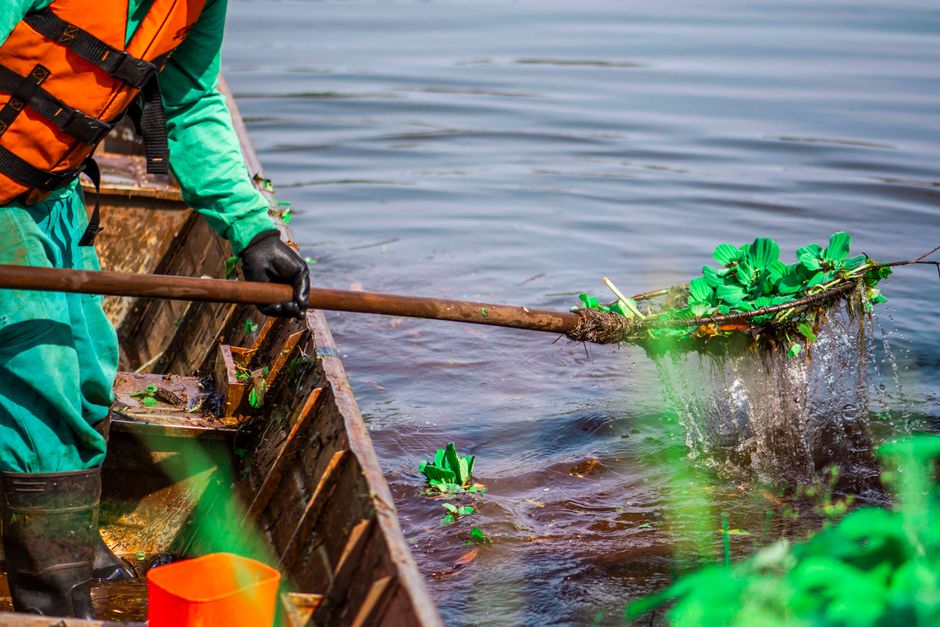
For small ponds, manual removal with rakes and nets is realistic. Pull plants gently to avoid breaking stolons, and remove material entirely from the water’s edge so fragments do not wash back in. Repeat every few weeks during the growing season.
For larger water bodies, mechanical harvesters are used, often by agencies managing navigation and flood control. Harvesting is expensive, must be repeated, and is generally treated as ongoing maintenance rather than a cure. Some operations use specialized equipment designed to collect fragments, but even then, regrowth is expected.
Two physical methods deserve caution:
- Shredding or chopping. Cutting plants into pieces spreads them. Avoid any method that leaves fragments in the water.
- Draining or drying. Water hyacinth can survive on wet mud for extended periods. Drying only works if plants fully desiccate, and seeds remain in the soil.
Physical removal is often the first step in a larger plan, not the whole plan.
Do Herbicides Work On Water Hyacinth?
Herbicides can kill water hyacinth quickly, and they are widely used in large-scale management. They are also regulated, and in the United States any herbicide applied to water generally requires compliance with federal and state aquatic pesticide rules.
Common aquatic herbicides used against water hyacinth include glyphosate, 2,4-D, diquat, and imazapyr, among others. Each has specific restrictions on use near drinking water intakes, irrigation, and sensitive species. Application timing matters: treating a large mat at once can cause plants to decay rapidly, which lowers dissolved oxygen and can kill fish. Managers often treat in sections to reduce that risk.
Herbicides do not kill seeds in the sediment. Regrowth from the seed bank is expected, and repeat applications are usually needed. This is not a failure of the product — it reflects the plant’s biology.
If you are considering herbicide use, the practical route is to contact your state’s aquatic plant management program or a licensed applicator. Rules vary by state, and misapplication can harm water quality, wildlife, and people.





What Is Biological Control Of Water Hyacinth?
Biological control uses natural enemies — mainly insects — to reduce water hyacinth over time. It is not a quick fix, but it is the only approach that can provide lasting suppression across large areas without repeated chemical or mechanical treatment.
The most studied agents are two weevils, Neochetina eichhorniae and Neochetina bruchi, which feed on the plant and can reduce its vigor and reproduction. A moth, Sameodes albiguttalis, has also been used. These insects do not eliminate water hyacinth; they weaken it and reduce its density.
Biological control has been used in many countries, including parts of Africa, Asia, and the southern United States. Results vary with climate, water nutrients, and how well the insects establish. In some locations, insect populations have reduced infestations substantially. In others, control has been partial.
Releasing insects is a regulated activity. In the U.S., it requires coordination with federal and state agencies. Individuals should not release biological control agents on their own.
Why Nutrient Control Matters More Than Most People Realize
Water hyacinth thrives in nutrient-rich water, especially water high in nitrogen and phosphorus. Fertilizer runoff, sewage, and livestock waste feed the plant. Controlling nutrients is slow and often overlooked, but it addresses the underlying cause.
Reducing nutrient inputs means managing what enters the water: stormwater runoff, agricultural drainage, septic systems, and lawn fertilizer. Buffer strips of vegetation along shorelines can help filter runoff. These measures do not kill existing plants, but they can reduce how aggressively water hyacinth regrows.
This is a long-term strategy. Nutrient reduction can take years to show effects in a large water body, and it works best alongside other methods rather than instead of them.
Can Water Hyacinth Be Used Or Sold Instead Of Removed?
Water hyacinth is sometimes promoted for composting, livestock feed, biogas, or craft material. These uses are real, and in some regions harvested material is put to work. But using the plant does not control it, and in most places it is illegal to move or sell it.
Water hyacinth is listed as a federal noxious weed in the United States. Under the Plant Protection Act, it is illegal to import or move it across state lines without a permit. Many states also prohibit possession, sale, or transport. Selling it — including through online marketplaces — can result in fines.
If you have water hyacinth on your property, the correct move is to check your state’s rules before doing anything with it. Composting or feeding it to animals may be allowed in some places, but only if local rules permit and if there is no risk of spreading fragments or seeds into waterways.
A common mistake is assuming a plant sold as an ornamental pond plant is safe to keep. In warm climates, water hyacinth can escape from ponds into natural water bodies through flooding or improper disposal. Once established, it is extremely difficult to remove.
What Does A Realistic Control Plan Look Like?
There is no single method that reliably eradicates water hyacinth. Effective control is a combination of approaches, applied consistently, with monitoring.
For a small private pond, that might mean manual removal every few weeks during the growing season, reducing nutrient runoff, and watching for regrowth. For a larger water body, it usually involves coordinated mechanical, chemical, and biological methods managed by agencies or professional applicators.
Timelines vary. Small infestations may be reduced within a season, but regrowth from seeds can continue for years. Large infestations are typically managed indefinitely rather than eliminated.
Two points are worth repeating because they are where most DIY efforts fail:
- Do not chop or shred plants in the water. Fragments spread the infestation.
- Do not assume one treatment solves it. The seed bank and rapid regrowth mean follow-up is required.
If you are dealing with water hyacinth on a public waterway or a large pond, the most useful step is to contact your state’s aquatic plant management program. They can tell you what is legal, what works locally, and what funding or assistance may be available.
Frequently Asked Questions
Can I get rid of water hyacinth by pulling it out by hand?
Hand pulling can clear small infestations, but it does not remove seeds in the sediment, so regrowth is likely. Pull plants carefully to avoid breaking stolons and remove all material from the water.
Is it legal to sell or move water hyacinth in the United States?
No. Water hyacinth is a federally listed noxious weed, and moving or selling it across state lines without a permit is illegal. Many states also prohibit possession or transport within their borders.
Does biological control actually work on water hyacinth?
Biological control using insects like Neochetina weevils can reduce water hyacinth density over time, but it does not eliminate it. Results vary by climate and location, and releases are regulated.
How long does it take to control water hyacinth?
Small infestations may be reduced within a single growing season, but regrowth from seeds can continue for years. Large infestations are usually managed long-term rather than fully eliminated.
