
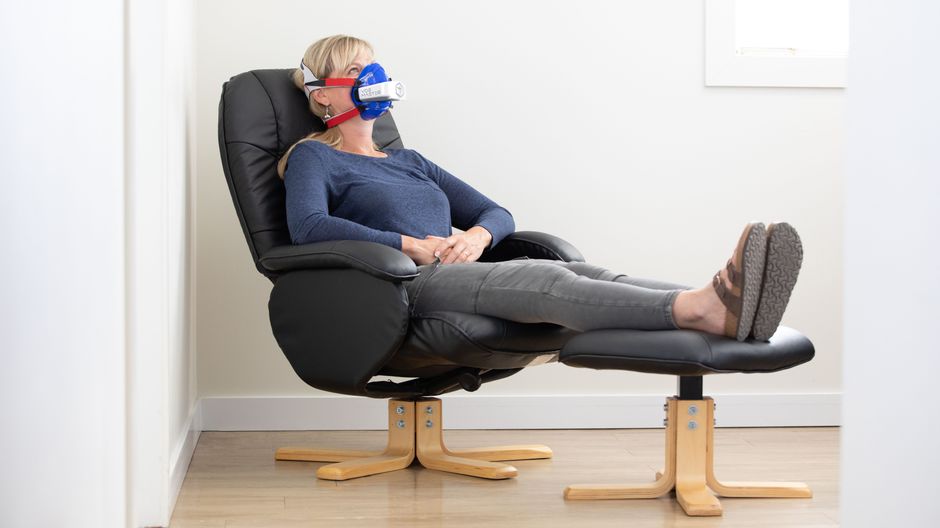
Getting off CPAP is possible for some people, but it is not a simple decision you can make on your own. CPAP treats obstructive sleep apnea, a condition where the airway collapses during sleep and breathing repeatedly stops. If you stop using it without addressing the underlying cause, those breathing pauses return — often on the very first night. The safe path off CPAP always starts with a repeat sleep study and a conversation with your sleep doctor.
Why Can’t I Just Stop Using My CPAP?
Because untreated sleep apnea does not go away when the machine does. The machine was never the problem. It was the solution.
Obstructive sleep apnea happens when the soft tissue at the back of your throat collapses and blocks airflow while you sleep. Your brain detects the drop in oxygen, briefly wakes you, and you start breathing again. This can happen dozens or hundreds of times a night. CPAP works by pushing a steady stream of air through your airway, keeping it open. Remove the air pressure, and the collapse returns.
The consequences of untreated apnea are not minor. Research consistently links moderate to severe obstructive sleep apnea to high blood pressure, heart rhythm problems, stroke, and daytime accidents from sleepiness. That is why stopping CPAP without a plan is genuinely risky — not because the machine is habit-forming, but because the disease it treats is still there.
One clarification worth making: CPAP is not addictive and does not weaken your breathing muscles. Some people worry the machine has made them dependent on it. It has not. It is simply holding open an airway that closes on its own.
How To Get Off A CPAP Machine Safely
The safe route is a supervised trial, not a unilateral decision. There is no shortcut around this.
Here is what that process generally looks like:
- Talk to your sleep physician first. Tell them why you want to stop — discomfort, travel, claustrophobia, or a change in your health.
- Get a repeat sleep study. This is usually done without CPAP to measure whether your apnea is still present and how severe it is.
- Address reversible causes. If weight loss, nasal surgery, or another treatment has changed your anatomy, that may reduce your apnea.
- Trial the alternative under monitoring. If you switch to a dental appliance or positional therapy, your doctor will typically want to confirm it actually controls your breathing.
- Keep a follow-up plan. Even if you stop CPAP, periodic re-testing matters because apnea can return if your weight or health changes.
The key point: you stop CPAP only after a test shows your apnea is gone or well controlled by something else. Not before.
Can Weight Loss Cure Sleep Apnea?
Weight loss can meaningfully reduce sleep apnea in some people, but it does not reliably cure it. The relationship is real but not simple.
Excess weight around the neck and throat narrows the airway, which is one reason obesity is a major risk factor for obstructive sleep apnea. Losing weight can lower the severity of apnea, and in some cases — particularly with substantial weight loss — people no longer meet the diagnostic criteria.
But “some cases” is doing a lot of work in that sentence. Many people lose weight and still have significant apnea. Others have apnea at a normal weight, because the cause is anatomical — a large tongue, a receding jaw, or a narrow airway — not weight. So weight loss is worth pursuing for its own sake, and it may help your apnea, but it is not a guaranteed exit from CPAP.
Bariatric surgery has produced remission of sleep apnea in a portion of patients in published research, but even there, remission is not universal and long-term follow-up varies. This is a decision to make with your doctor, not from a headline.
What Other Treatments Can Replace CPAP?
Several alternatives exist. None works for everyone, and each has trade-offs.
Oral appliances. These are custom mouthguards that push the lower jaw forward to keep the airway open. They tend to work best for mild to moderate obstructive sleep apnea. For severe apnea, they are generally less effective than CPAP. A dentist trained in sleep medicine fits them, and a follow-up sleep study confirms whether they work.
Positional therapy. Some people have apnea mainly when sleeping on their back. Devices that keep you on your side can help in those specific cases. This is a narrow solution, not a general one.
Surgery. Procedures to remove tissue, reposition the jaw, or place nerve stimulators exist for selected patients. These are typically considered when CPAP fails and other options do not fit. Outcomes vary widely, and surgery is not a first-line treatment for most people.
Hypoglossal nerve stimulation. An implanted device stimulates the nerve that controls the tongue, moving it out of the way during sleep. It is approved for certain patients who cannot tolerate CPAP. It is not appropriate for everyone, and candidacy is determined by specific criteria.
Notice what all of these have in common: they require a test to confirm they actually control your breathing. Feeling better is not proof. Many people with untreated apnea do not feel obviously worse, which is exactly why objective testing matters.
Is It Ever Safe to Stop CPAP on Your Own?
Only if a sleep study confirms your apnea has resolved. In practice, that is uncommon.
There is one situation where stopping is clearly reasonable: if you had mild apnea, you made a significant change such as major weight loss, and a repeat test shows you no longer meet diagnostic criteria. In that case, stopping is not just safe — it is appropriate.
But there is a trap here. Some people feel fine after a few nights without CPAP and conclude they no longer need it. That feeling is not reliable. Sleep apnea often produces no obvious symptoms, and the damage to the heart and blood vessels accumulates quietly over years. The absence of symptoms is not evidence the condition is gone.
If you are considering stopping, the honest position is this: you cannot know whether it is safe without testing. Guessing puts your heart and your alertness at risk.
What Happens If You Stop CPAP Without Testing?
Your apnea returns, usually immediately, and so do the risks.
The breathing pauses and oxygen drops come back the first night you sleep without treatment. Over time, untreated moderate to severe apnea is associated with higher rates of high blood pressure, heart disease, irregular heart rhythms, and stroke. It also raises the risk of drowsy-driving crashes.
Some people notice daytime sleepiness returning within days. Others notice nothing at all, which can be more dangerous because it removes the warning signal.
There is a middle path worth knowing about. If CPAP is uncomfortable, the answer is often to fix the fit — a different mask, a heated humidifier, or a pressure adjustment — rather than to abandon treatment. Many people who “cannot tolerate” CPAP do well once the right mask and settings are found. Before you decide to quit, it is worth asking your sleep clinic whether your setup can be improved.
Frequently Asked Questions
Can sleep apnea go away on its own?
Mild sleep apnea sometimes improves with weight loss or other changes, but it rarely disappears on its own. For most people, obstructive sleep apnea is a long-term condition that needs ongoing treatment.
How do I know if I still need my CPAP machine?
The only reliable way to know is a repeat sleep study done without CPAP. How you feel is not a dependable guide, because apnea often causes no obvious symptoms.
Can I stop using CPAP if I lose weight?
Weight loss can reduce apnea severity, and some people no longer need CPAP after substantial weight loss. However, many still have significant apnea, so a repeat sleep study is needed before stopping.
What happens if I stop CPAP suddenly?
Your breathing pauses typically return the first night, along with the associated heart and alertness risks. Stopping without testing is not considered safe for most people with diagnosed sleep apnea.
