
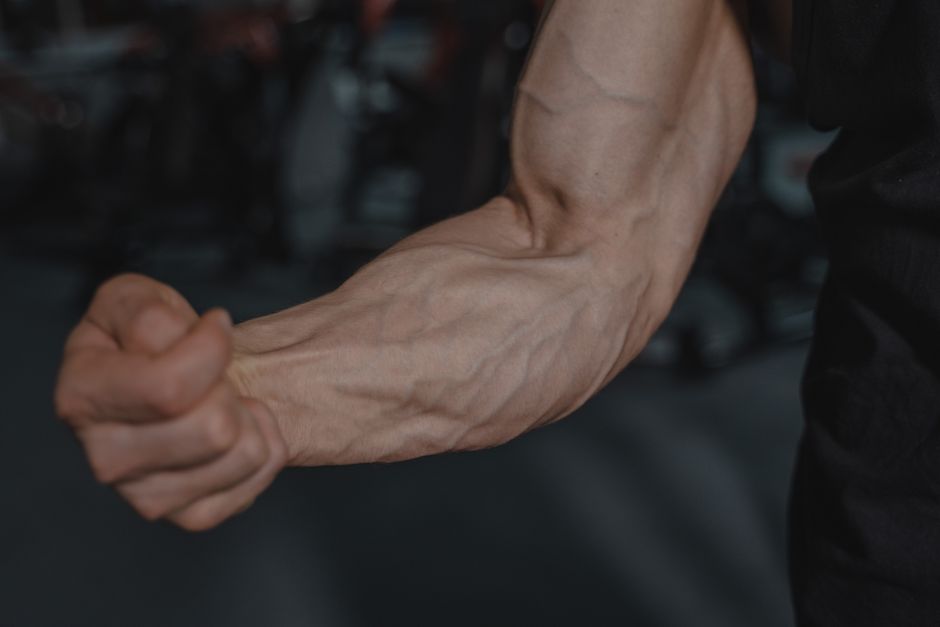
Visible veins on the biceps come from a mix of low body fat, muscle size, blood flow, and genetics. You cannot change your genetics, but you can lower the fat layer between skin and muscle, build the biceps, and use blood flow to make veins stand out temporarily. None of this is guaranteed. Vein visibility is one of the most genetically determined features of your body, and some people will never get a pronounced vein no matter how lean or muscular they become.
What Actually Makes A Bicep Vein Visible?
Veins sit close to the surface of the skin. What you see is not the vein itself but the blood inside it, seen through skin and a layer of subcutaneous fat. Two things control visibility: how much fat sits over the vein, and how much pressure the blood inside it is under.
Fat is the bigger lever for most people. Subcutaneous fat acts like a curtain. Even a modest layer blurs the outline of a vein. As body fat drops, that curtain thins and the vein’s shape becomes clearer. This is why vascularity is common in lean people and rare in people carrying more body fat, regardless of muscle size.
Muscle size matters too, but in a specific way. A larger biceps pushes the skin outward and stretches it slightly. Thinner, tighter skin over a firm muscle makes any vein underneath easier to see. Muscle also needs blood, and trained muscle can hold more blood flow during and after exercise, which raises pressure inside the veins that drain it.
Genetics set the ceiling. The pattern of your superficial veins, how thick they are, and where they run are largely inherited. Some people have a prominent cephalic vein running along the outer biceps. Others have veins that stay deeper and flatter no matter what they do. That is not a training failure. It is anatomy.
How Do You Lower Body Fat To Show Arm Veins?
Body fat is the single biggest factor most people can change. Arm veins typically appear as body fat drops, and they fade again when it rises. There is no specific body fat percentage that guarantees visible veins, because fat distribution varies widely between people and arms are not where everyone stores fat first.
A slow, sustainable calorie deficit is the standard approach. Very low body fat is not automatically better. It is hard to maintain, it can affect hormone function and energy, and for some people it still will not produce visible arm veins because their fat is stored elsewhere.
Resistance training while losing fat helps you keep muscle. Losing fat without training tends to shrink muscle too, which works against the look you want. The combination of a modest deficit and consistent lifting is what changes the ratio of muscle to fat over time.
Spot reduction does not work. You cannot diet fat off your arms specifically. Training your arms burns calories and builds the muscle, but it does not preferentially remove fat from that area. Fat loss happens across the body according to your own genetic pattern.
Which Biceps Exercises Help Build The Muscle Under The Vein?
Any exercise that grows the biceps increases the muscle the vein sits on. The biceps has two main jobs: bending the elbow and rotating the forearm so the palm faces up. Exercises that load those actions with enough resistance to drive growth are what matter.
- Barbell and dumbbell curls. The basic elbow flexor. Easy to load progressively over time.
- Hammer curls. A neutral grip (palms facing each other) trains the brachialis, a muscle under the biceps that can add thickness to the arm.
- Incline dumbbell curls. The arm hangs behind the body, which puts the biceps under stretch at the bottom. Some lifters find this useful for growth.
- Preacher or cable curls. Good for controlled tension through the range of motion.
The exercise choice matters less than progressive overload: gradually adding weight or reps over weeks and months. Muscles grow in response to increasing demand, not to variety. Two or three biceps sessions per week, with enough recovery between them, is a reasonable structure for most people. More is not better if it limits recovery.
Biceps size has a ceiling set by genetics and training history. Some people add visible arm mass quickly. Others train for years for modest gains. Both are normal.
Does A Pump Make Veins Show, And Why?
Yes, temporarily. During hard resistance training, working muscles demand more blood. Blood vessels in the muscle widen to deliver it, and blood flow to the arm rises. This is the “pump” — a feeling of tightness and fullness during and shortly after a set.
The visible effect comes from increased blood volume in the superficial veins and from the muscle itself pressing outward as it fills with blood. Veins that are faint at rest can become obvious mid-workout. The effect fades over roughly 30 to 60 minutes as blood flow returns toward baseline. It is real, but it is temporary.
Higher-rep sets with short rest periods tend to produce a stronger pump than heavy low-rep sets, because sustained blood flow and metabolic buildup are greater. That does not mean high reps build more muscle. For growth, a range of rep schemes works when effort is high enough. The pump is a side effect, not the goal.
Do Warmth, Hydration, And Caffeine Affect Vein Visibility?
Warmth dilates superficial veins. A warm room, a hot shower, or simply being warm makes hand and forearm veins more visible by widening the vessels near the skin. Cold does the opposite and constricts them. This is a real physiological response, and it is temporary.
Hydration is commonly cited as a factor, and the logic is reasonable — blood volume affects vein fullness — but the visible effect of drinking more water in an already well-hydrated person is not well documented. Dehydration can reduce blood volume and make veins flatter. Beyond staying normally hydrated, there is little reliable evidence that extra water changes how veins look.
Caffeine is a stimulant that can raise heart rate and blood pressure slightly in some people, and some lifters report more visible veins after coffee. The effect is inconsistent and short-lived. No good evidence shows caffeine reliably increases vein visibility. It is a weak lever at best.
One clarification worth knowing: veins look blue through the skin not because the blood is blue, but because of how light penetrates and is absorbed by skin and blood. Deoxygenated blood is a dark red. The blue appearance is an optical effect.
What Are The Risks Of Chasing Visible Veins?
Pushing body fat very low to reveal veins carries real costs. Extremely low body fat can disrupt hormone production, reduce energy, affect sleep and mood, and impair training performance. In men, very low body fat is associated with lower testosterone. In women, it can disrupt menstrual function. These are not minor side effects.
Some people turn to techniques that carry genuine risk. Severe dehydration to “dry out” before an event is used in physique sports and is dangerous — it can cause kidney stress and cardiovascular strain. It has no place in everyday training. Similarly, anything that artificially raises blood pressure to push veins out is unsafe.
Visible superficial veins are usually harmless. But a vein that becomes hard, hot, painful, or suddenly swollen should be checked by a doctor. Superficial thrombophlebitis — inflammation of a surface vein, sometimes with a clot — can happen, and it needs medical assessment. This is uncommon, but it is not something to ignore.
There is no supplement, cream, or device with good evidence for making arm veins permanently more visible. Marketing for these products outruns the science by a wide margin. No study has confirmed that any topical product increases vein visibility.
Frequently Asked Questions
How long does it take to get visible bicep veins?
It varies enormously and there is no reliable timeline. Some people see changes within weeks of starting a fat-loss and training program, while others train for years without prominent arm veins because of genetics.
Can everyone get visible bicep veins?
No. Vein pattern, vein depth, and where your body stores fat are largely inherited, and some people will not develop prominent arm veins at any body fat level.
Do I need to be very lean to see arm veins?
Leaner usually means more visible veins, but the exact body fat level varies by person. Very low body fat carries health risks and is not a reasonable target for most people.
Do supplements make veins more visible?
No clinical evidence confirms that any supplement permanently increases vein visibility. Claims for these products are not supported by good human trials.
