
Sloped shoulders are common and usually not a medical problem. They happen when the outer edge of the shoulder sits lower than the base of the neck, giving the neckline a downward angle instead of a flat line. In most people, this comes down to muscle balance and posture, and targeted exercises and stretches can change how the shoulders sit over time.
The short answer: strengthen the muscles that lift and stabilize the shoulder blades, stretch the tight muscles that pull them forward and down, and be consistent. Changes build gradually, often over weeks to months, because you are retraining muscle length and tension rather than fixing a single joint. Some slopes are structural and will not change much with exercise, and that is worth understanding before you start.
What Actually Causes Sloped Shoulders?
Two very different things get called sloped shoulders, and they respond differently to exercise.
The first is postural. The shoulder girdle is held in place by muscles, not by a rigid frame. When certain muscles are weak or overstretched and others are tight, the shoulder blades drift into a position that lowers the outer shoulder line. This type can improve with training.
The second is structural. The clavicle, or collarbone, has a natural shape and angle. Its outer end sits at the acromioclavicular joint, where the collarbone meets the shoulder blade. The slope of that bone varies between people. If your collarbone naturally angles downward, no amount of exercise will raise the outer shoulder much, because you cannot change bone shape through training.
Postural sloped shoulders are commonly linked to a few patterns:
- Weakness in the muscles that elevate and stabilize the shoulder blade, especially the upper and middle trapezius and the serratus anterior.
- Tightness in the pectoral muscles at the front of the chest, which can pull the shoulders forward and down.
- Prolonged time in rounded, forward-shouldered positions, which over time encourages the body to rest in that shape.
- General deconditioning, where the muscles that hold the shoulder up lose tone.
It is worth separating these. If your shoulders have always sloped, even in childhood photos, structure is likely playing a large role. If the slope developed gradually alongside more desk time or less activity, posture is more likely the driver.
How To Fix Sloped Shoulders With Exercises And Stretches
The approach is straightforward: strengthen what lifts the shoulder, stretch what pulls it down, and practice holding the corrected position.
Strengthening targets the muscles that raise and retract the shoulder blades. The upper trapezius helps elevate the shoulder. The middle and lower trapezius help pull the shoulder blades back and down against the ribcage. The serratus anterior helps the shoulder blade glide and rotate properly. When these work well together, the shoulder sits higher and more stable.
Stretching targets the pectoralis major and minor at the front of the chest, and sometimes the upper fibers of the trapezius if they are tight and overactive rather than weak. This distinction matters. The upper trapezius can be either weak or overworked depending on the person, so blindly stretching or strengthening it can go the wrong way.
Here is what the training generally looks like:
- Rows of any kind — cable, dumbbell, or band — to build the middle back and pull the shoulders back.
- Face pulls or band pull-aparts to target the rear shoulder and upper back.
- Shrugs to build the upper trapezius if it is weak, which directly raises the shoulder line.
- Wall slides or serratus punches to train the shoulder blade to move and stabilize.
- Doorway or wall chest stretches to lengthen tight pectoral muscles.
Two or three sessions a week is a reasonable starting point for most healthy adults. The exact number matters less than consistency over months.
Which Stretches Help Most?
Chest stretches do most of the work here, because tight pectorals are a common reason the shoulders sit forward and low.
The doorway stretch is simple and effective. Stand in a doorway, place your forearms on the frame with elbows at about shoulder height, and step gently forward until you feel a stretch across the chest. Hold for a comfortable period without forcing it. If you feel pinching in the front of the shoulder, lower your arms slightly.
A single-arm wall stretch works the same area one side at a time. Place your palm on a wall slightly behind your shoulder line, then turn your body away from the wall until you feel the stretch across the chest.
For the upper trapezius, a gentle side-neck stretch can help if that muscle feels tight. Tilt your head toward one shoulder and use your hand for light overpressure only. Do not pull hard.
Stretching alone will not fix sloped shoulders. It addresses one half of the problem. Without strengthening the muscles that lift the shoulder, the position tends to drift back.




Does Posture Really Change Shoulder Shape?
Posture can change how the shoulders sit, but the effect is gradual and the evidence on how much it changes long-term is mixed.
What is well established is that muscles adapt to how they are used. Muscles held in a shortened position over long periods tend to stay shorter, and muscles that are rarely loaded lose strength. This is basic muscle physiology. What is less clear is how quickly and how completely posture training reverses years of habit.
Some studies suggest that strengthening and stretching programs improve shoulder posture and reduce forward head position in office workers. Other research shows that posture is influenced by many factors, including joint structure, and that individual results vary widely.
The practical takeaway: posture training is worth doing, but treat it as a slow process, not a quick fix. People who train consistently for several months often notice a difference. People who stretch for a week and stop usually do not.
How Long Does It Take To See A Change?
Meaningful change usually takes weeks to months, not days.
Muscle strength begins to increase within a few weeks of consistent training, largely through improved nerve signaling. Visible changes in muscle size take longer, typically several weeks to a few months. Changes in resting posture tend to follow the same timeline, because the body has to build new strength and let tight tissue gradually lengthen.
A reasonable expectation for a consistent program is some noticeable difference in how the shoulders sit within a couple of months, with continued change over a longer period. Progress is not linear, and it varies a lot between people. Someone with a mild postural slope and good consistency may see change sooner than someone with a strong structural component.
If nothing changes after several months of consistent work, structure is likely the main factor. That is not a failure of the program. It simply means the slope is part of your natural build.
When Should You See A Professional?
Most sloped shoulders are not a medical concern. There are situations where a healthcare provider should evaluate them.
See a doctor or physical therapist if the slope is new or changing quickly, if it appears on one side only, if it comes with pain, weakness, numbness, or tingling in the arm or hand, or if you have trouble lifting the arm. These can point to nerve, joint, or muscle conditions that need proper assessment.
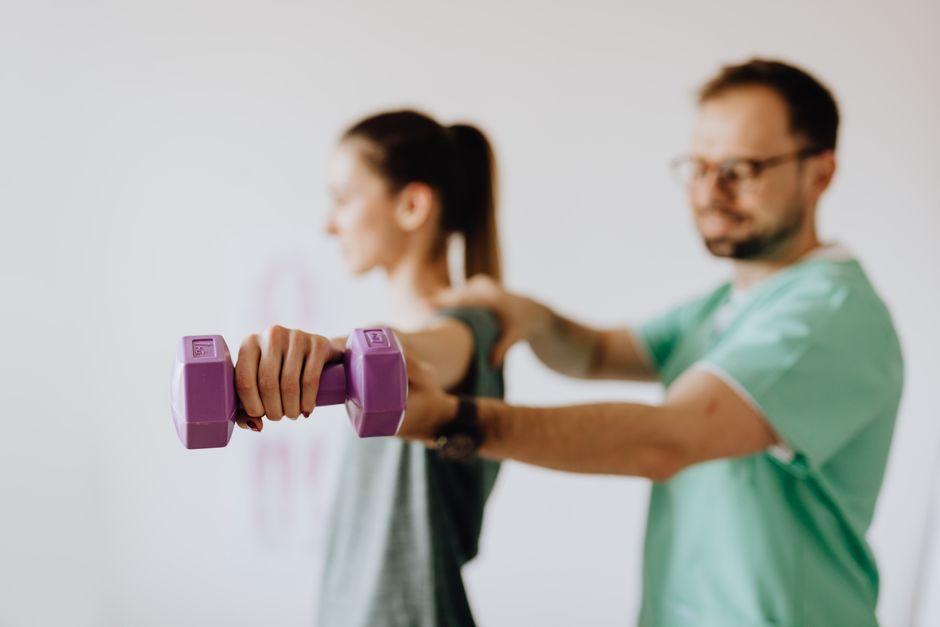
A physical therapist can assess whether your slope is postural or structural and build a program around your specific pattern. This is useful because the muscles involved vary between people. Someone whose upper trapezius is weak needs different work than someone whose upper trapezius is tight and overactive.
For most people with a mild postural slope and no other symptoms, a home program of strengthening and stretching is reasonable to try. If it is not helping after a few months, an assessment can clarify why.
Frequently Asked Questions
Can exercises actually fix sloped shoulders?
Exercises can improve sloped shoulders when the cause is postural, by strengthening the muscles that lift the shoulder blades and stretching tight chest muscles. If the slope comes from the natural shape of the collarbone, exercise will not change it much.
How long does it take to see results?
Most people notice some change after a couple of months of consistent training, with continued change over a longer period. Results vary widely depending on whether the cause is postural or structural.
What is the single most effective exercise for sloped shoulders?
There is no single best exercise, because the fix depends on which muscles are weak or tight in your case. Rows, shrugs, and chest stretches are common starting points that address the main patterns.
Are sloped shoulders a health problem?
In most people, sloped shoulders are a normal variation in body shape and not a health concern. See a doctor if the slope is new, one-sided, or comes with pain, weakness, or numbness in the arm.
