
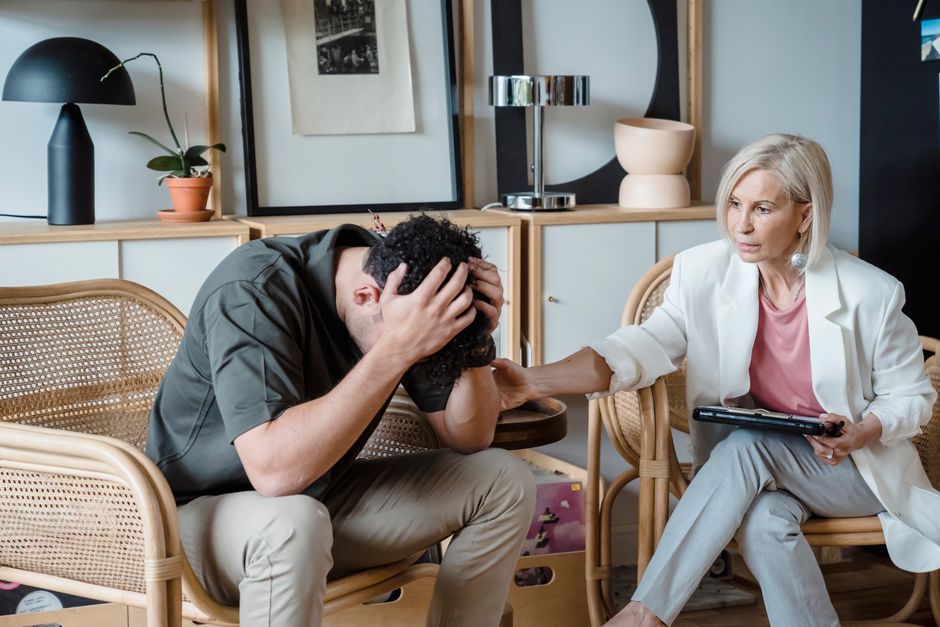
Erectile dysfunction has two broad drivers: physical problems with blood flow or nerve function, and psychological ones — anxiety, stress, fear of failure, or relationship strain. When a doctor has ruled out or managed physical causes, the treatment for the psychological side centers on cognitive behavioral therapy, reducing performance anxiety, sex therapy, and in some cases medication used as a short-term bridge. This is a well-established clinical approach, not a fringe idea.
The key thing to understand is that psychological ED is real and treatable. It is not “all in your head” in the dismissive sense. Anxiety triggers real physiological changes — it raises adrenaline, tightens blood vessels, and interferes with the relaxation response a man needs to get and keep an erection. That is a measurable, physical chain of events.
What Does Psychological Erectile Dysfunction Actually Mean?
Psychological ED means the erection difficulty is driven primarily by mental and emotional factors rather than by a structural or vascular problem. The penis itself is working. The signal is being disrupted.
An erection is not a simple on-switch. It depends on the parasympathetic nervous system — the “rest and digest” branch — allowing blood vessels in the penis to relax and fill. Anxiety and stress activate the opposite branch, the sympathetic nervous system, which does the reverse. It constricts blood vessels and prepares the body for threat. When a man is worried about whether he will get an erection, that worry itself can block the physical response. This is why the problem often feels like it feeds on itself.
Doctors sometimes call this a “vicious cycle.” One disappointing experience creates anxiety about the next one. That anxiety makes the next one more likely. Over time the pattern becomes entrenched. Breaking that cycle is the core of treatment.
How Do You Tell Psychological ED Apart From Physical ED?
The single most useful clue is whether erections still happen in some situations but not others. If a man gets firm morning erections, or can get an erection during masturbation but not with a partner, that pattern points strongly toward a psychological component. Physical causes tend to affect erections more uniformly.
Morning erections are a rough gauge because they occur during REM sleep, when psychological anxiety is largely offline. Their presence suggests the blood flow and nerve pathways are intact. Their absence does not prove a physical cause, though — sleep quality, age, and other factors affect them too. This is a clue, not a diagnosis.
Other patterns that suggest a psychological driver include:
- Erections that are firm at the start and fade during sex, often tied to a spike in self-monitoring or worry
- Difficulty that appears suddenly, often after a stressful event, rather than gradually over years
- Difficulty that is situation-specific — present with one partner or in certain circumstances but not others
- Performance anxiety that started after a single bad experience
That said, physical and psychological causes frequently overlap. A man with mild vascular disease may develop anxiety about his erections, which then makes the problem worse than the underlying physical issue alone would. Doctors generally look for both. A physical evaluation — including blood pressure, blood sugar, cholesterol, and a medication review — is a reasonable first step, because untreated physical causes will not resolve with therapy alone.
Why Does Anxiety Block an Erection?
Anxiety activates the body’s stress response, and that response is directly hostile to erection. This is well-established physiology, not speculation.
When the brain perceives threat — including the social threat of sexual failure — it releases adrenaline and norepinephrine. These chemicals cause blood vessels to constrict and shift blood flow toward muscles and away from non-essential functions. The penis needs blood vessels to dilate, not constrict. The two states are incompatible.
There is a second layer. Anxiety pulls attention inward. A man starts monitoring himself — “Is it working? Is it hard enough? What is she thinking?” — and that self-focused attention takes him out of the sensory experience that erotic arousal depends on. Arousal requires attention to be on the erotic cue. Self-monitoring competes with that directly. This is why distraction and “spectatoring,” as clinicians call it, are such common features of psychological ED.
Stress outside the bedroom matters too. Work pressure, financial worry, depression, and relationship conflict all raise baseline anxiety and can suppress sexual desire and response. Depression itself is associated with reduced libido and erectile difficulty, and some antidepressants can affect sexual function as a side effect — a point worth raising with a prescribing doctor rather than stopping a medication on your own.
How To Fix Psychological Erectile Dysfunction With Therapy
Cognitive behavioral therapy is the most studied psychological treatment for erectile dysfunction, and the evidence supporting it is reasonably strong. CBT targets the thoughts and behaviors that maintain the cycle — the catastrophic predictions, the self-monitoring, the avoidance.
A therapist helps a man identify the automatic thoughts that spike anxiety (“I’ll fail again,” “She’ll think I’m less of a man”) and test them against reality. Over time the threat response softens. The goal is not to think positive thoughts but to stop treating sex as a performance test with a pass-fail outcome.
Sex therapy, often delivered by a qualified sex therapist or couples counselor, adds a behavioral component. A common technique is sensate focus, in which couples temporarily set aside intercourse and practice non-goal-oriented touch. This removes the pressure to perform and rebuilds comfort with physical intimacy. It is widely used in clinical practice. The evidence base for sensate focus specifically is smaller than for CBT as a whole, so it is best described as a well-established clinical technique rather than one proven in large trials.
For men in relationships, including a partner in treatment often helps. Relationship strain and mismatched expectations can maintain the problem, and addressing communication directly tends to improve outcomes.
What Role Do Medications and Physical Factors Play?
Medication is not a psychological fix, but it can be a useful short-term tool. PDE5 inhibitors — the class that includes sildenafil and tadalafil — do not treat anxiety. What they can do is provide a reliable erection, which breaks the cycle of failure and reduces the fear attached to sex. Some clinicians use them as a temporary “bridge” alongside therapy, then reduce or stop them as confidence returns.
This is common clinical practice. It is worth being honest that the strategy of using medication purely as a confidence bridge is supported more by clinical experience than by large trials designed to test that specific approach. It is not unreasonable, but it should be framed as a tool a doctor may consider, not a guaranteed fix.
Medications carry real risks and interactions — particularly with nitrates, where the combination can cause a dangerous drop in blood pressure. Anyone considering them should speak with a doctor or pharmacist, not self-prescribe.
Physical factors deserve attention even when the problem looks psychological. Poor sleep, heavy alcohol use, smoking, and a sedentary lifestyle all affect erectile function. So does untreated depression. Addressing these is not a substitute for therapy but improves the odds.
What Can You Do Without a Therapist?
Some self-directed steps have reasonable grounding, though they are not a replacement for professional care when the problem is significant or persistent.
- Reduce performance pressure. Temporarily removing intercourse from the equation, and focusing on touch and intimacy without a goal, interrupts the failure cycle.
- Address the self-monitoring. When you notice yourself “checking,” redirect attention outward to sensation and to your partner rather than to your own performance.
- Manage baseline stress. Regular physical activity and adequate sleep support both mood and vascular health. The evidence for exercise improving erectile function is strongest in men with cardiovascular risk factors.
- Limit alcohol. Alcohol reduces erectile function in a dose-dependent way, and heavy use is a well-recognized contributor.
- Talk to a doctor. A physical evaluation rules out causes that self-help cannot fix.
One clarification worth making: psychological ED is not a sign of weakness or a character flaw, and it is not something a man should simply “get over.” It is a recognized clinical condition with established treatments. Men who seek help tend to do better than those who wait it out, because the cycle tends to entrench rather than resolve on its own.
Frequently Asked Questions
Can psychological erectile dysfunction be cured?
Yes, in many cases it improves substantially with treatment such as cognitive behavioral therapy and sex therapy. Results vary, and some men benefit from combining therapy with medical evaluation and short-term medication.
How do I know if my ED is mental or physical?
Erections that still occur during sleep, masturbation, or with some partners suggest a psychological component. A doctor can assess physical causes like blood pressure, blood sugar, and medications to be sure.
Does performance anxiety cause erectile dysfunction?
Yes, performance anxiety is a well-recognized cause because it activates the stress response, which constricts blood vessels and interferes with the relaxation needed for an erection. It also pulls attention away from arousal.
Should I take Viagra for psychological ED?
Some clinicians use PDE5 inhibitors as a short-term bridge to rebuild confidence alongside therapy. They carry real risks and drug interactions, so this should be decided with a doctor rather than self-prescribed.
